How Do You Know If You Should Get Bangs? Face Ratios & Fit Guide
Find out how do you know if you should get bangs using forehead share (30-36%), face shape rules, cowlick tests, and our four-fringe upkeep table.
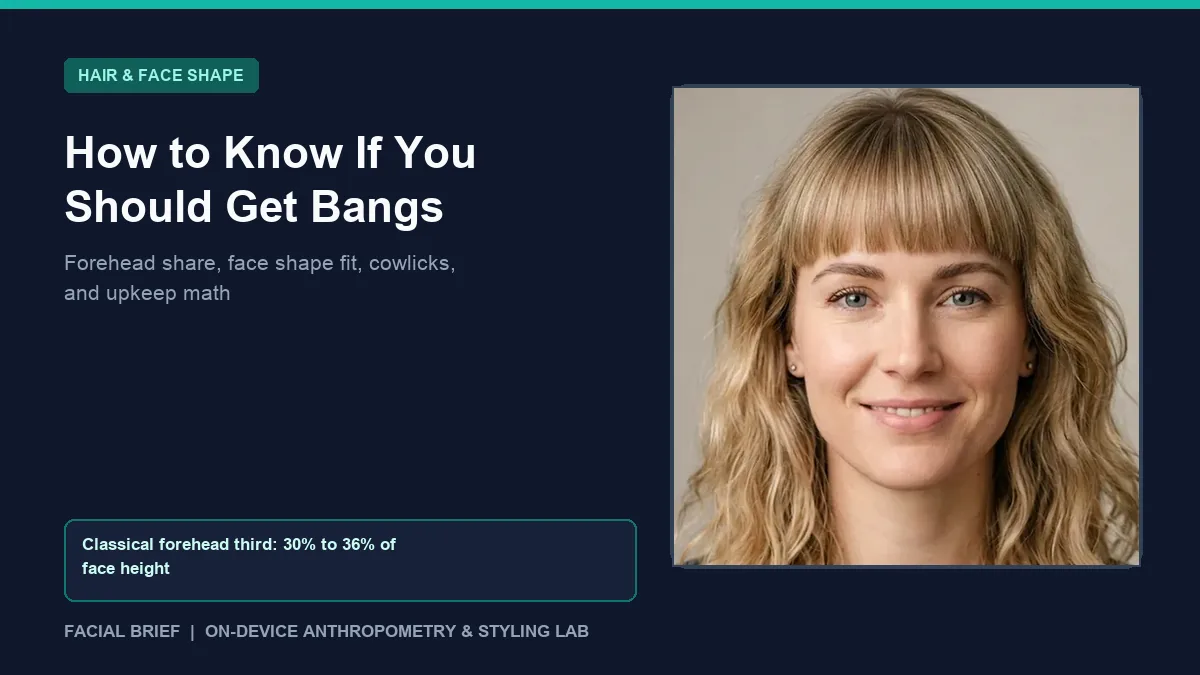
How do you know if you should get bangs without trading an impulse haircut for six weeks of morning frustration? Most online hair advice splits into two noisy extremes: supportive commenters repeating "hair grows back," and seasoned fringe wearers warning about stubborn hairline cowlicks, greasy midday strands, and awkward grow-out stages. Hairstylists cut through both camps using simple pre-cut facial geometry.
A fringe succeeds or fails on three measurable ratios (forehead share of face height, overall face shape outline, and upper temple width) plus four everyday hair habits that no social photo filter reveals. You can check your exact forehead percentage and rank four practical fringe cuts directly in your browser using Check Bangs Fit Free.
Key Takeaways
- Balanced facial proportions divide hairline-to-chin height into three bands (
30% to 36%each); foreheads exceeding36%benefit most from fuller curtain or blunt cuts, while foreheads under30%suit lighter wispy or side-swept pieces. - Face shape guides perimeter lines: round and heart faces favor center-parted curtain or diagonal side-swept bangs, square jaws soften under wispy fringes, and oblong faces shorten with brow-grazing lines.
- Hair density, curl shrinkage (Type 3 and 4 curls spring up 25% to 50% when dry), and hairline cowlicks control daily styling time far more than bone shape.
- Midday fringe oiliness comes mainly from forehead sweat, moisturizer, and sunscreen transferring onto hair strands.
- Blunt fringes need salon trims every
3 to 4 weeks, whereas curtain and side-swept cuts stay tidy for6 to 8 weeks.
Measuring Forehead Share and Face Shape Before You Cut
Check your bare hairline proportion before browsing haircut inspiration. Close-up smartphone selfies held 30 cm away stretch upper-face height artificially, convincing many people with normal proportions that they need heavy bangs. Step 1.5 meters back from an eye-level camera with all hair pulled off your forehead for an honest baseline.
The 30% to 36% Forehead Rule Explained
In craniofacial anthropometry, the upper facial third spans from center hairline (trichion) to brow ridge (glabella) and typically occupies 30% to 36% of hairline-to-chin height. Where your measurement sits gives immediate clarity.
Foreheads measuring over 36% of face height represent the strongest candidates for bangs. Covering part of the upper band evens out the three vertical sections and brings focal attention straight to your eyes and cheekbones, an effect noted across this r/femalehairadvice tall-forehead bangs thread. Longer curtain bangs or full brow-skimming fringes deliver the most balanced correction.
Foreheads sitting inside 30% to 36% need no proportional correction, turning bangs into a pure style decision guided by hair behavior. When your forehead measures under 30%, heavy blunt bangs leave barely 2 to 3 cm above the eyebrows and crowd the eyes, as seen in this r/beauty discussion on bangs with a small forehead. Airy wispy pieces or a light side-swept fringe preserve breathing room.
Matching the Four Bangs Types to Six Face Shapes
Once forehead share is clear, match fringe geometry to your facial outline:
- Oval outlines (1.30 to 1.50 L/W ratio) handle curtain, side-swept, wispy, and blunt fringes easily. As our oval face hairstyles guide notes, fuller blunt cuts balance longish ovals while light curtain pieces preserve cheekbone openness.
- Oblong faces (1.55+ L/W ratio) gain horizontal balance from brow-grazing blunt or textured bangs that shorten perceived upper-third length.
- Round outlines (1.00 to 1.15 L/W ratio) look wider under flat horizontal lines, so opening at the center with cheek-skimming curtain bangs or angled side-swept bangs creates welcome vertical flow.
- Square jaws (1.00 to 1.15 L/W, sharp corners) already carry horizontal weight across the brow and mandible; feathered wispy or side-swept pieces soften sharp angles cleanly, covered further in our square face hairstyles guide.
- Heart shapes widen at the temples toward a tapered chin, pairing naturally with curved curtain or diagonal fringes that slim upper width.
- Diamond shapes narrow at the forehead above prominent cheekbones, so parted curtain bangs open temple width without swallowing the midface.
For broader full-length matching alongside bangs, see our haircut depending on face shape guide.
Four Real-World Factors a Photo Cannot Measure
Threads like r/QOVESStudio discussions on choosing bangs and r/bangs pros-and-cons threads show why day-three regret almost always traces back to texture, oil, and lifestyle habits instead of bone structure.
Hairline Cowlicks and Curl Shrinkage
Inspect your damp hairline where your natural part forms. A front cowlick pushes roots upward or sideways; forcing straight blunt bangs flat over it demands daily wetting, side-to-side blow-drying, and round-brushing without exception. Air-drying splits blunt bangs right down the center by lunchtime. Curtain or side-swept bangs styled along your cowlick's natural turn cooperate smoothly.
Strand thickness and curl pattern matter just as much. Fine Type 1 hair looks sparse under thin sectioning unless cut slightly deeper from the crown, while thick coarse strands need soft point-cutting at the ends to avoid puffing forward. Curly and coily Type 3 to 4 hair shrinks 25% to 50% as moisture evaporates, so stylists should cut curly fringes dry or 2 to 3 cm longer below the eyebrows to prevent accidental micro-bangs.
Forehead Oil Transfer, Glasses, and Sensory Tolerance
Commenters in this r/femalehairadvice thread asking if bangs are worth the work point out two surprises: hair tickling the eyebrows irritates many first-time wearers, and bangs turn greasy by midday. Hair resting directly on skin picks up forehead sebum, rich moisturizers, and mineral sunscreen within hours.
Contributors in this r/HaircareScience guide to stopping greasy bangs solve oil transfer with three habits: swapping rich forehead creams for light gel hydrators plus translucent setting powder underneath the fringe, rinsing just the bangs in the sink with gentle shampoo on non-wash days, and misting dry shampoo onto clean dry bangs right after styling so starch absorbs oil proactively.
Eyewear also affects length. Eyebrow-length blunt bangs catch behind thick top frames and smudge lenses quickly, whereas curtain or swept bangs clear bridge lines comfortably. Testing a folded faux fringe with a headband for two evenings at home settles sensory tolerance before any cut.
How to Test Bangs Safely and Talk to Your Stylist
Testing proportions visually first removes guesswork before booking your chair.
Gateway Cuts, Try-On Limits, and Salon Instructions
Readers in this r/femalehairadvice thread on zero-regret bangs overwhelmingly point beginners toward curtain bangs hitting near cheekbone height. They frame the eyes, clip back cleanly during workouts, and blend smoothly into face-framing layers within six weeks if you grow them out.
Stay cautious with casual social media hair filters that subtly narrow jaws or enlarge eyes alongside pasting hair shapes. Facial Brief's AI Hairstyle Try-On keeps your measured facial proportions intact while rendering curtain, side-swept, and blunt styles directly on your photo. When meeting your stylist, ask for a dry cowlick check first, name your exact center stop point (bridge of nose for curtain, brow bone for blunt), request soft temple blending, and state how many minutes you will realistically spend blow-drying every morning. Men chasing similar framing can request a textured crop fringe, angled side fringe, or center-parted curtain top.
Comparing Fringe Styles, Upkeep Schedules, and Fit
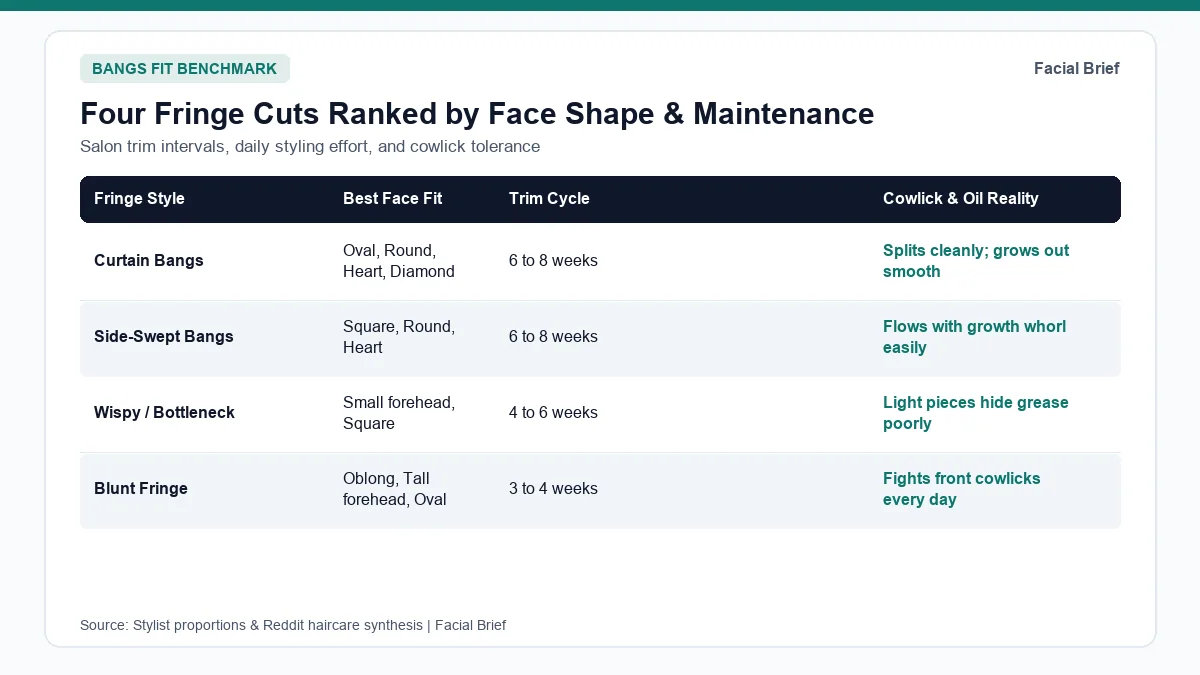
The table below compares all four fringe categories against forehead share, trim cadence, styling effort, and men's barber equivalents.
| Fringe Style | Best Proportions & Shapes | Daily Styling Time | Salon Trim Cycle | Cowlick & Grease Tolerance | Men's Barber Equivalent |
|---|---|---|---|---|---|
| Curtain Bangs | Tall or balanced forehead; Oval, Round, Heart, Diamond | 1 to 2 min (brush or air-dry) | Every 6 to 8 weeks | High tolerance; center split pairs with whorls | Center-parted curtain fringe |
| Side-Swept Bangs | Any forehead height; Square, Round, Heart | Under 1 min blow-dry | Every 6 to 8 weeks | High tolerance when angled with root growth | Textured side fringe on tapered sides |
| Wispy / Bottleneck | Short forehead (<30%); Square, Oval, Diamond | 30 sec finger dry | Every 4 to 6 weeks | Moderate; sparse pieces show grease faster | Light feathered crop fringe |
| Blunt Fringe | Tall forehead (>36%); Oblong, Oval | 3 to 5 min wet-to-dry daily | Every 3 to 4 weeks | Low tolerance; fights cowlicks and traps heat | French crop or straight Caesar fringe |
| No Bangs (Layers) | Short forehead; active or oily routines | 0 min fringe work | Normal trim schedule | Eliminates forehead oil transfer completely | Off-face quiff or textured side part |
Reviewing trim frequency next to styling minutes highlights the real commitment behind blunt versus parted fringes.
Frequently Asked Questions
How do I know if bangs will look good on my face shape?
Measure your forehead's percentage of total face height on a straight eye-level photo taken 1.5 meters back. Foreheads above 36% of hairline-to-chin height balance noticeably with fuller curtain or blunt fringes, while foreheads under 30% suit airy wispy or side-swept cuts that keep skin open. Match shape movement next: curtain or diagonal bangs add vertical flow to round and square faces, while brow-grazing cuts shorten oblong outlines cleanly.
What is the easiest starter style if I am unsure about getting bangs?
Cheekbone-length curtain bangs tapering toward the mid-cheek are the lowest-risk starter cut. Because they split gently down the center and blend into surrounding side layers, they flatter oval, round, heart, and diamond faces, cooperate with front cowlicks, go 6 to 8 weeks between salon trims, and tuck smoothly behind your ears with bobby pins if you decide to grow them out.
Do bangs really require washing and styling every single morning?
Unless you have completely straight, cowlick-free hair paired with naturally dry forehead skin, yes, fringes demand brief daily styling attention. Hair strands resting directly against forehead skin collect sebum, sweat, and mineral sunscreen far faster than the rest of your scalp hair. Clipping lengths back to wash only the bangs in the sink and blow-drying for 60 seconds with a round brush keeps them bouncy on non-wash days.
Can I get bangs if I have wavy hair, curly hair, or a front cowlick?
Yes, if your stylist tailors the cut to natural root growth and bounce. Ask for dry cutting or leave 2 to 3 cm of extra length below the eyebrow on wavy and curly textures so curls do not spring up shorter than expected. For strong hairline cowlicks, pick curtain or side-swept bangs angled with your whorl instead of forcing straight blunt lines flat.
Referenced Community Discussions & Sources
- r/bangs: Realistic pros and cons of getting bangs before cutting: Outlines everyday trade-offs including cowlick management, midday oil buildup, and regular 4-week trims.
- r/femalehairadvice: Honest discussion on whether bangs are worth daily upkeep: Highlights sensory discomfort of forehead strands and daily round-brush blow-drying routines.
- r/femalehairadvice: Why curtain bangs cause far less regret than blunt cuts: Documents smoother grow-out phases when starting with cheek-skimming curtain layers.
- r/HaircareScience: Preventing greasy bangs from forehead skin and sunscreen transfer: Explains translucent powder skin barriers, proactive dry shampoo on clean hair, and sink-washing fringes alone.
- r/QOVESStudio: Using facial thirds and proportions to predict bangs fit: Discusses upper-third proportions, cheekbone contrast, and why generic hairstyle filter apps warp bone proportions.
- r/beauty: Navigating bangs with a naturally small forehead: Compares eye-crowding heavy bangs against lighter wispy or side-swept cuts for compact foreheads.
- r/femalehairadvice: Balancing a taller forehead with bangs and testing pin-backs: Shows how covering tall upper thirds balances eyes and recommends testing folded front sections first.
- Styling References: Farkas, L. G. (1994), Anthropometry of the Head and Face classical facial thirds standards; professional salon guidelines for dry-cutting curly fringes and cowlick growth alignment.
Paired Facial Brief Analyzer
Measure your own proportions on-device
Run private 478-point landmark geometry in your browser with zero server photo upload on free tools.
Continue Reading