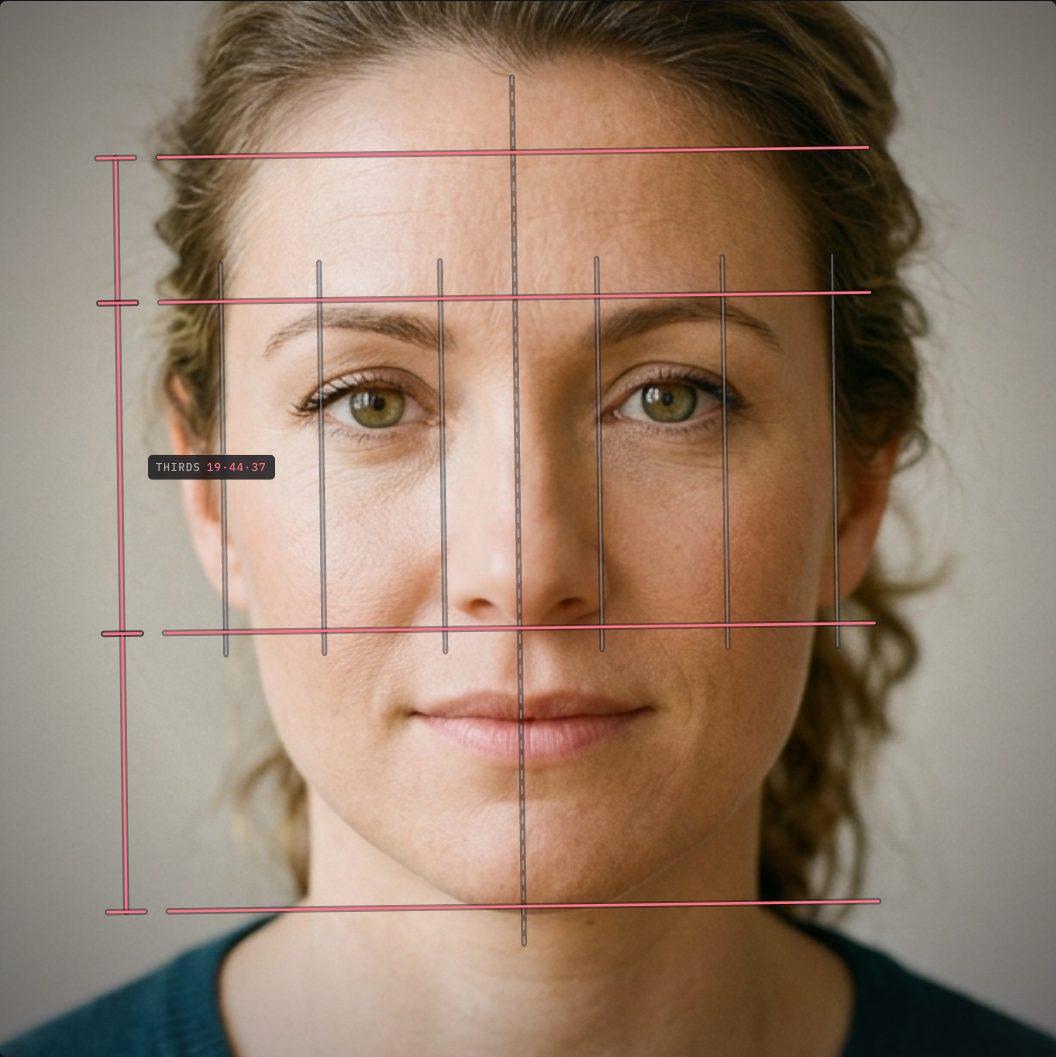
Is this an AI attractiveness test?
Yes - with the formula shown. It combines four geometric components (symmetry, facial thirds, facial fifths, and golden-ratio proximity) into a reproducible 0–100 facial-harmony proxy. It does not measure every quality that shapes real-world attraction, and the disclosed weights are product calibration rather than a universal scientific formula.
Is this the same as a beauty test or a pretty test?
Yes - 'beauty test', 'pretty test', 'prettiness test', and 'attractiveness test' are different names people use for the same measurement. Whether you arrived asking 'how pretty am I?' or 'how attractive am I?', the tool runs identical geometry: 478 landmarks scored for symmetry and proportional balance on a 0–100 beauty scale. It measures the same things for every face and doesn't change its scoring based on gender.
Is this a beauty scanner? What does it scan?
It works like a beauty scanner in the sense that it scans a photo for measurable geometry - bilateral symmetry, facial thirds, facial fifths, and golden-ratio proximity - and turns them into one score. Unlike most beauty scanner apps, the scan happens in your browser (the free test never uploads your photo), and the formula behind the score is published on this page rather than hidden.
Can this rate my looks out of 10?
Yes - it rates your looks from one photo, but on a 0–100 scale rather than 1 to 10, because a finer scale can show which of the four measured components moved your number. Don't divide by 10 to get a 1–10 rating: this scale is strict near the top, so read the tier instead. 87+ is the top tier (Showstopper), 80+ means above-average measured balance, and 60–79 is a mixed profile where photo conditions matter more than the headline number. That tier is the honest 'out of 10' answer: a single 1–10 number from a stranger is an opinion, while this is a measurement of your photo.
Is this a looks rater? Can an AI rate me from a photo?
Yes. This is a free AI looks rater: upload one front-facing photo and it rates your face from 478 landmarks, with no login and no upload for the free test. 'Rate my looks', 'rate my face', 'rate me' - people arrive with different phrasings, and the tool runs the same geometry for all of them: symmetry, facial thirds, facial fifths, and golden-ratio proximity, scored 0–100 with the formula shown. Unlike a rate-me thread or a stranger's opinion, the same photo gets the same score every time under the same engine version.
Am I beautiful? Can a photo test actually tell me?
It can tell you something specific: how close the geometry in your photo sits to this tool's symmetry and proportion targets, scored 0–100. That is the measurable slice of 'am I beautiful?', and it is the same slice a beauty test or pretty scale test measures. It is not a verdict on beauty as a whole - warmth, expression, skin, style, and how you carry yourself all count, and none of them are in a landmark map. Use the number to learn which measured feature moves your score, then decide what, if anything, you want to do with that.
Am I hot? Am I handsome? Does the test work for men as well as women?
Yes, and it runs identical geometry for everyone. 'Am I hot', 'am I handsome', 'handsome test', 'handsome checker', 'how hot am I' - these all land on the same measurement: 478 landmarks scored for bilateral symmetry, facial thirds, facial fifths, and golden-ratio proximity. The scoring does not switch to a male or female scale, so a man and a woman with the same measured balance get the same number. What a photo test cannot see is most of what reads as 'hot' in person: build, voice, confidence, grooming, and the way you smile.
Is this a face card rating?
If you mean 'how strong is my face card', yes: it rates the face in one photo from measured geometry rather than opinion, and it gives you a face card to share with the score, tier, and standout feature on it. Because it is a measurement, it is a brutally honest face rating in one sense - the same photo always gets the same score - and a gentle one in another, because it never comments on anything it did not measure. Lighting, angle, and expression change the number, so a bad photo can make a strong face card look weak.
Is this a beauty calculator or a pretty scale test?
It is both in the sense people mean: a beauty calculator that turns landmark measurements into one 0–100 score, and a pretty scale test because the score maps onto the tier bands above. The difference from a typical looks calculator is that the formula is printed on this page (symmetry 35%, thirds 25%, fifths 25%, golden ratio 15%), so you can see exactly why the calculator gave you the number it did. No quiz questions and no self-report: only the photo is scored.
What is a face potential test, and does this show my potential?
A face potential test asks a different question from 'how attractive am I?': not where your face is today but how far it could move with realistic, non-surgical changes. The free score here is the baseline half of that. The full report is the potential half: it ranks the measured features by how much each one is holding your score back, gives a concrete non-surgical plan for the top levers (grooming, hair, brows, skin, styling), and shows a styling concept from your own photo so you can see the direction instead of guessing.
Is this an attraction test?
Not in the two-person sense. An attraction test usually means a quiz about whether someone is attracted to you, or whether you are attracted to them, and this page cannot answer that. It measures facial attractiveness from one photo: symmetry and proportion geometry scored 0–100. If you arrived looking for an attraction test with pictures, the closest thing here is scoring the photos you would actually use and reading which one measures best in even light with a neutral expression.
How do I test how attractive I am with a photo?
Upload (or take) one front-facing photo with your face level and hair off your forehead. The test detects 478 facial landmarks in your browser, measures symmetry and proportions, and returns a 0–100 score, tier, and one personalized measurement preview. Your photo is never uploaded for the free test; derived scores are saved temporarily so a result link and optional paid report can work, and are also recorded in our usage analytics. No login is required.
What is a good attractiveness score?
On the current calibrated scale, 80+ indicates above-average measured balance, 84+ indicates a strong geometry profile, and 87+ is the highest tier. These are bands within this tool, not universal beauty percentiles or a verdict on how people see you.
How is this different from other AI beauty score tools?
Two key differences: the formula is disclosed - symmetry 35% + thirds 25% + fifths 25% + golden ratio 15% - and the measurements come from MediaPipe's 478 facial landmarks in your browser. That makes the same photo reproducible under the same engine version while keeping the limitations visible.
Can I improve my score?
You can make the measurement more consistent with a straight-on camera, neutral expression, even lighting, and a non-wide-angle lens. Hairstyle, grooming, and makeup can change how proportions read visually, but facial exercises are not a reliable way to change adult skeletal symmetry. Treat repeated scores as photo-condition baselines, not medical or anatomical targets.
Why is my score lower than I expected?
Three common reasons. First, photo conditions: tilted angles, smiles, asymmetric expressions, and poor lighting all reduce scores significantly. Try a neutral, front-facing photo with even lighting. Second, this scale is strict near the top: 90+ requires close alignment across all four measured components. Third, the score measures distance from selected geometric targets, which do not capture every form of attractiveness.
Does the AI have racial or gender bias?
The aesthetic-ideal ranges used here come from cosmetic surgery literature and Western anthropometric studies, which have well-documented Eurocentric bias. The tool doesn't classify by race or gender, but the ratio targets reflect a particular aesthetic tradition. Faces from non-European populations may score lower not because they're less attractive but because their natural proportions deviate from these specific norms. Treat the score as a measurement against one tradition, not a universal judgment.
Should I use this score to pick dating photos?
It can be a useful tiebreaker if you have several similar photos and want to pick the one with the best lighting and angle (which strongly affect the score). But research on dating-app photo selection consistently finds that warmth, approachability, and a genuine smile predict matches better than mathematical harmony. A photo with a slightly lower harmony score but a genuine smile usually outperforms a higher-harmony but neutral one.
What does science actually say about facial attractiveness?
Decades of research (Rhodes, 2006; Little, 2014; and others) consistently identify several factors that correlate with attractiveness ratings: bilateral symmetry, averageness (faces close to the population mean), sexual dimorphism (gender-typical features), and clear skin. Beyond these, expression, behavior, vocal qualities, and cultural context strongly modulate perceived attractiveness. The harmony score captures the symmetry + proportional aspects; the others require a real human, not a photo.
Can this test rate my side profile?
Not from a front photo - the 478-point mesh needs to see both sides of the face, so a 90° profile is refused rather than scored badly. Use the side profile analyzer instead: it traces your silhouette and measures facial convexity, the nasolabial and nasofrontal angles, the E-line lip position and your nose profile type, drawn on the photo.