PSL Score Test
A PSL calculator that measures instead of guessing. 478 facial landmarks score your symmetry and proportions 0–100, then translate them into a broad PSL-style range - no login, photo stays in your browser.
For a comparable range: keep the lens at eye level, look straight ahead, and make both sides of your face equally visible.
Upload a photo
Drag and drop or choose a file
JPG, PNG or HEIC, up to 30MB
Your photo never leaves your device ·
What Is a PSL Score?
A PSL score is a facial attractiveness rating on a 1–8 scale that originated on the looksmaxxing forums PuaHate, SlutHate, and Lookism (hence "PSL"). Unlike the casual 1–10, the community convention sets its midpoint at 4, describes 5 as above that midpoint, and treats 6+ as rare. Eight is a theoretical ceiling anchored to a handful of celebrity examples. There is no official PSL rating: forum scores are crowd opinion, and most online PSL tests are guesses dressed up as numbers.
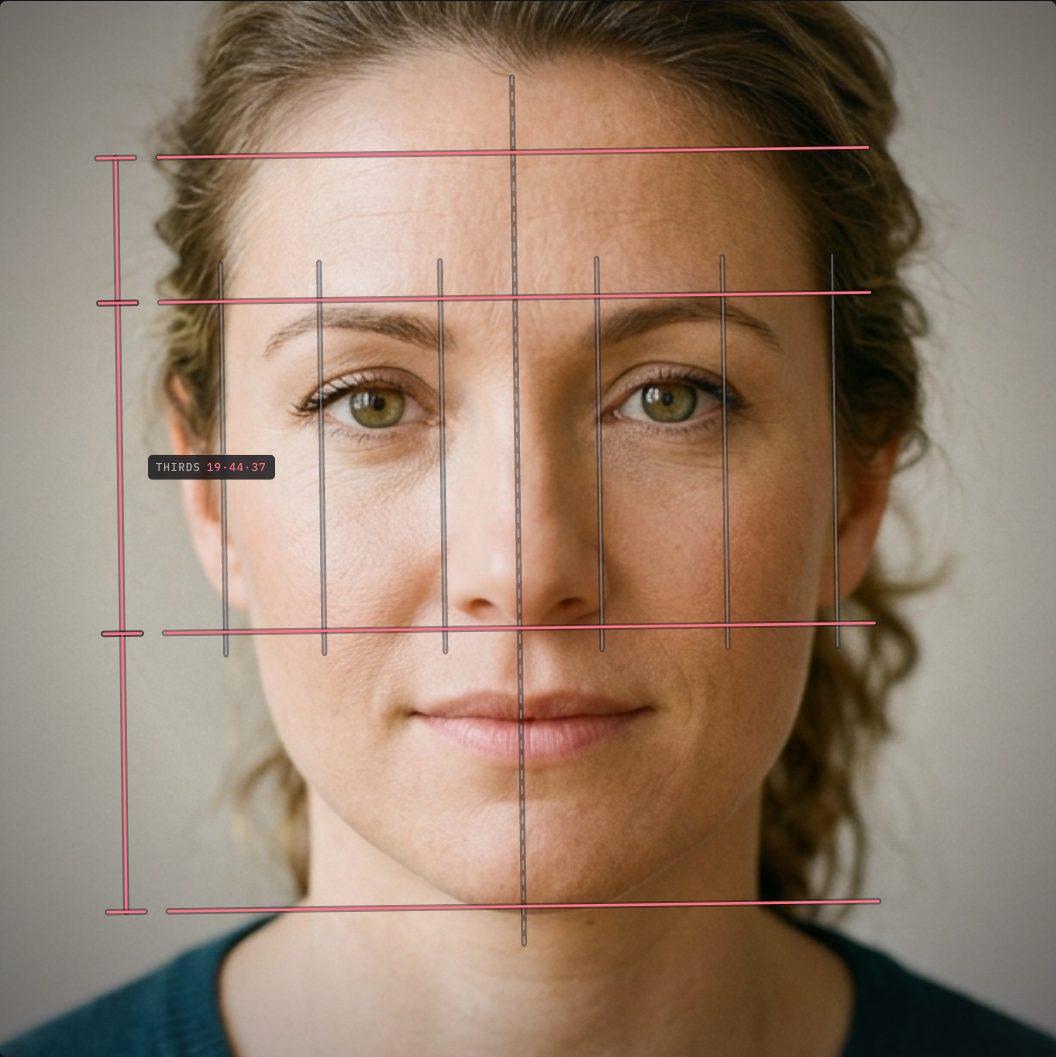
This calculator takes a transparent geometry approach. It combines 2D symmetry (35%), visible facial thirds (25%), facial fifths (25%), and golden-ratio proximity (15%) from 478 landmarks into a 0–100 score, then converts that score to a broad PSL-style range. Those weights and ranges are an authored calculator model - not a scientific formula for attractiveness - and photo pose can change the result.
How This PSL Test Works
- Upload a straight-on photo. The free test measures your photo in your browser - no login, and the photo is not uploaded for the free measurement. Your scores are saved, without the photo, for your result link and usage statistics.
- 478 landmarks are mapped. An on-device face mesh places the points used for symmetry, thirds, fifths, and ratio measurements.
- Geometry is scored 0–100. Symmetry (35%), visible facial thirds (25%), facial fifths (25%), and phi proximity (15%) combine into one harmony score.
- The score becomes a PSL range. The mapping published below converts the harmony score into a broad PSL-style band - never a precise decimal rating.
Each component can also be run on its own: the golden ratio face calculator isolates the phi measurement, and the face symmetry test breaks down the left/right comparison feature by feature.
The PSL Scale, Band by Band
The bands below document the community's convention and the way forums describe its upper end. Those rarity labels are cultural lore, not measured population prevalence.
The full looksmaxxing chart puts sub 3, sub 5, LTN, MTN, HTN and True Adam on these same bands, with the out-of-10 numbers alongside.
8 - PSL God
Forum ceilingReserved by the community for a short list of celebrity faces treated as the aesthetic ceiling - prime Delon, O'Pry-tier model bone structure. By construction almost nobody rates an 8; it functions as the scale's anchor, not a band people land in.
7–7.5 - Chad / Stacy
Forum-defined outlierThe community uses this band for exceptional harmony across nearly every feature at once, often with model or celebrity examples. It is a subjective forum category, not a measured population percentile.
6–6.5 - Chadlite
Described as rareCommunities use this for faces they consider clearly above their scale's midpoint, while allowing one or two features to differ from the preferred canon. Claims about an exact top percentage are not validated.
5–5.5 - High-tier normie
Above the scale midpointThe forum convention describes this as above its midpoint and generally good-looking, especially in a well-matched photo. There is no validated crosswalk from this label to a casual 1–10 rating.
4–4.5 - Normie
Scale midpointFour is the convention's defined midpoint, not a measured population average. The label describes ordinary variation around that midpoint; real-world attraction includes much more than static geometry.
1–3.5 - Below the scale midpoint
Forum lower bandFurther from the scale's photographic canon - which is a statement about distance from one aesthetic tradition, not about real-world attractiveness. Plenty of faces here are attractive in ways a static-photo canon can't read.
Converting Your Score to the PSL Scale
The test above returns the PSL-style range first and keeps its 0–100 geometry score visible underneath. The shared mapping below is given as ranges on purpose: there is no official PSL calibration, and a rating to two decimal places would be false precision. Extreme 1–3 labels and precise 7–8 labels remain cultural reference points rather than calculator outputs.
Harmony 87–100 → PSL ≈ 6+
The upper reference band for this geometry calculator. Forum labels above 6 remain subjective and are not assigned as precise results.
Harmony 80–86 → PSL ≈ 5–6
A high match to the calculator's symmetry and proportion references, translated as a broad range rather than a decimal rating.
Harmony 75–79 → PSL ≈ 4.5–5.5
An above-middle geometry band. Pose, expression, and camera distance can move a photo across a neighboring range.
Harmony 56–74 → PSL ≈ 4–4.5
The calculator's broad middle band. It describes one front photo, not a population ranking or a whole-person attractiveness verdict.
Harmony Below 56 → PSL ≈ 3.5–4
Further from this calculator's authored geometry references. It is a broad photo-based range, not a diagnosis or whole-person judgment.
A Reality Check on PSL Culture
Read this before taking the number seriously
- The PSL scale was invented for rating strangers' photos on forums. It compresses a whole person into static geometry and ignores everything that moves attraction in real life - expression, voice, style, confidence, warmth.
- The celebrity anchors the scale idolizes are lit, styled, and photographed by professionals. Comparing your phone selfie to a retouched editorial is a rigged comparison.
- The aesthetic canon behind both the forums and this measurement has documented Eurocentric bias. Distance from that canon is not distance from being attractive.
- Communities built around these ratings can encourage fatalism or risky procedures. A geometry number is not a treatment plan; styling and photo conditions can change presentation, while medical or weight-change decisions deserve qualified health advice rather than a forum score.
- If the number is affecting how you feel about yourself, close the tab. It's a measurement of a photo, not of you.
Frequently Asked Questions
What does PSL mean, and what does it stand for?
In looksmaxxing, PSL means a 1–8 rating of facial attractiveness. The letters stand for three looksmaxxing forums - PuaHate, SlutHate, and Lookism - whose users developed the shared rating convention. When someone calls a face 'PSL 5' or asks for your PSL rating, they mean a place on that scale: communities define 4 as the midpoint, describe 5 as above it, and use 8 as a theoretical celebrity-anchored ceiling. 'PSL god' is the forum label for that ceiling. There is no official body or representative population calibration behind it.
Is this an AI PSL rating? How does the PSL scan work?
The AI part is the face scan: an on-device machine-learning face mesh finds 478 landmarks in your photo. The PSL rating itself is not a neural network guessing how attractive you look. It is fixed geometry - symmetry, facial thirds, facial fifths, and golden-ratio proximity - scored 0–100 and converted to a broad PSL range with the table on this page, so the same photo returns the same range under the same engine version. The free PSL scanner runs in your browser and does not upload the photo. A chatbot asked for a PSL rating has no fixed formula, so asking it twice can return two different numbers.
Is this a free looksmaxxing AI rating?
Yes. It rates your face on the PSL scale that looksmaxxing communities use, with no login and no subscription: the PSL range and the 0–100 geometry score are both free. The face mesh scans 478 landmarks and the formula behind the looksmaxxing scale result is published on this page, so you can check how the number was produced. It rates front-photo geometry only. Skin, hair, body, and style are part of most looksmaxxing plans, and this rating does not measure them.
What is an average PSL score?
4 - by the convention's definition. That makes 4 the scale's intended midpoint, not a scientifically measured population average. No representative dataset establishes what share of people belongs in each PSL band, so claims such as 'top 10%' should be treated as forum lore rather than population statistics. This calculator uses broad ranges and does not assign extreme 1–3 or precise 7–8 labels from a selfie.
Is this a free PSL rater?
Yes. It is a free PSL rater and calculator: no login, no upload for the free test, and the photo is processed in your browser. Upload one straight-on photo and it returns a PSL rating as a broad range (for example ≈ 4.5–5.5) with the 0–100 geometry score underneath. The range format is deliberate - there is no official PSL calibration, so a rater that prints a precise decimal is presenting a guess as a measurement. If the head angle is too far off, the tool withholds the range and asks for a retake rather than rating a photo it cannot measure reliably.
How do I take a PSL scale test online?
Use the test at the top of this page. Take or upload a front-facing photo at eye level with a neutral expression and hair off your face, then let the on-device face mesh map 478 landmarks. The PSL scale test scores symmetry, facial thirds, facial fifths, and golden-ratio proximity into one 0–100 geometry number and converts it to a PSL-style range using the mapping published above. It takes a few seconds, and the same photo returns the same range under the same engine version, so you can compare two photos of yourself under matched conditions.
Is this an official PSL rating?
No official PSL rating exists - forum ratings are crowd opinion, and every 'PSL calculator' online is an approximation of that opinion. This test maps 478 facial landmarks in your browser, combines 2D symmetry (35%), visible thirds (25%), facial fifths (25%), and golden-ratio proximity (15%) into a geometry score, then translates it into a broad PSL-style range. It is a transparent calculator model, not a validated attractiveness rating.
How is a PSL score different from a 1–10 rating?
The PSL convention compresses the top and stretches the middle. Its communities pin the midpoint at 4 and intend higher half-points to be increasingly selective, while casual 1–10 ratings vary by rater and context. There is no validated conversion between the two systems, so a PSL 5 cannot be reliably translated into one specific casual score.
What is the difference between PSL and appeal?
In looksmaxxing slang, PSL is facial structure judged the forum way: bone structure, symmetry, and proportions in a neutral photo, as if hair, skin, and styling were held equal. Appeal is how attractive a person looks to the general public in real life, which also depends on hair, skin, grooming, style, expression, body, and age. So PSL vs appeal is structure vs overall impression: a face with average geometry can have high appeal because of good hair and style, and the reverse happens too. This calculator measures only the PSL side, and only a narrow part of it: front-photo geometry. It says nothing about appeal, which is one reason a friend's rating and a PSL range often disagree.
Can I raise my PSL score?
This calculator is most useful for comparing carefully matched photos, not chasing a permanent number. Head pose, expression, lens distance, and lighting can change the measured result even when your face has not changed. Grooming, hair, skin, expression, and style can strongly affect real-world attractiveness while barely moving a landmark-only geometry score; adult skeletal proportions generally do not change through routines or exercises.
Is the PSL scale scientific?
No. The 1–8 bands, labels, celebrity anchors, and this site's conversion are community-style conventions, not a scientific scale. Research finds some group-level links between facial shape, symmetry, averageness, and attractiveness judgments, but effects vary by sample and do not produce a universal formula for one person. This calculator measures a narrower set of front-photo geometry and uses the golden ratio only as an authored reference - not as a proven law of beauty.
What is a good PSL score?
By the forums' own convention, anything above the midpoint of 4 is described as above average, with 5–5.5 labeled 'high-tier normie' and 6+ treated as rare. There is no validated definition of a 'good' PSL score, because no representative dataset calibrates the scale. This calculator reports broad ranges rather than precise decimals, and matched photo conditions - straight-on, neutral expression, even lighting - matter more to the measured result than chasing a particular number.
Is there a PSL scale for women?
Yes. The forums rate women on the same 1–8 PSL scale, with 4 as the midpoint and 8 as a celebrity-anchored ceiling. They also give the female tiers labels of their own; apart from 'Stacy' at the top, most of those labels are insults, so this page does not list them. This calculator does not detect or ask your sex and applies the same geometry to every face, so a woman gets the same kind of result a man does: a broad PSL range from symmetry, facial thirds, facial fifths, and golden-ratio proximity. Makeup, hair, and expression change how a face reads in real life far more than they change these landmark measurements.
Why is my PSL score lower than what friends rate me?
Three reasons. The PSL convention is deliberately harsher than casual social ratings. The calculator only sees static front-photo geometry, while expression, charisma, voice, style, familiarity, skin, and hair all shape real attraction. And photo conditions can change the measurement: head angle, expression, lens distance, and uneven lighting can read as different symmetry or proportion. Use a neutral, straight-on, evenly lit photo for the most comparable result.
Related Tools and Guides
Attractiveness Test
The same measurement with the full 0–100 framing
Canthal Tilt Calculator
The eye-angle metric PSL culture obsesses over - measured
Hunter Eyes, Explained
What the term means and what's actually changeable
Looksmaxxing Guide
Every technique tiered by what actually works
Looksmaxxing Chart
Sub 5, LTN, MTN, HTN, Chadlite, Chad and True Adam on one chart