Best FaceIQLabs Alternative: Free & One-Time Face Tools
Compare every major FaceIQLabs alternative by free scan limits, monthly vs. one-time pricing, privacy, and ratio accuracy in a 6-tool comparison table.
Independent Editorial & Trademark Notice: This guide is an independent research analysis published by Facial Brief and is not affiliated with, endorsed by, or sponsored by any third-party apps, platforms, or brands discussed below. All trademarks belong to their respective owners.
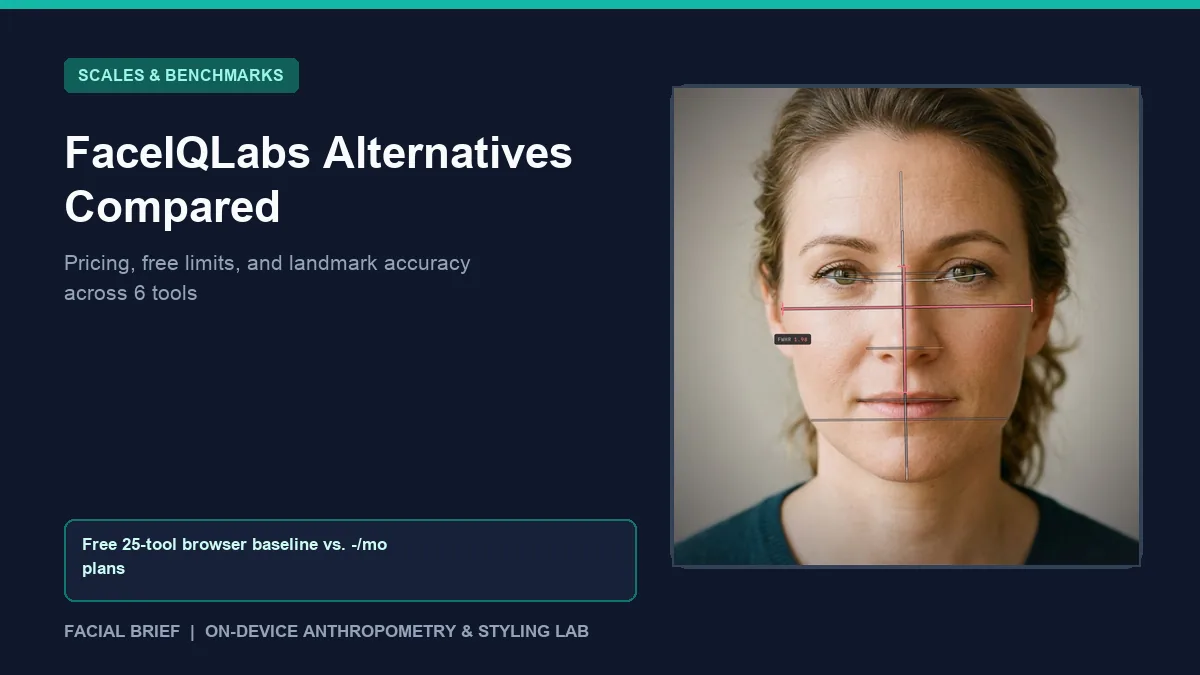
Search for a faceiqlabs alternative on Reddit and the same complaint shows up right away: users upload front and side photos expecting a fast ratio check, receive a partial preview with 10 harmony metrics, and hit a $24.99 to $49.99 monthly paywall for the combined score and pillar breakdowns. Between web memberships and App Store lookalikes billing weekly trials, finding an honest facial analyzer takes longer than reading the geometry itself.
Automated face tools measure landmarks, midline symmetry, and ratios like facial width-to-height or jaw taper. If you want a clean baseline without entering a credit card or uploading portraits to external servers, Try Attractiveness Test on Facial Brief to inspect your symmetry, thirds, fifths, and phi alignment directly inside your browser.
Key Takeaways
- FaceIQLabs includes landmark plots, a side-profile readout, and 10 harmony ratios for free, while gating its combined score, angularity, and dimorphism pillars behind $24.99/month Basic or $49.99/month Pro plans.
- Separate mobile apps using FaceIQ-style branding on iOS and Android run independent billing, commonly $2.99 to $3.99 per week after a 3-day trial or about $39.99 per year.
- Facial Brief runs 478-landmark geometry locally at $0 across 25 browser tools, with an optional $17.49 one-time full report instead of a subscription.
- Reddit threads on r/trueratediscussions and r/LooksmaxingAdvice document wide score swings from lighting, lens distance, and calibration quirks, including famous actors landing near 5.x on harmony-heavy models.
- Shooting from 5 to 8 feet away with an eye-level camera eliminates close-range 24mm selfie distortion, which otherwise stretches midface ratios and widens the nose visually.
What FaceIQLabs Measures and Why Users Look Elsewhere
FaceIQLabs markets more than 100 facial metrics organized around four pillars: harmony, angularity, dimorphism, and individual traits. On the faceiq scale, an average face sits near 5.0, matching the center of a bell curve where most everyday adults fall. That structure drew interest on looksmaxxing forums from people tired of inflated 7/10 casual ratings.
Friction builds around paywall structure and score calibration.
On the face iq labs free tier, visitors get landmark mapping, a side-profile score, 10 harmony ratios, and two strengths alongside two weaknesses. Once you try to view the combined front-and-side harmony figure, overall rating, dimorphism scores, angularity metrics, or tracking charts, the platform gates those sections behind recurring subscriptions. Published plan pages price Basic around $24.99 per month (near $119.88 billed annually) and Pro around $49.99 per month (near $239.88 annually). Committing to $25 or $50 a month makes little sense when you only want one proportion check before changing your haircut or grooming habits.
Confusion also surrounds the faceiq app on mobile stores. As users clarify in this r/LooksmaxingAdvice alternatives thread, mobile downloads sharing the FaceIQ name or similar looksmax branding operate independently from the FaceIQLabs website. Those App Store and Google Play utilities lean on 3-day trials that auto-convert into $2.99 to $3.99 weekly subscriptions or $39.99 annual plans unless cancelled 24 hours early.
Paid subscribers also question calibration consistency. In a r/trueratediscussions accuracy debate, commenters note that faceiqlabs weights proportional harmony heavily while under-weighting dimorphism, bone presence, and skin quality. A separate thread evaluating Tom Cruise on FaceIQLabs drew laughs when the actor scored an ordinary mid-5 harmony rating, while a r/Truepslrateme poster asked why the algorithm placed their photo in a top tier despite noticeable asymmetries. Seeing formulas in plain view helps explain why many readers move to transparent tools.
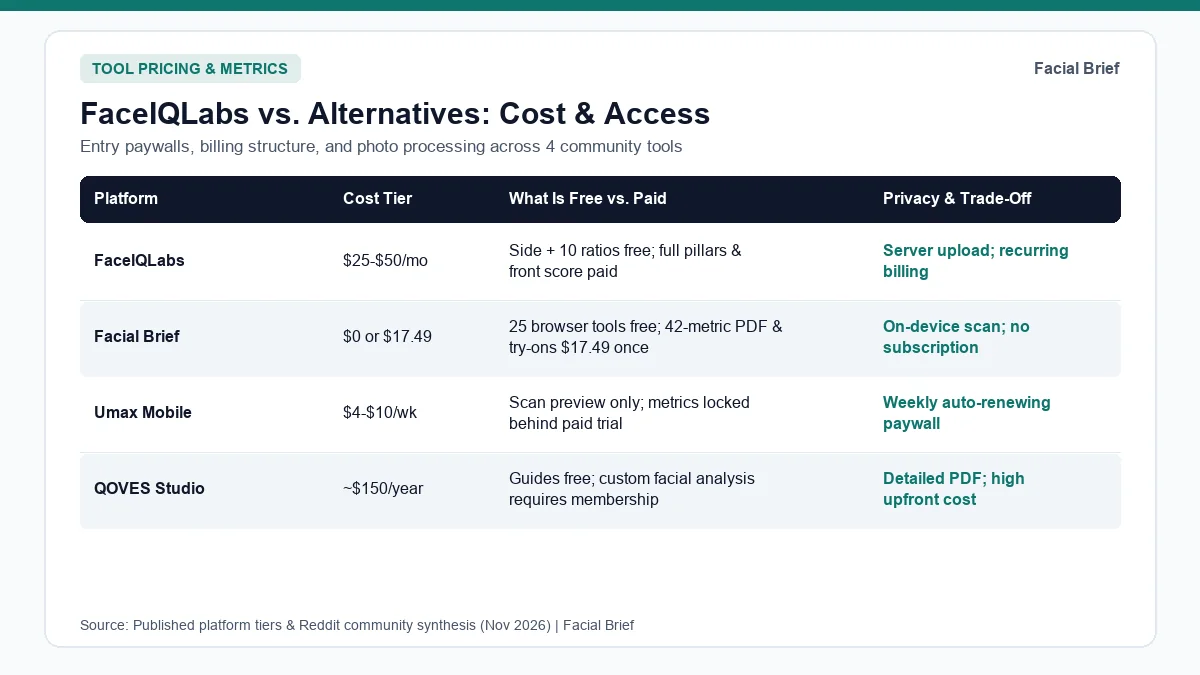
Six Alternatives to FaceIQLabs Compared
If you want a face iq free geometry readout without monthly auto-renewals, options split into four categories: browser-based calculators, mobile subscription trackers, human-reviewed memberships, and legacy photo-retouch tools.
| Platform / Tool | Free Tier Scope | Paid Model | Photo Processing | Best For |
|---|---|---|---|---|
| Facial Brief | 25 free tools, 478 landmarks, ratio & symmetry breakdown | $17.49 one-time full report (PDF + 6 AI hair try-ons) | On-device browser scan for free tools | Transparent formulas and zero subscriptions |
| FaceIQLabs | Landmark map, side score, 10 harmony ratios | $24.99-$49.99/month or $119.88-$239.88/year | Server upload | Monthly chart tracking across photos |
| PinkMirror | Basic face score, shape label, retouch preview | Paid upgrades for deeper breakdowns | Server upload | Viewing auto-retouched photo previews |
| QOVES Studio | Educational guides and reference articles only | Roughly $150/year membership | Private portal submission | Detailed reports with researcher input |
| Umax (iOS / Android) | Photo scan only; numeric metrics locked | $3.99-$9.99/week recurring trial | Mobile cloud processing | Gamified daily phone check-ins |
| RealSmile.online | Free browser symmetry, golden ratio, and smile tests | $0 (indie side project) | Client-side browser | Quick experimental checks without sign-ups |
On-Device Browser Tools: Facial Brief and Indie Builds
Software that executes geometric math locally eliminates cloud subscription walls. Facial Brief runs Google's 478-point face mesh inside your browser across 25 free tools, covering symmetry, bilateral mirror composites, canthal tilt, jaw angles, face shape, and 12 ratios in our Facial Ratios Calculator. Photos stay on your device throughout free scans.
Facial Brief prints the exact scoring weights beneath every card instead of hiding behind proprietary scores. The Attractiveness Test derives its 0 to 100 figure from 35% bilateral symmetry, 25% vertical facial thirds, 25% horizontal fifths, and 15% phi alignment. When you want practical guidance beyond numbers, the 42-Metric Full Report costs $17.49 once, adding 6 AI hairstyle try-ons on your own portrait, a 12-season color palette, and a 4-week plan with zero recurring fees. Preview every section beforehand on the sample report page.
Solo developer projects follow a similar open approach. In an r/SideProject launch post, a developer shared RealSmile.online for client-side symmetry, golden ratio, and jawline tests without mandatory accounts. Indie tools can change quickly, yet they remain handy second opinions against strict paid graders.
Mobile Looksmaxing Apps: Umax and Weekly Trackers
Apps like Umax capture front and side selfies, ask onboarding questions, run a brief scan animation, and then place the score behind a paywall. Viewing your 0 to 100 number, jaw score, or skin rating usually requires a $3.99 to $9.99 weekly plan. Our Umax alternative guide explains what weekly trackers compute compared with browser utilities. If you test any mobile trial, cancel in Apple ID or Google Play settings immediately after checking your readout if you do not plan to keep paying weekly.
Editorial Research Memberships: QOVES Studio
QOVES focuses on detailed anatomical reports linking measurements to craniofacial norms and styling advice. Because QOVES shifted from cheap single reports to an annual membership near $150 per year, casual users cannot run a free test first. Our QOVES alternative comparison details when long-form editorial analysis beats automated geometry.
Legacy Retouch Graders: PinkMirror
PinkMirror is one of the oldest automated beauty checkers online. Uploading a portrait produces a rough score, a face shape label, and an auto-retouched preview smoothing skin or tweaking proportions. Its older 2D marker set lacks modern 478-point eye and jaw detail; see our PinkMirror alternative guide for a closer look at landmark accuracy.
Why Identical Photos Score Differently Across Analyzers
Ask Redditors in this r/LooksmaxingAdvice accuracy thread why scores jump between uploads, and camera physics explains most of the swing. Even accurate 478-point meshes measure flat 2D pixels, so tiny capture shifts alter calculated ratios.
Camera distance causes the sharpest distortion. A phone selfie held 12 to 18 inches away shoots near a 24mm equivalent perspective. Because the nose tip sits closer to the glass than the ears or jaw corners, perspective enlargement widens the nose relative to the mouth, stretches vertical midface proportion, and pulls cheekbones visually backward. Stepping 6 to 8 feet back and shooting with a rear 2x or 3x lens (closer to 50mm or 85mm framing) restores realistic depth compression.
Lighting and head angle introduce another 5 to 12 points of variance. Overhead bathroom bulbs cast shadows beneath the brow ridge and deepen under-eye hollows. Turning your chin 3 degrees sideways skews bilateral midline symmetry and shifts apparent eye tilt. Instead of chasing a fluctuating composite number, track raw measurements such as fWHR, canthal tilt, and jaw-to-cheekbone ratio under identical front window light.
What Static Scores Miss in Real Life
Landmark grids capture bone outline and symmetry, yet human impression depends on motion, grooming, and warmth that static photos miss. Threads on r/OnlineDatingApps show users blaming a 5.2 app score for poor match rates while overlooking blurry mirror selfies, harsh shadows, unkempt haircuts, and stiff expressions. Treating an automated scan as a diagnostic starting point for haircut balance, eyebrow neatness, and skin care delivers far better real-world results than obsessing over decimal shifts.
Frequently Asked Questions
Is there a completely free FaceIQLabs alternative?
Yes. Facial Brief offers 25 browser-based facial analyzers completely free with no account sign-up, calculating 478 landmarks for symmetry, facial ratios, face shape, canthal tilt, jawline angles, and 12-season color tones locally on your phone or laptop. Community side projects such as RealSmile.online also provide no-cost client-side ratio checks without uploading images to commercial subscription portals or handing over billing details just to read basic symmetry percentages.
Is FaceIQLabs accurate compared to human raters?
FaceIQLabs measures geometric harmony proportions reasonably well when fed straight-on, evenly lit portraits taken from several feet away. However, Reddit discussions show inconsistent composite ratings on celebrities and casual selfies because harmony algorithms heavily prioritize proportional spacing over dimorphism, skin clarity, hair framing, and facial expression, all of which human raters notice right away when judging real-world attractiveness across varied photos and social contexts.
Why does the FaceIQ mobile app cost a different amount than FaceIQLabs?
FaceIQLabs is an independent web service priced near $24.99 per month for Basic and $49.99 per month for Pro tiers, with discounted annual plans. Mobile apps using FaceIQ or looksmaxing names on iOS and Android are built by separate publishers that rely on 3-day trials rolling into $2.99 to $3.99 weekly subscriptions or $39.99 annual renewals unless you cancel through Apple ID or Google Play settings.
How can I get consistent numbers when testing facial ratios?
Place your phone on a shelf or tripod 5 to 8 feet away at eye height, face natural window light directly to avoid uneven shadows, and switch to the rear camera with a 2x zoom instead of shooting a close-range front selfie. Pull hair behind your ears and off your forehead so the landmark mesh plots your hairline, cheekbones, and outer jaw corners cleanly every time.
Referenced Community Discussions & Sources
- r/LooksmaxingAdvice: User thread requesting alternatives to FaceIQLabs: Compares free browser analyzers, weekly mobile apps, and subscription lock-ins.
- r/trueratediscussions: Debate on whether FaceIQ ratings are accurate: Explains why harmony-weighted algorithms diverge from overall attractiveness assessments.
- r/trueratediscussions: Testing Tom Cruise on FaceIQLabs: Viral thread showing calibration quirks where recognizable actors score near a mid-5 harmony tier.
- r/LooksmaxingAdvice: Evaluating FaceIQLabs accuracy on user submissions: Pinpoints photo angle, lens distance, and lighting swings as main sources of erratic scores.
- r/SideProject: Free client-side AI face analysis web suite launch: Developer launch showing how browser-side landmark geometry removes account sign-up friction.
- r/OnlineDatingApps: Reality check on AI face scores vs. profile presentation: Separates static facial geometry from grooming, photo quality, and real-world dating outcomes.
- Anthropometric and photographic methodology: Craniofacial landmark definitions follow standard soft-tissue norms (Farkas) paired with perspective-compression physics comparing 24mm close-range lenses against 50mm and 85mm portrait distances.
Paired Facial Brief Analyzer
Measure your own proportions on-device
Run private 478-point landmark geometry in your browser with zero server photo upload on free tools.
Continue Reading