Online PD Measurement: Your Pupillary Distance From a Photo
One front-facing photo, no card, no app, no ruler to print. The tool finds both irises with a 478-point face mesh and uses the iris itself (11.7 mm across in almost every adult) as the ruler, so your PD comes back in millimetres - binocular, monocular and near - drawn on your own eyes, with your face width and the frame sizes that centre your pupils. Free, processed in your browser.
For a reliable reading: face the camera squarely, look into the lens (not the screen), eyes open, even light.
Upload a photo
Drag and drop or choose a file
JPG, PNG or HEIC, up to 30MB
Your photo never leaves your device ·
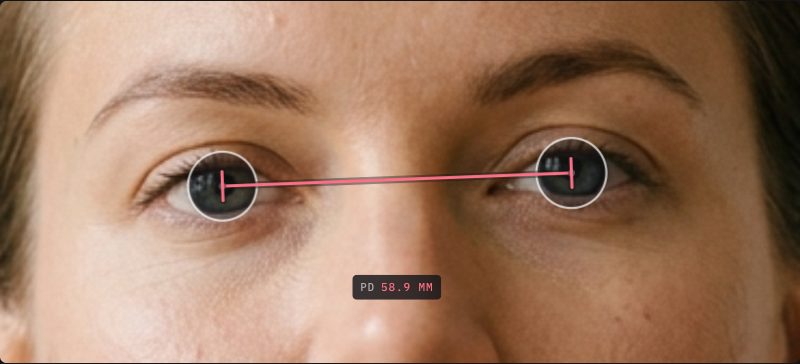
What Is Pupillary Distance (PD)?
Pupillary distance is the distance between the centres of your pupils, in millimetres. Every pair of glasses is cut so the optical centre of each lens sits exactly in front of each pupil; when the centres are off, the lens behaves like a weak prism, which is the usual cause of "my new glasses feel wrong". Opticians measure it with a pupillometer or a ruler, and online lens retailers ask you for it because it is rarely printed on a prescription unless you ask.
There are three versions of the number. Binocular (distance) PD is the single pupil-to-pupil figure most orders use. Monocular PDs split it at the bridge of the nose into a right and a left value, which progressive lenses need because faces are not symmetric. Near PD is measured while reading and runs about 3 mm shorter. This tool reports all three.
How an Online PD Measurement From a Photo Works
A photo has no scale, so most online tools ask you to hold a bank card against your forehead. This one uses a ruler you already have: the iris. The horizontal diameter of the human iris is 11.7 mm with a standard deviation of only about 0.5 mm across adults, which is why Google's MediaPipe team uses it to estimate metric distance from a plain camera. The face mesh returns the outline of both irises; their pixel width converts the pixel distance between your pupil centres into millimetres. Both irises and the pupils sit in the same plane, so camera distance cancels out.
Google's validation of the iris method against a depth sensor found a mean error near 4%, so the tool shows a ± band of about 3 mm around your figure. That is comfortably inside the tolerance for everyday single-vision lenses. For strong prescriptions, progressives, or any time two readings disagree, take a second measurement with the printable PD ruler or ask your optician to write the PD on your prescription.
Photo Tool, Printable PD Ruler, PD App or Optician?
Every PD measurement method answers the same question with a different ruler. The table shows what each one needs and where it is the right choice.
| Method | You need | Reads | Best for |
|---|---|---|---|
| Photo tool on this page | One selfie from any phone or laptop camera. | Binocular, dual (monocular) and near PD in millimetres, with a ± band of about 3 mm. | A first number, and everyday single-vision orders. |
| Printable PD ruler | A printer at 100% and a mirror, or a friend to read it. | Distance PD to the millimetre. Average three readings: the usual error is the ruler tilting or the eye moving. | Confirming the photo figure, or when there is no camera to hand. |
| PD measurement apps and retailers' digital PD rulers | A phone, and usually a bank card held flat against the brow as the scale. | Binocular PD, sometimes dual. Accuracy rests on the card sitting flat and square. | Ordering from that retailer. |
| Optician with a pupillometer | An appointment. | Distance and near PD to the half millimetre, with monocular values. | Strong prescriptions, progressives, children. |
Whichever route you take, two readings that agree within 2 mm settle it. If they disagree, the optician's figure wins, and the printable PD ruler is the cheapest second opinion.
Average Pupillary Distance
| Group | Typical PD | Note |
|---|---|---|
| Adults (all) | ≈ 63 mm | Nearly everyone falls between 54 and 74 mm. |
| Adult men | ≈ 64 mm | Means sit a couple of millimetres above the overall average; the ranges overlap almost completely. |
| Adult women | ≈ 62 mm | A slightly lower mean, same wide spread. |
| Children | 43–58 mm | Grows with the skull and settles in the late teens; a child's PD should be measured fresh for every pair. |
Figures follow Dodgson (2004), "Variation and extrema of human interpupillary distance", which pooled anthropometric surveys of several thousand adults. PD is a fitting measurement: there is no better or worse value, only a correct one for your lenses.
How to Read PD on Your Prescription
PD 63
A single binocular distance PD: pupil centre to pupil centre, looking far away.
PD 31.5 / 31.5 (or R 32 / L 31)
Dual or monocular PD: the distance from the bridge of the nose to each pupil. The two rarely match exactly - faces are not symmetric.
PD 63 / 60
Distance PD then near PD. Near PD is about 3 mm shorter because the eyes converge for reading; reading glasses use it.
Getting an Accurate Reading
Face the camera squarely
Head turn foreshortens one iris and one half of the PD. The tool withholds a number above 10° of turn, or with the chin more than 25° down or 18° up, rather than guess.
Look straight into the lens
Distance PD is measured with the eyes fixed far away. Looking at the screen instead of the lens converges the eyes and shortens the reading by a millimetre or two.
Fill the frame, even light
The iris is the ruler, so it needs to be sharp: face at least a third of the frame height, eyes open, no strong shadows across them. Glasses are fine; heavy reflections are not.
Ordering strong lenses? Confirm it
Above about ±4.00 D, a 2 mm PD error starts to matter. Print the ruler for a second reading or ask the optician for the PD on your prescription.
Frequently Asked Questions
What is pupillary distance?
Pupillary distance (PD) is the distance between the centres of your pupils in millimetres. Lens makers use it to put the optical centre of each lens directly in front of each eye; if the centres are off, the lenses act as weak prisms and can cause eye strain or blur. It appears on a prescription as one number (binocular, e.g. 63) or two (monocular, e.g. 31.5/31.5), sometimes with a second, smaller near value for reading.
How accurate is an online PD measurement from a photo?
This tool uses your iris as the ruler: the human iris is 11.7 mm across with very little variation between people, so the pixel width of your irises converts the pixel distance between your pupils into millimetres. Two corrections are applied. The face mesh draws its iris ring about 5% outside the visible edge of the iris, so the ring is scaled down to the true iris (calibrated in September 2026 against 33 studio portraits of adults). And a photo taken at arm's length catches your eyes converging on the camera, which pulls the pupils about 1.5 mm closer together than they sit for distance vision, so 1.5 mm is added back. Google's published validation of the iris-reference method found a mean error of about 4%, which is roughly ±3 mm on a typical PD. That is accurate enough for ordering everyday single-vision glasses; for strong prescriptions, progressives or if two readings disagree, confirm with the printable ruler or your optician.
What is a normal pupillary distance?
Adult PDs cluster around 63 mm, with men averaging about 64 mm and women about 62 mm. Almost all adults fall between 54 and 74 mm, and children between about 43 and 58 mm. A PD anywhere in that band is normal - it is a fitting measurement, not a feature to have more or less of.
What is the difference between distance PD and near PD?
Distance PD is measured with your eyes looking far away; near PD is measured while reading, when the eyes turn inward. Near PD is conventionally about 3 mm smaller. Everyday glasses and most online orders use the distance PD; dedicated reading glasses use the near PD. This tool reports the distance value and an estimated near value.
Why does my prescription show two PD numbers?
Two numbers around 30-35 are monocular PDs, also written as dual PD: the distance from the bridge of your nose to each pupil, right eye first. They are more precise than one binocular number because most faces are not symmetric, and progressive lenses in particular are cut to them. Add the two together to get the binocular PD. Two numbers like 63/60 are distance and near PD instead.
What happens if my PD is wrong by a few millimetres?
Each millimetre of error shifts the optical centre and adds a small prism effect proportional to the lens power: at ±1.00 D a 2 mm error is barely noticeable, at ±5.00 D the same error can cause headaches, pulling sensations or double vision. That is why weak prescriptions tolerate an estimate and strong ones should be measured by an optician.
Can I measure my PD at home with a ruler?
Yes. Stand about 20 cm from a mirror, hold a millimetre ruler flat against your brow, close your right eye and line the zero up with the centre of your left pupil, then close your left eye and read the mark at the centre of your right pupil without moving the ruler. Repeat three times and average. Our printable PD ruler has the scale and a bank-card outline to confirm your printer kept it at true size.
Do I need a PD measurement app?
No. This page does what the apps do, in the browser of the phone or laptop you already have, with nothing installed and no photo uploaded. PD measurement apps and the digital PD rulers on glasses retailers' sites also work from a photo against a known-size reference, usually a bank card held to your forehead; here the reference is your iris. If you already have a reading you trust, keep it. If two methods disagree by more than 2 mm, take the printable PD ruler to a mirror and let that settle it.
Which PD do I enter when ordering glasses online?
For single-vision distance glasses, enter the binocular distance PD: one number that for almost all adults sits between 54 and 74 mm. If the order form has two boxes it wants dual (monocular) PD, right eye then left, each measured from the bridge of the nose; this tool reports both. Dedicated reading glasses use the near PD, about 3 mm less. Progressives are cut to the monocular values, and for those an optician's measurement is worth the visit.
Can I use my phone screen as a digital PD ruler?
Only after calibrating it. Screens differ in pixel density, so an on-screen millimetre scale is true size only once you have matched it against a bank card, and a phone held flat to your brow is awkward to read in a mirror. The photo measurement above avoids the problem by using your iris as the scale, and the printable PD ruler is true size on paper at 100%. If you do use a screen ruler, check it against a card first.
Does pupillary distance change with age?
It grows through childhood as the skull widens and is stable from the late teens onward. Small differences between measurements (a millimetre or so) are measurement noise, not your face changing. Weight, hairstyle and glasses do not change it.
Is my photo uploaded to measure my PD?
No. The 478-point face mesh, the iris detection and the millimetre conversion all run in your browser. The photo is not transmitted, stored or used for training unless you later choose a feature that explicitly asks for it.
Related Tools and Guides
Printable PD Ruler
Print at 100% or save as PDF; true-size millimetre scale with a bank-card check
Best Glasses for Your Face Shape
Frame shapes that balance each of the six face shapes
Face Shape Detector
Oval, round, square, heart, diamond or oblong from 478 landmarks
Facial Ratios Calculator
Eye spacing, midface and ten more measurements from the same photo