Facial Brief

Jawline Rating Test

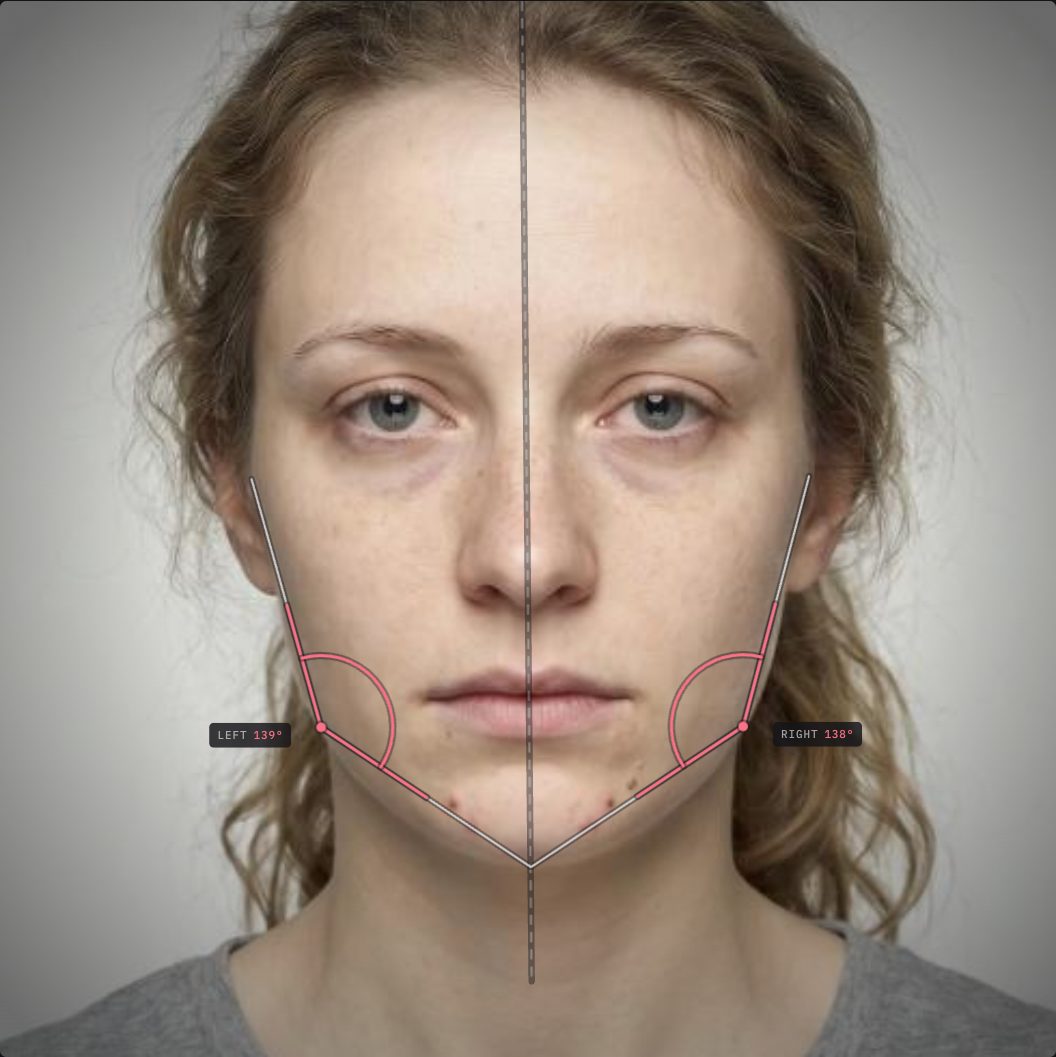
Rate your jawline with a free AI jawline rater. A 2D front-photo jaw-angle estimate, symmetry, visible width, and lower-face proportion - computed from 478 facial landmarks and drawn on your photo. No login; the photo stays in your browser.

For a reliable result: keep the lens at eye level, your chin neutral, and both sides of your face equally visible.

Upload a photo

Drag and drop or choose a file

or

JPG, PNG or HEIC, up to 30MB

Your photo never leaves your device ·

Both jaw corners measured in degrees, the jaw-to-cheek and lower-face spans, and where each sits among 4,237 faces. Built on your device in about a second.

What Your Jawline Score Means

The jawline score is a 0–100 comparison with four transparent, front-photo reference checks. It is not an attractiveness rating, diagnosis, or population percentile. The bands describe distance from this calculator's reference centers:

90–100 - Very Close

Very close to the center of this calculator's four front-photo reference checks. This describes geometric agreement, not attractiveness or health.

80–89 - Close

Close to the combined angle, width, symmetry, and lower-face references, with a modest difference in one or more components.

70–79 - Moderate Match

A moderate match across the four geometry checks. The component scores explain which measurements are closer or farther away.

60–69 - Mixed Match

Some measurements are close to the calculator references and others differ. The scalar alone does not identify a jawline shape.

Below 60 - Outside Reference

One or more visible-photo measurements are farther from the internal reference centers. This is not a diagnosis or a negative appearance judgment.

How Your Score Is Calculated

Four geometric components use fixed heuristic weights. The angle overlay and left, average, and right estimates are shown with the free result; the report keeps the deeper component interpretation.

Front-Photo Jaw Angle

45%

The 2D corner formed by the chin, outer-jaw mesh anchor, and side-face mesh anchor on each side. The internal 118°–126° scoring band belongs to this calculator's front-photo coordinate system; it is not a clinical gonial-angle range.

Symmetry

15%

Left-versus-right jaw-anchor distances compared around the detected facial midline. Pose and perspective can affect this visible-photo estimate.

Visible Jaw Width

30%

Outer-jaw mesh-anchor width divided by cheekbone-anchor width. It uses the same calibrated 0.76–0.82 reference band and peaked score curve as the report's Jaw-to-Cheekbone Width metric; it is not a direct bigonial measurement.

Visible Lower Face

10%

Nose-base-to-chin distance divided by visible forehead-anchor-to-chin height. It shares the report metric's 0.36–0.42 reference band and score curve.

The Gonial Angle, Explained

The clinical gonial angle describes the bend between the mandibular ramus and body at the gonion. That anatomical measurement is not directly visible in an ordinary frontal selfie. This tool instead reports a different, explicitly labeled 2D angle made from visible Face Mesh anchors near the jaw outline. For normal ranges, sharp vs obtuse patterns, and what actually changes the angle, see our full gonial angle guide.

Clinical measure

Anatomical

Uses identified bone or validated anatomical landmarks, often from a lateral cephalogram or suitable 3D imaging.

This calculator

118–126°

Internal scoring band for the front-photo angle formed by the chin, outer-jaw anchor, and side-face anchor. It is not a cephalometric reference range.

How to use it

Compare

Use the number to compare similarly framed photos. Do not use it to infer bone anatomy, health, attractiveness, or a jawline type.

Why the distinction matters: research comparing 2D photographs with direct measurements found poor agreement for bigonial and bizygomatic breadth, and noted that gonion is difficult to locate in a frontal 2D image. Pose and lens perspective add further variation. The result is therefore presented as visible-photo geometry, not a substitute for a clinical measurement.

Tips for Accurate Measurement

Front-facing, eye-level camera

Hold the camera at eye level and square to your face. Our pose regression found score movement beginning around 2° yaw or 3° pitch; the page shows an accuracy note when the broader production pose check marks a photo fair or poor.

Neutral expression

Smiling pulls the cheek and jaw landmarks. A relaxed, closed-mouth expression gives the most stable jawline measurement.

Hair off the jaw

Hair covering the jaw outline blocks landmark detection on the affected side, often inflating asymmetry. Tie hair back so the cheek-to-chin line is visible.

Even, soft lighting

Hard shadows under the jaw exaggerate definition; flat lighting hides it. Diffused front lighting (window light works well) gives the cleanest jawline reading.

Frequently Asked Questions

What is a good jawline score?

There is no universal good or bad score. A higher number means the four measurements in this particular front-photo model sit closer to its reference centers; it does not mean a face is more attractive, healthy, or normal. Use the component values to understand the number.

What is the perfect gonial angle?

No single gonial angle is perfect across people, measurement methods, and viewing angles. One 2016 internet survey preferred 130° in male profile views, but that study's profile angle is not the same measurement as this tool's front-photo mesh angle. This calculator therefore labels its degree value as a front-photo estimate.

How is the gonial angle measured?

A clinical gonial angle uses anatomical mandibular landmarks, commonly on a lateral cephalogram or validated 3D image. This tool cannot see those bone landmarks. It computes the 2D angle from the chin to two visible Face Mesh anchors on each side, then shows the left, right, and average values without claiming clinical equivalence.

How is this different from other jawline rating tools?

It uses MediaPipe's 478-point surface mesh and deterministic 2D geometry in your browser. The same image produces the same calculations, and the overlay shows the anchors behind the angle. It remains a photo-based estimate: pose, lens perspective, hair, and landmark visibility can change the result.

Can I improve my jawline?

You can improve the reliability of this photo score with neutral posture, an eye-level camera, even lighting, and an unobstructed jaw outline. Questions about lasting anatomical or medical changes are individual; discuss them with a qualified clinician rather than using a photo score as guidance.

Does mewing actually work?

There is not good controlled evidence that mewing reshapes an adult jaw. Changes between photos can reflect head posture, camera angle, expression, lighting, or normal development rather than new bone structure. For bite, breathing, or jaw-development concerns, use advice from a qualified dental or medical professional rather than a photo score.

Why is my jawline score lower than I expected?

A lower number can come from any combination of the four components; it cannot be translated into a single label such as soft or square. Photo conditions also matter. Our pose regression showed that even small viewpoint changes can move this 2D score, so compare photos taken with the same straight-on setup.

Does the score account for gender?

No. The model uses one transparent set of front-photo reference bands and does not infer or apply a gender-specific attractiveness standard. The result is a geometry comparison, not a demographic norm.

What are the different jawline shapes?

Common descriptive labels include square, tapered, rounded, and angular. They are visual categories rather than diagnoses, and a frontal photo cannot reliably determine profile projection or skeletal position. This tool does not force a shape label from the total score; it reports the underlying angle, width, symmetry, and lower-face checks instead.
References

Related Tools and Guides