Beard Styles With Face Shape: Guard Lengths & Trim Rules
Match beard styles with face shape using jaw-to-cheek ratios, millimeter trimmer guards, neckline spacing, Reddit grooming notes, and a style table.
A beard acts as soft-tissue architecture around the lower third of the face. Shifting cheek thickness by just 4 to 6 mm relative to chin length changes perceived jaw width, chin projection, and facial length-to-width balance faster than any haircut adjustment. Across r/beards, r/BeardAdvice, and r/malegrooming, matching beard styles with face shape follows one consistent rule: add hair volume where bone structure runs narrow, and trim closely where width or vertical length already dominates. Before setting a trimmer guard or carving cheek lines, verify your underlying length-to-width and bigonial jaw-to-cheek ratios under straight-on five-foot lighting with Detect Your Face Shape, since close-up phone selfies often warp lower-jaw breadth.
Key Takeaways
- Grooming threads converge on nudging extreme outlines toward balanced oval ratios (
1.25to1.45length-to-width) by trading cheek thickness against chin length. - Millimeter guard settings fall into four tiers: light stubble (
1to3 mm), heavy stubble (5 mm), short boxed or corporate beards (7to10 mm), and medium-long beards (13to19+ mm). - Let facial hair grow untouched for 4 to 6 weeks before picking a shape for beard borders; shaping during week two removes slower-growing cheek and chin density.
- Placing the neckline two horizontal fingers above the Adam's apple prevents the artificial "chin-strap" gap caused by shaving right onto the jawbone.
- Follicle coverage outranks ideal charts: sparse upper cheeks look cleaner in a lowered cheek line, Balbo, or
3to5 mmstubble than a forced full beard.
How Jaw Ratios and Growth Density Dictate Beard Geometry
Anthropometry types lower-face proportions using three coordinates from Leslie G. Farkas' clinical standards: facial length-to-width ratio (tr-gn divided by zy-zy), bigonial jaw-to-cheek taper (go-go over zy-zy), and lateral gonial angle. Hair length changes how wide or tapered those boundaries appear at conversational distance.
Before picking angles, experienced contributors on r/beards stress one physical limit: growth pattern beats theory. If upper cheeks remain patchy after a month while your mustache and chin connect thickly, forcing a high boxed line draws attention to bare skin gaps. A smart face type beard sits at the overlap between your bone proportions and your densest follicle zones.
The 4 to 6 Week Baseline Before Shaping
Early trimmers routinely carve cheek and neck borders around day ten, right when stubble itches and uneven follicle speeds look messy. Veterans on r/BeardAdvice recommend waiting four to six full weeks (roughly 12 to 18 mm of unshaped growth) before sculpting final lines. Slower terminal hairs across the mid-cheek and under-chin transition often fill thin patches by week five.
Millimeter Guard Tiers Explained
Working in millimeters prevents confusion across clipper brands:
1to3 mm(light stubble): shows skin clearly beneath, sharpens strong jaw angles, and requires minimal styling.5 mm(heavy stubble): masks minor skin texture while holding crisp cheek lines with a detail trimmer.7to10 mm(short corporate or boxed beard): crosses from stubble into solid coverage capable of reshaping narrow or soft chins.13to19+ mm(medium full beard or ducktail): builds clear vertical or lateral silhouette change, needing balm, boar-bristle brushing, and tapered sideburns.
Best Beard Types for Face Shapes: Six Structural Matches
Choosing beard types for face shapes is simplest when grouped by whether a silhouette needs vertical drop, side width, or corner softening.
Round and Oval Faces: Lengthening vs. Preserving Balance
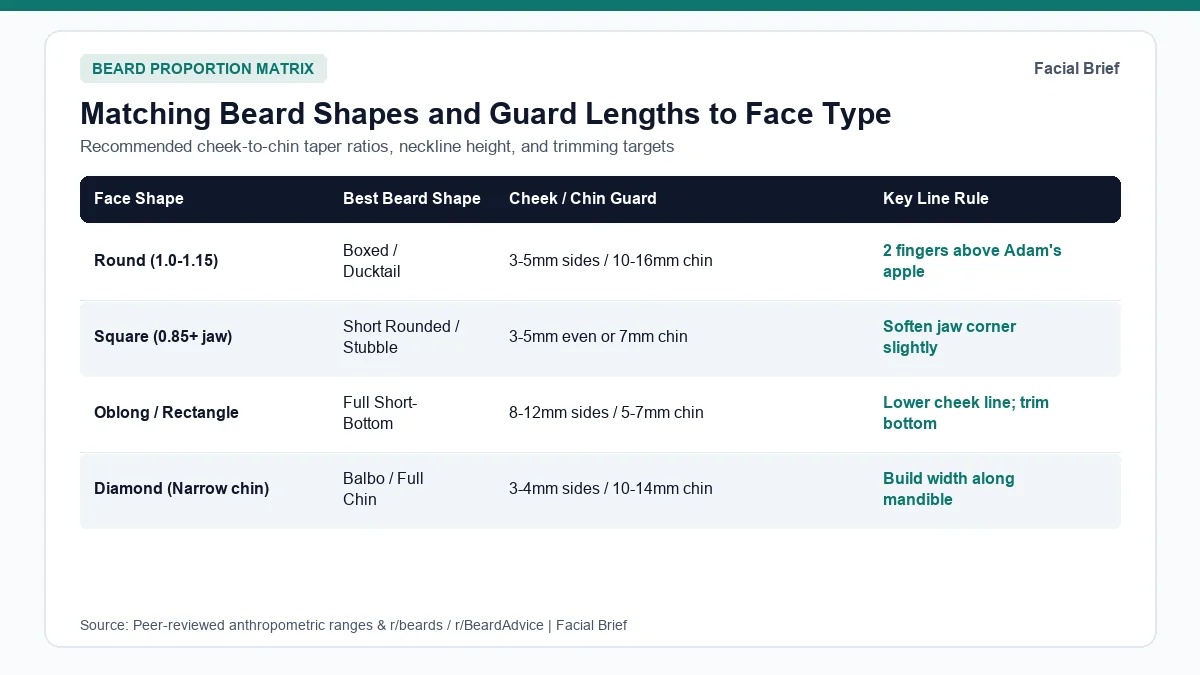
Round faces (1.00 to 1.15 length-to-width) pair full cheeks with gentle jaw curves. Puffy 10 mm side hair widens curved cheeks further. Keep cheek guards tight at 3 to 5 mm, cut a straight diagonal cheek line from sideburn top to mustache corner, and grow 10 to 16 mm under the chin in a tapered boxed beard, short ducktail, or extended goatee to lengthen the lower face.
An oval face shape (1.25 to 1.45 length-to-width) handles almost any shaped beard cleanly, from 3 mm stubble to a tidy 10 mm corporate trim. Avoid narrow 18+ mm chin curtains with shaved cheeks, which pull balanced proportions oblong.
Square and Triangle Faces: Rounding Corners and Taming Jaw Bulk
Square jaws (0.83+ jaw-to-cheek ratio and 110 to 120 degree gonial angles) look overly blocky under square-cut beard edges. Even 3 to 5 mm stubble preserves crisp angles naturally, while 7 to 9 mm beards look cleaner with softly rounded chin corners.
Triangle or pear shapes reverse typical proportions, placing wider mandibular width below a narrower forehead. Heavy jawline hair exaggerates bottom weight quickly. Stick with 2 to 4 mm tight stubble and slightly fuller mustache presence, then balance upper-third proportion using crown volume or fringe height covered in our Norwood scale guide and bangs for face shape guide.
Oblong, Rectangle, and Diamond Faces: Shifting Width Laterally
Oblong and rectangular outlines (1.45+ length-to-width) flip the round-face formula. Pointed ducktails stretch vertical height even further, so trim the chin bottom tightly at 5 to 7 mm while keeping 8 to 12 mm along the cheeks and lowering the cheek line slightly to add side width.
Diamond faces pair wide cheekbones with narrow foreheads and tapered chins. Trim cheeks neat at 3 to 4 mm and grow 10 to 14 mm across the chin and lower jaw (via a Balbo, anchor style, or chin-weighted full beard) to build lower-third width without expanding beside the cheekbones. Pair jaw width with upper hair choices in our diamond face hairstyles guide or compare haircuts and beards side by side inside Custom Style Studio.
Different Beard Shapes Comparison Table
This table aligns different beard shapes with facial measurements, cheek-to-chin guard splits, line spacing, and common barber traps.
| Face Type | Best Beard Shape | Cheek / Chin Guard | Neckline & Cheek Line Spec | Common Pitfall to Avoid |
|---|---|---|---|---|
| Round | Boxed beard or short ducktail | 3-5 mm sides / 10-16 mm chin | 2 fingers above Adam's apple; straight cheek slope | Bushy cheek sides widening curved cheeks |
| Oval | Classic short full or stubble | 3-10 mm balanced all around | Natural under-jaw crease; clean upper cheek dust | Narrow chin beard pulling length oblong |
| Square | Short rounded beard or stubble | 3-5 mm sides / 7-9 mm curved chin | Soft rounded bottom; skip hard 90-degree corners | Thick squared bottom doubling jaw width |
| Oblong / Rectangle | Short-bottom full beard | 8-12 mm cheeks / 5-7 mm chin | Slightly lower cheek line; flat bottom trim | Long goatees stretching vertical face height |
| Triangle / Pear | Mustache + tight designer stubble | 2-4 mm jaw / fuller mustache | Razor edge along jaw shadow; zero neck bulk | Full flaring jaw beard adding lower bulk |
| Diamond | Balbo or chin-weighted full | 3-4 mm cheeks / 10-14 mm chin | Wide chin base; tidy sideburn taper | Thick mid-cheek hair widening cheekbones |
See how jaw corners, chin projection, and cheek ratios appear together on a biometric readout in our sample facial report or check lower-third proportions with the Jawline Score analyzer.
Neckline, Cheek Line, and Taper Blending Mechanics
Choosing the right pairing across beard styles and face shapes handles half the silhouette; disciplined border lines complete the rest. On r/BeardAdvice photo critiques, misaligned necklines cause most complaints about messy or awkward facial hair.
The Two-Finger Neckline Rule and Fade Gradient
Shaving directly onto the visible jawbone edge creates a tight "chin-strap" outline the moment you speak or look down. Place your index and middle fingers horizontally above your Adam's apple, trace a gentle U-curve outward from the top edge of your index finger toward the points behind each earlobe, and shave everything underneath. Running a stepped 3 to 5 mm guard for 1 cm directly above that bottom edge fades the drop cleanly instead of leaving a harsh cliff.
Straight Diagonal vs. Natural Curved Cheek Lines
A straight diagonal slope from upper sideburn to mustache corner sharpens soft round cheeks, whereas a gentle natural downward curve preserves cheek fullness on oblong faces and sidesteps sparse upper patches. Always trim dry hair cautiously one millimeter shy of your final line, since fixing an over-carved cheek edge takes weeks of grow-out.
Frequently Asked Questions
How do I match beard styles with my face shape?
Match facial hair to whatever dimension your silhouette lacks by checking length-to-width and jaw-to-cheek ratios in a five-foot straight-on portrait. Compact round faces benefit from shorter 3 to 5 mm cheeks paired with 10 to 16 mm chin growth to add vertical length, while narrow oblong faces need fuller 8 to 12 mm sides and closer 5 to 7 mm chin trims.
What millimeter guard length works best for a short shaped beard?
A short, structured corporate or boxed beard usually lands between 7 mm and 10 mm across the chin and lower mandible, tapered down to 4 mm or 6 mm across the upper cheeks and sideburns. Leaving that 2 to 4 mm gradient keeps ears and cheekbones sleek while preserving thick enough chin density to square or round the lower profile cleanly.
Where should the beard neckline sit for different face types?
Place two horizontal fingers directly above your Adam's apple and follow a smooth U-shaped curve outward toward the back of both jaw angles behind the earlobes. Rounder necks stay cleaner right at the two-finger mark to define an under-chin shadow, while leaner angular faces can sit slightly higher along the natural jaw crease without climbing onto the visible facial jawbone.
What beard shape looks best if my cheeks grow patchy?
When upper cheeks remain sparse after 4 to 6 weeks of untouched growth, lower your cheek border down to your densest jawline strip or pivot toward a Balbo, anchor style, or 3 to 5 mm heavy designer stubble. Razor-edging stray thin upper cheek hairs cleanly creates much sharper visual contrast than trying to stretch thin uneven patches into a forced full beard.
Referenced Community Discussions & Sources
- r/coolguides: Visual breakdown of beard style matching by face shape: Community breakdown mapping oval, round, square, triangle, and oblong beard silhouette goals.
- r/beards: Millimeter guard lengths mapped to common beard styles: Practical clipper guide converting
1 mmto19+ mmguards into stubble, corporate, and full styles. - r/beards: Shaping beard proportions to suit individual facial geometry: Member feedback weighing cheek tapering, chin bulk, and natural density constraints.
- r/BeardAdvice: Neckline placement checks and avoiding the high chin-strap line: Real photo checks applying the two-finger rule above the Adam's apple and neckline fades.
- r/BeardAdvice: When to trim cheek lines vs. necklines during early growth: Advice supporting a 4 to 6 week unshaped baseline before committing to higher or lower borders.
- r/malegrooming: Comprehensive guide to pairing beard types with face contours: Overview balancing cheek width, mustache weight, and chin length across six head shapes.
- Leslie G. Farkas, Anthropometry of the Head and Face (2nd ed., Raven Press): Clinical craniofacial width and lower-third gonial measurement standards.
Paired Facial Brief Analyzer
Measure your own proportions on-device
Run private 478-point landmark geometry in your browser with zero server photo upload on free tools.
Continue Reading