Haircut Depending on Face Shape: Ratios, Angles, and Fit
Pick a haircut depending on face shape using L/W ratios, jaw angles, and hair texture rules. Includes a 6-shape styling table and Reddit barber tips.
Choosing a haircut depending on face shape starts with treating hair as optical framing. Every cut redistributes perceived weight around three checkpoints: forehead width, cheekbone span, and lower jaw corners. When volume lands in the wrong zone, a chin-length bob widens soft cheeks, or a tall quiff stretches a narrow profile past proportion. Browse styling threads on Reddit and one complaint keeps coming up: users trace their reflection on a bathroom mirror with dry-erase marker, follow a chart, and still leave the salon unhappy because close-up camera distortion or hair texture threw off the geometry. Before booking a trim, Detect Your Face Shape in your browser using 478 facial landmarks to get an accurate length-to-width baseline.
Key Takeaways
- Oval faces with a length-to-width (L/W) ratio between 1.30 and 1.50 carry balanced thirds across most lengths, though heavy one-length hair pulls weight downward.
- Round faces near a 1.00 to 1.15 L/W ratio look longer with 2.5 to 4.0 cm of crown height, tighter sides, and collarbone layers, while chin-level blunt bobs widen the cheeks.
- Square jawlines with 115 to 125 degree lower corners soften under textured fringes, tousled layering, and off-center parts instead of straight geometric cuts.
- Heart and diamond shapes benefit from fullness below the ears, such as chin-length waves or jaw-skimming bobs, to balance wide temples or sharp cheekbones.
- Barbers and stylists on Reddit note that hair density, curl shrinkage, cowlick direction, and daily styling habits matter as much as bone structure after day one.
How Cranial Ratios Determine a Haircut Based on Face Shape
Every practical haircut based on face shape guide builds on four landmarks from Leslie Farkas's craniofacial standards: trichion (center hairline), menton (lowest chin point), zygion (outer cheekbone arch), and gonion (outer jaw corner). Dividing vertical face length (trichion to menton) by cheekbone width produces your Length-to-Width Ratio (L/W). Comparing forehead span against cheekbone and jaw width then separates shapes with identical L/W scores, such as round versus square silhouettes.
Many people misread their own geometry before visiting a stylist because of smartphone perspective. A front camera held 30 cm away shoots near a 24mm equivalent focal length. Wide-angle lenses enlarge central features, narrow the apparent ears and temples, and stretch vertical midface height by 8% to 12%. Someone with an oval or round outline takes a close selfie, sees an elongated middle third, and requests heavy bangs suited for an oblong face.
Stylists answering questions in r/HairStyleAdvice proportional fit threads advise shooting straight on from 1.5 meters (5 feet) away at eye level with dry hair pulled behind the ears, or tracing your hairline-to-chin outline on a flat mirror. Once you verify your proportions, an AI Hairstyle Try-On lets you preview six cuts selected for your detected shape directly on your photo before cutting. If your L/W sits between 1.35 and 1.48, our oval face hairstyles guide covers how subtle internal layers stop thick hair from flattening natural balance.
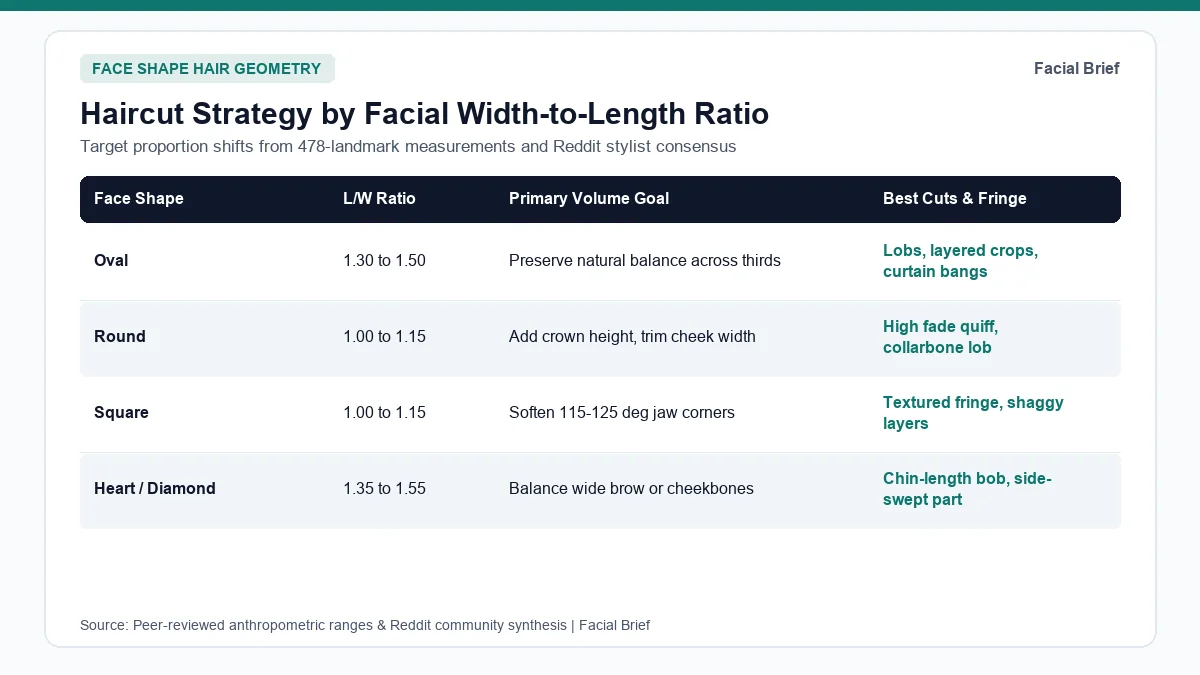
Face Shapes and Hairstyles: Comparing All Six Silhouettes
Matching face shapes and hairstyles works best when every shape links to clear proportion targets. The table below maps all six silhouettes across length-to-width bounds, widest facial zones, optical volume goals, and proven styles.
| Face Shape | Typical L/W Ratio | Widest Zone & Jaw Profile | Optical Volume Goal | Proven Hairstyles & Fringe Rules |
|---|---|---|---|---|
| Oval | 1.30 to 1.50 | Cheekbones slightly wider than jaw; soft chin | Keep balance across all three vertical thirds | Collarbone lobs, textured side parts, curtain bangs, medium tapers |
| Round | 1.00 to 1.15 | Cheek width near length; soft jaw curve | Add 2.5 to 4.0 cm crown lift, trim side bulk | High fade textured quiff, long layers, deep side part, cheekbone curtain bangs |
| Square | 1.00 to 1.15 | Forehead, cheeks, jaw near equal; 115 to 125 deg corner | Soften horizontal jaw corners with movement | Tousled shag, textured crop with wispy fringe, waves falling below the jaw |
| Heart | 1.25 to 1.45 | Broad forehead and temples; pointed chin | Shift visual bulk downward toward the jawline | Chin-length wavy bob, side-swept bangs, medium flow tucked behind one ear |
| Diamond | 1.35 to 1.55 | High wide cheekbones; narrow brow and jaw | Fill temple width and add softness below ears | Side-parted layers, swept brow fringe, shoulder waves with lower fullness |
| Oblong | 1.55 or higher | Narrow uniform span; vertical stretch | Shorten forehead height, widen midface sides | Eyebrow-skimming fringe, medium layered flow, wavy chin-to-collarbone lob |
Oval and Oblong Face Proportions
Oval faces (1.30 to 1.50 L/W) form the baseline most styling rules aim toward. With cheekbones marginally wider than a gently curved jaw and balanced vertical thirds, pixies, shoulder lobs, side parts, and short crops all sit comfortably. The main mistake noted in r/malehairadvice face-shape breakdowns is wearing very long, dense, unlayered hair straight down the center, which drags visual weight downward and hides cheekbone structure.
Oblong faces push past 1.55 L/W, making extra height on top counterproductive. Steep pompadours or tight skin fades elongate an already tall silhouette. Barbers shorten the upper third with textured fringes ending near the eyebrows and keep 1 to 2 cm of relaxed volume around the temples and ears.
Round and Square Lower Thirds
Round and square shapes share similar 1.00 to 1.15 L/W ratios yet need opposite perimeter lines. Round cheeks lack sharp mandibular corners, so blunt cuts stopping at the chin accentuate midface fullness. In r/femalehairadvice chop consultations, posters who cut straight chin-level bobs often regret how flat horizontal edges spotlight cheek curve. Dropping length 4 to 6 cm past the chin, or pairing tapered sides with crown lift, stretches vertical lines cleanly. Our round face hairstyles breakdown details exact parting offsets and layer lengths.
Square jaws carry bold horizontal width and crisp 115 to 125 degree lower corners. Heavy blunt bangs cut straight across the brow create a second horizontal bar above a boxy mandible. Off-center parts, wispy fringes, and curved layers falling past the jawbone break up rigid geometry without erasing natural definition.
Heart and Diamond Cheekbone Contrast
Heart and diamond outlines share a tapered, pointed chin, differing mainly across the upper forehead. Heart silhouettes widen at the temples, so slicked-back ponytails or clipped sides exaggerate forehead breadth. Adding textured weight below the ears with chin-length wavy bobs or mid-length flows fills the jaw nicely, covered further in our heart face hairstyles guide. Diamond faces peak sharply at the cheekbones while narrowing at both forehead and jaw; light side-swept bangs widen narrow temples while waves near the nape anchor the chin.
Haircuts Suitable for Different Face Shapes vs. Hair Texture Reality
Ask working barbers on Reddit why haircuts suitable for different face shapes still disappoint clients, and they point straight to hair texture. Across r/Barber fit discussions and r/Hair cut consultations, professionals estimate that face geometry sets roughly 40% of a cut's success while density, strand thickness, curl pattern, and growth whorls decide the rest. Fine, straight Type 1 strands collapse flat against the crown within two hours, so a round-faced client chasing top lift needs 5 to 7 cm of graduated layering plus matte clay or sea-salt spray. Coarse wavy Type 2 hair does the reverse, expanding outward at ear level unless internal weight is channel-cut properly instead of attacked with thinning shears near the roots.
Curl shrinkage and growth cowlicks matter just as much. Type 3 and Type 4 curls bounce upward by 25% to 50% as water evaporates; a stylist who cuts wet curls to collarbone length for a round face can accidentally leave a cheek-widening triangle once dry. Meanwhile, a strong front crown whorl will split short blunt bangs down the middle no matter how tall your forehead measures. Leaving fringes 1.5 cm longer for weight, or steering into an asymmetric curtain sweep, avoids fighting natural root direction every morning.
Choosing Hairstyles for Your Face Shape at the Salon
To get dependable hairstyles for your face shape in person, skip broad requests like "cut it for a square face" and bring specific inputs. Show two or three photos of people who share your actual strand density, wave pattern, and hairline, not actors with thicker hair or studio blowouts. Be honest about morning styling time, since a wash-and-go habit rules out blow-dried quiffs or round-brushed curtain bangs. Ask your stylist where perimeter bulk will settle once air-dried, and compare candidate shapes in the Hairstyle Finder first.
Frequently Asked Questions
How do I measure what haircut fits my face shape?
Stand 1.5 meters (5 feet) from a camera lens at eye height with dry hair pulled completely off your forehead and behind your ears. Measure vertical hairline-to-chin length and horizontal spans across the forehead, cheekbones, and jaw corners. Dividing length by cheekbone width gives your L/W ratio: values from 1.00 to 1.15 signal round or square profiles, 1.30 to 1.50 indicate oval or heart balance, and 1.55 or higher suggest oblong proportions.
What is the haircut best for face shape hybrids?
Most faces blend two categories, such as an oval length paired with a square jaw corner or heart cheekbones. Always target the single proportion that creates the sharpest visual imbalance first rather than following a generic label. For example, if your L/W ratio measures 1.38 (oval) alongside a wide, sharp 118 degree jaw, prioritize soft cheekbone-to-chin layers that break horizontal lower-third weight instead of adding extra crown height.
Which hairstyles for face shape roundness avoid making cheeks look wider?
Avoid blunt horizontal cuts ending directly between the earlobes and chin, heavy straight-across bangs, and bulky side layers starting above the cheekbones. Those lines draw the eye sideways across the widest midface span. Instead, choose cuts ending at least 4 cm below the chin, deep off-center parts, long diagonal layers, or short tapered fades paired with 3 cm of top volume to lengthen the vertical line.
Should haircuts suitable for different face shapes account for glasses or beards?
Yes, eyewear and facial hair reshape lower and middle facial thirds just as strongly as scalp hair. Thick angular frames widen the midface and visually shorten a tall oblong profile, while short boxed beards squared at the chin sharpen a soft round jaw so you need less crown height on top. Always wear your daily glasses during a salon consultation and tell your barber your typical beard length before setting fade lines.
Referenced Community Discussions & Sources
- r/HairStyleAdvice: Stylist perspective on matching haircuts to face proportions and texture: Explains why hair density, natural part, and daily effort outweigh strict face-shape rules in real consultations.
- r/malehairadvice: Community guide to face shapes and flattering men's haircuts: Breaks down crown-height vs. side-taper ratios across oval, square, round, diamond, and heart silhouettes.
- r/Barber: How barbers evaluate width-to-length balance and hair growth patterns: Details mirror proportion checks, cowlick constraints, and bringing texture-matched photos to the chair.
- r/femalehairadvice: Mirror tracing and avoiding chin-level blunt bobs on round cheeks: Documents common chop regrets when blunt perimeters sit right against the widest part of the face.
- r/Hair: Balancing heart, oblong, and oval proportions with layers and fringes: Compares curtain fringes, collarbone lobs, and weight placement for narrow chins vs. broad foreheads.
- Farkas, L. G. (1994). Anthropometry of the Head and Face (2nd ed.). Raven Press: Clinical craniofacial definitions for trichion, menton, bizygomatic, and bigonial landmark ratios.
- Ward, B. et al. (2018). JAMA Facial Plastic Surgery: Photographic analysis demonstrating how 30 cm smartphone wide-angle lenses distort nasal and midface proportions compared with 1.5 m portraits.
Paired Facial Brief Analyzer
Measure your own proportions on-device
Run private 478-point landmark geometry in your browser with zero server photo upload on free tools.
Continue Reading