Facial Brief

Face Symmetry Test

Measure left-right facial balance with a 478-landmark detector, a straight-on photo check, and a visual overlay - in your browser.

Upload a photo

Drag and drop or choose a file

or

JPG, PNG or HEIC, up to 30MB

Your photo never leaves your device ·

Twelve landmark pairs reflected across your facial axis, both mirrors, and where each feature sits among 7,986 faces. Built on your device in about a second.

Is My Face Symmetrical? How the Test Works

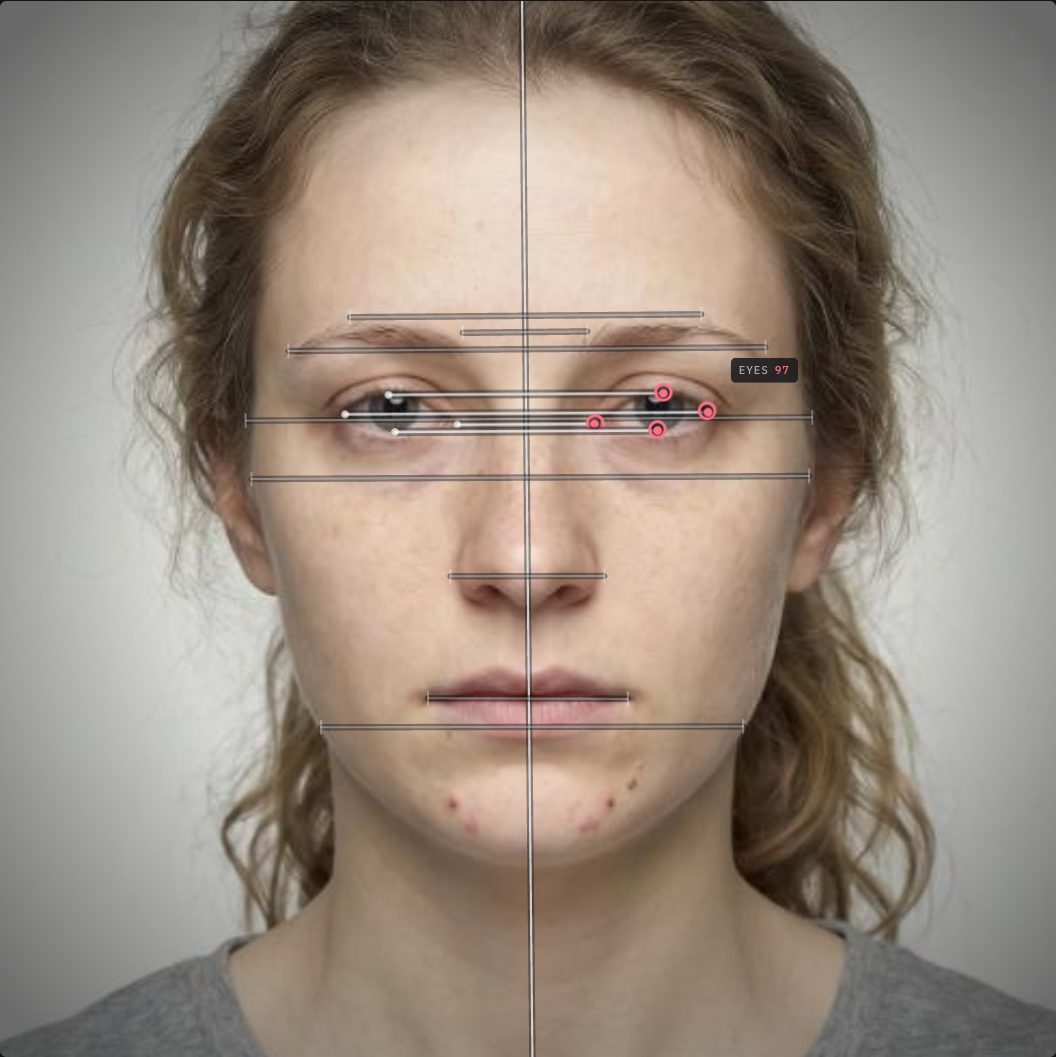
The fastest way to check facial symmetry is a landmark test: upload one front-facing photo, and the detector maps 478 points. The scorer then selects 12 corresponding left/right pairs across the eyes, eyebrows, nose, mouth, and broad facial outline, reflects each left point across a fitted midline, and measures the two-dimensional residual. You get a score out of 100, one feature-level proof point, and an interactive overlay - no login, and the photo stays in your browser.

Almost certainly, your face is not perfectly symmetrical - nobody's is. Treat this as a photo-based comparison, not a diagnosis or population percentile. Head turn is especially important: the tool withholds a score above 2° of measured yaw rather than presenting a pose artifact as facial asymmetry.

What Is Facial Symmetry?

Facial symmetry measures how closely the left and right sides of your face mirror each other when reflected across a vertical midline. No human face is perfectly symmetric - even faces widely considered the most attractive show measurable bilateral differences. This checker's 0–100 score is a product-specific summary of selected landmark residuals; it is not directly interchangeable with clinical anthropometric percentages.

Symmetry can influence perception, but it is only one signal among expression, proportions, skin, lighting, familiarity, and individual preference. A higher score is not a verdict on attractiveness or personal value.

What Your Score Means

The overall symmetry score is a weighted average of five internal feature scores (eyes, eyebrows, nose, mouth, jaw), each scaled 0–100. These bands explain this tool's output; they are not population percentiles or clinical categories.

ScoreLabelIn this toolWhat it meansCaution
90–100Very close matchSmallest reflected-pair residualsThe selected left/right landmark pairs sit very close to their reflected partners in this photo.Not a population percentile or clinical rating.
80–89Close matchSmall reflected-pair residualsMost selected pairs are close to their reflected partners, with some photo-specific difference remaining.Compare only straight-on photos taken under similar conditions.
70–79Moderate matchModerate reflected-pair residualsOne or more selected feature pairs differ enough to lower this photo's combined score.Expression, yaw, lens position, and lighting can all move the result.
Below 70Larger measured differenceLarger reflected-pair residualsAt least one selected pair is farther from its reflected partner in this photo. The score does not identify the cause.Retake before interpreting a low result; this is not a diagnosis.

The Five Feature Scores

The tool computes a separate symmetry score for each of five feature groups by comparing bilateral landmark pairs against a stable facial midline. A low score in one feature can pull the overall down even when other features are well-balanced.

Eye Symmetry

What it measures: Compares the positions of the inner and outer corners of each eye, plus the upper and lower lid contour, against the facial midline. Detects differences in eye height, opening width, and tilt.

Common causes of asymmetry: Orbicularis oculi muscle imbalance, ptosis (drooping lid) on one side, sleeping position causing fluid retention, prior lid surgery, neurological causes (rare).

Eyebrow Symmetry

What it measures: Compares the positions of the brow head, peak, and tail on each side. Detects differences in arch height, brow length, and resting position.

Common causes of asymmetry: Frontalis muscle dominance on one side, habitual brow-raising patterns, asymmetric eyebrow grooming, congenital differences in brow placement.

Nose Symmetry

What it measures: Compares one left/right pair at the outer nasal ala (the visible sides of the nose) after reflection across the fitted midline.

Common causes of asymmetry: A photo can show differences from natural anatomy, head turn, expression, lighting, prior trauma, or surgery. This score cannot diagnose a deviated septum.

Mouth Symmetry

What it measures: Compares the left and right lip corners (commissures). It detects position differences at rest, but does not score lip volume or the full lip contour.

Common causes of asymmetry: Natural resting expression, a slight smile, dental support, camera angle, or temporary muscle tension can change the measurement.

Jaw Symmetry

What it measures: Compares three broad-outline pairs at the temples, cheekbones, and jaw contour. The chin helps fit the midline but is not a separate scored jaw pair.

Common causes of asymmetry: Natural skeletal or soft-tissue differences, jaw tension, head turn, hair occlusion, and lighting can all affect the outline. The score cannot determine which applies.

A low jaw score does not identify its cause: natural anatomy, soft tissue, hair, lighting, tension, and camera pose can all change the visible outline. For an evidence-aware overview of jaw appearance, see how to improve your jawline naturally.

How the Analysis Works

  1. 1. 478-landmark detection. MediaPipe Face Mesh detects 478 points across the visible face. Detection density supports the overlay, but the symmetry score itself uses 12 selected bilateral pairs rather than all 478 points.
  2. 2. Stable midline construction. Rather than relying on a single point, the tool fits a line through five anchors (upper forehead, forehead center, nose bridge, nose base, chin bottom). Head roll is handled by the fitted line; head turn still distorts 2D geometry, so scores are withheld above 2° of measured yaw.
  3. 3. Bilateral pair comparison. For each selected pair (for example, the left and right outer eye corners), the left point is reflected across the fitted midline. The scorer then measures the full two-dimensional residual between that reflected point and its right-side partner, so vertical displacement is included as well as left/right spacing.
  4. 4. Per-pair scoring. The residual is normalized by that pair's average distance from the midline so image scale does not determine the result. A fixed penalty converts it to 0–100, then pairs are grouped into eyes, eyebrows, nose, mouth, and jaw scores.
  5. 5. Weighted overall. The overall symmetry score is a weighted sum of the five feature scores. The product currently weights jaw 35%, eyes 25%, eyebrows 15%, mouth 15%, and nose 10%. These are product weights, not a clinical severity formula.

Tips for an Accurate Test

Photo conditions strongly affect the score. Following these tips gives the most reliable measurement of your true bilateral symmetry.

Front-facing, neutral expression

Smiling activates your dominant muscles and exaggerates asymmetry. Use a neutral, relaxed expression for the most accurate baseline.

Hair pulled back

Hair covering the forehead or jaw outline blocks landmark detection. Tie hair back so the full face contour is visible.

Even, soft lighting

Side lighting creates shadows that mimic asymmetry. Use diffused front lighting - natural daylight from a window works well.

Camera at eye level

Tilted camera angles distort facial proportions. Keep the camera level with your eyes and roughly arm's length away.

No glasses, hats, or heavy makeup

Glasses obscure eye landmarks. Heavy contouring can shift the apparent jaw and cheekbone outlines.

Private by Design, Photo-Specific by Nature

Landmark detection and scoring run in your browser. The free checker does not send your photo or 478-point mesh to the server. It saves a compact, session-linked score summary without the photo or mesh so a result link and optional report handoff can work. Your photo is uploaded only if you explicitly choose the paid report and complete its consent step.

For comparison over time, use the same camera, distance, lighting, neutral expression, and eye-level position. A change between unmatched photos can reflect capture conditions rather than a change in your face.

What to Do With Your Score

A photo score cannot identify why a left/right difference appears. Retake first, then treat the result as a prompt for context rather than a prescription. The appropriate next step depends on whether a concern is temporary, habitual, dental, neurological, or structural.

Exercise evidence is limited

A small uncontrolled face-yoga study found changes in cheek fullness and perceived age, but it did not measure bilateral symmetry or test extra repetitions on one side. If you want a cautious routine with the evidence and limitations shown side by side, see See the 7 evidence-based exercises →

Habitual patterns making it worse

Jaw tension, dental issues, repeated expression, and preferred chewing patterns can affect appearance or function, but this checker cannot tell which factor is present. For a broader overview of habits, evidence, and treatment limits, see Habits to fix →

Volumetric or skeletal asymmetry

Exercise does not remodel adult facial bones. If a difference is sudden, worsening, painful, associated with weakness, or affects chewing or speech, seek a qualified medical or dental clinician. Elective treatment decisions require an in-person assessment, not an online landmark score.

Face Symmetry Mirror: Your Two Mirrored Faces

The mirror test is the oldest symmetry check there is: reflect the left half of your face across the midline to build a whole face from two left halves, then do the same with the right. The checker builds both from your fitted landmark midline (not the centre of the photo) and shows them beside the original, with a one-click composite to save. Most people find the two mirrored faces look like two different relatives - a wider face from one side, a narrower or longer one from the other. That gap is your normal asymmetry made visible, and it appears on every face ever tested.

Neither mirrored face is the "real" you and neither is the more attractive version by default; perception studies generally rate the original above both artificial composites because a perfectly mirrored face reads as unnatural. Use the view to see where the sides differ - jaw, brow height, eye size - then check the feature scores above for how much.

Frequently Asked Questions

What is a good face symmetry score?

On this tool, 90–100 means a very close match, 80–89 a close match, 70–79 a moderate match, and below 70 a larger measured difference between the selected left/right landmark pairs. These are internal interpretation bands, not population percentiles or a clinical scale. Use a straight-on, neutral photo and retake under the same conditions before comparing scores.

Why does my face look more asymmetric in photos than in the mirror?

This is the Mere Exposure Effect, a well-established psychological phenomenon. You see your mirrored reflection thousands of times and develop a strong preference for that reversed version of your face. When you see an unflipped photograph - which shows your face as others actually see it - asymmetries appear on the 'wrong' side compared to what you expect, making them seem worse than they are. Friends and family tend to prefer the unflipped photo because that's the version of your face they recognize.

Can perfect facial symmetry exist?

Perfect bilateral symmetry is not a realistic human baseline. Faces normally contain small left/right differences, and a 100 from this tool means only that its selected landmark pairs matched extremely closely in one photo. It does not mean that every point on the face is identical or that the result is a clinical measurement.

Does symmetry equal attractiveness?

Symmetry is one factor in perceived attractiveness, but it's not the only one - and beyond a certain threshold, more symmetry doesn't continue to add appeal. Other strongly correlated factors include facial proportions (the relationships between thirds and fifths of the face), sexual dimorphism (gender-typical features), skin quality and texture, and averageness. Studies of perceived attractiveness consistently find that symmetric, average, and feature-typical faces are rated highly, but exceptional attractiveness usually comes from a combination of all three rather than maximum symmetry alone.

Can I improve my facial symmetry?

It depends on the cause, which a photo score cannot diagnose. A small uncontrolled 2018 face-exercise study found changes in cheek fullness and perceived age, but it did not test facial symmetry or prove that extra exercise on one side corrects asymmetry. Skeletal differences are not changed by facial exercise. Seek a qualified clinician for sudden, progressive, painful, or function-affecting asymmetry.

Why is my smile crooked in photos?

A smile can look uneven because the two sides activate differently, but head angle, timing, dental support, prior injury, and normal anatomy can also contribute. Use a neutral expression for this test because it scores resting geometry, not smile function. If facial weakness appeared suddenly, seek urgent medical advice rather than relying on an online test.

How accurate is AI face symmetry analysis?

This tool has not been validated against a clinical gold standard, so it does not publish an accuracy percentage. It detects 478 landmarks, then scores 12 selected bilateral pairs against a fitted midline. Head turn can strongly distort a 2D symmetry score, so results are withheld when measured yaw exceeds 2°. Expression, occlusion, lighting, and lens position can still affect valid-looking photos.

Why are my left and right sides different sizes?

A size difference in one photo can come from normal anatomy, head turn, lens perspective, expression, lighting, hair, soft tissue, or skeletal geometry. A landmark score cannot separate those causes. Retake under matched, straight-on conditions; seek a clinician if a difference is new, worsening, painful, or affects facial movement, chewing, or speech.

Is my face asymmetrical, or is it just the camera?

Often it is partly the camera. A front camera held close is a wide-angle lens at short range, which enlarges whatever is nearest the lens and can exaggerate one side of the face; a mirrored selfie preview then flips the image away from what others see. To separate lens effects from anatomy, use the rear camera at arm's length or farther, keep the lens at eye level, and face it straight on - or use this test, which fits a face midline from landmarks and withholds a score when your head is measurably turned.

What is the face symmetry mirror test?

It reflects one half of your face across the midline to make a whole face from two identical halves - once with the left half, once with the right - and shows both beside the original. This checker builds them from your fitted landmark midline rather than the centre of the photo, so a slightly off-centre selfie does not skew them, and lets you save all three as one comparison image.

Why do my two mirrored faces look like different people?

Because every face is asymmetric: one side is usually slightly wider, one brow sits higher, one eye opens more. Mirroring doubles whichever traits a side carries, so two left halves exaggerate the left side's proportions and two right halves the right side's. The larger the difference between your two mirrored faces, the more left-right variation the photo contains - part anatomy, part head turn and lens distance. It is a visual, not a score; the feature breakdown above puts numbers on it.
References

Related Tools and Guides