How to Strengthen Jawline Definition Without Wrecking Your TMJ
Learn how to strengthen jawline contour safely: clinical masseter trials, body fat thresholds, broader jaw fixes, and our method comparison table.
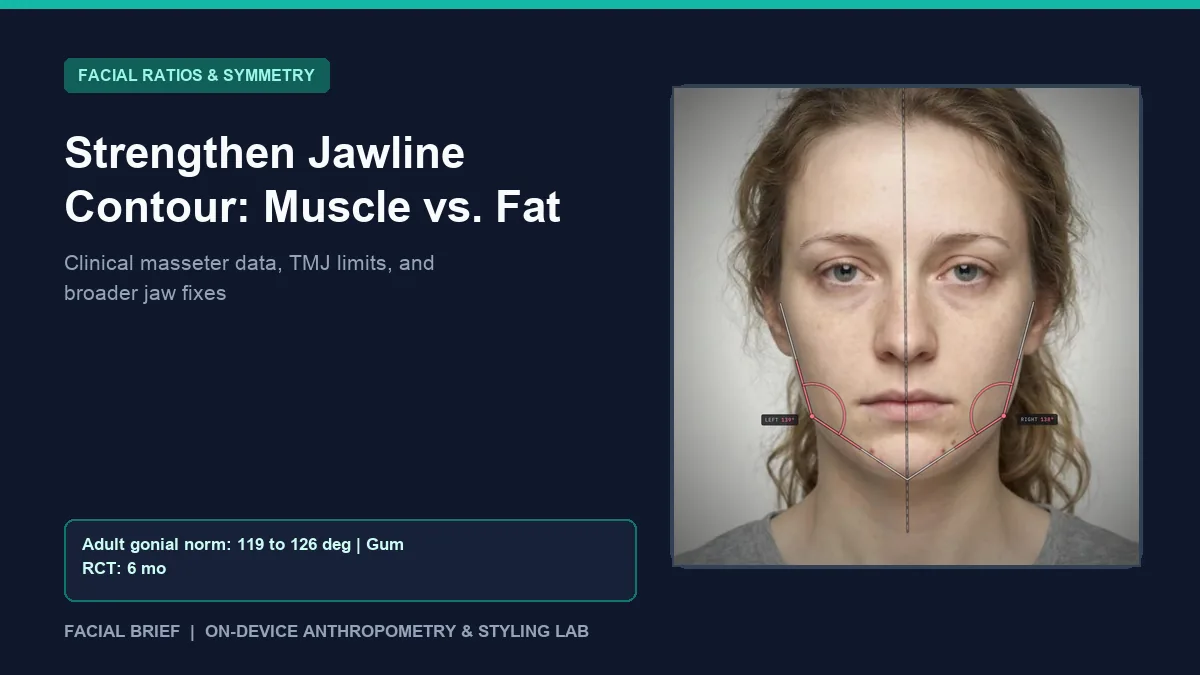
People trying to strengthen jawline sharpness usually run into conflicting advice within five minutes of searching online. One corner tells you to chew thick resin gum for an hour a day until your cheeks ache; another tells you to press your tongue into your palate for a year; a third tells you that only body fat matters. Behind those competing claims sit three separate anatomical layers: the mandible itself, the masseter muscles draping over its rear corners, and the soft tissue underneath the chin.
Before copying someone else's routine, check whether your lower face actually lacks width, projection, or simple definition under the skin. You can measure your front jaw-to-cheek taper and estimated gonial balance using Check Jawline Score, then view lateral chin projection in the Side Profile Analyzer.
Key Takeaways
- Overall fat loss exposes existing mandibular bone far more reliably than facial drills, with sharper lower-third definition often appearing around 10% to 14% body fat in men and 18% to 22% in women.
- A 2024 randomized controlled trial (Jung et al., Journal of Oral Rehabilitation) followed 58 adults chewing resistance gum three times daily for 6 months and recorded higher bite force without statistically significant gains in masseter thickness or jaw shape.
- Learning how to strengthen masseter muscle tissue requires caution: heavy mastic gum and silicone bite gadgets frequently trigger TMJ clicking, temple headaches, and uneven left-right bulk.
- Fixing a broader jaw depends on its layer: muscle hypertrophy from clenching eases with night guards or neuromodulators, whereas submental puffiness improves with caloric deficits and lower sodium.
- Palatal tongue suction and upright neck alignment lift under-chin tissue immediately while held, even though adult jawbone stays stationary.
Muscle, Fat, and Bone: What Drives the Jawline Effect
A sharp jawline effect in photos comes from a clean shadow running from below the earlobe forward to the chin. Three anatomical layers decide how crisp that border looks indoors.
First sits the mandible. Anthropometric norms in our gonial angle guide place balanced adult jaw corners near 119 to 123 degrees in men and 123 to 126 degrees in women, sitting inside proportions mapped in our facial measurement norms guide. Second sits the masseter muscle spanning between cheekbone arch and outer jaw corner. Third sits subcutaneous fat, skin laxity, and the suprahyoid muscles beneath the tongue.
Why Body Fat and Puffiness Hide Existing Bone
In this r/selfimprovement jawline thread and this r/PlasticSurgery evaluation, experienced commenters remind people asking how do i fix my jawline that spot fat reduction does not exist. Most young adults already carry solid mandibular bone hidden under 4 to 8 kilograms of extra weight.
Running a steady 300 to 500 calorie daily deficit for 8 to 20 weeks clears submental padding far more cleanly than jaw gadgets. Night-to-night water retention matters too: salty dinners, alcohol, or short sleep draw fluid along the lower cheeks within 24 hours, then clear after two or three normal days.
Skeletal Recessiveness vs. Soft Tissue Slack
Even at low body fat, some profiles look soft when the chin sits behind the lower lip or the jaw corner sits high near the ear. Dieting cannot lengthen a short chin bone, so checking lateral projection early prevents chasing unrealistic weight drops.
How to Strengthen Masseter Muscle Safely vs. Mastic Gum Claims
Because bone growth finishes after puberty, fitness forums pivot toward how to strengthen masseter muscle fibers to square out lower corners. While skeletal muscle responds to load, the jaw joint handles heavy resistance differently from limb joints.
What Clinical Chewing Trials Show vs. Social Media
In a 2024 randomized controlled trial in the Journal of Oral Rehabilitation, Jung and colleagues tracked 58 healthy adults split between controls and daily sugar-free gum chewing three times daily for 6 months. Maximum bite force and occlusal contact climbed noticeably by month 3. Yet ultrasound measurements of masseter thickness and mandibular shape showed no statistically significant hypertrophy over controls across 6 months.
Older trials showing modest masseter growth mostly tested medical rehabilitation tools in seniors with muscle wasting. Clinical masseter hypertrophy in young adults usually stems from years of nocturnal teeth grinding (bruxism) rather than six weeks of gum workouts.
TMJ Strain and One-Sided Hypertrophy Risks
Reddit posts on increasing masseter size and evening out uneven masseter bulk document real joint fallout. The temporomandibular joint uses a thin cartilage disc beside the ear canal, leaving narrow tolerance for heavy grinding. Three problems recur in user reports:
- Chewing instinctively on one dominant side enlarges one cheek more than the other, as tracked in this r/orthotropics asymmetry thread.
- Rubber bite blocks compress front incisors and premolars instead of back molars, risking tooth tipping and gum pain.
- Sustained chewing triggers joint clicking, morning jaw stiffness, and temporalis headaches.
Skip resistance gum completely if you hear ear-level clicking or clench under stress. Healthy users who still test chewing should limit sessions to 10 to 15 minutes evenly across both molar rows and stop immediately if soreness appears.
Broader Jaw vs. Soft Contour: Balancing Your Lower Third
Not everyone wants wider corners. Searches for broader jaw fixes often come from readers who feel their lower face looks boxy against narrower cheekbones.
Slimming Muscle Bulk vs. Framing Bone Structure
When lower-face width stems from clenched masseters, r/TMJ masseter reduction threads and r/PlasticSurgery wide-jaw discussions prioritize habit relief first. A dentist-fitted occlusal night guard protects enamel during sleep, while cutting gum, chewy foods, and daytime clenching lets overworked fibers settle over months.
For severe bruxism or pronounced muscular bulk, clinicians sometimes offer masseter botulinum toxin ($400 to $900 every 4 to 6 months) to relax hyperactive muscle temporarily. Patients on Reddit note one trade-off: rapid masseter slimming can unmask soft cheek laxity or midface creases, linking directly to volume shifts discussed in our nasolabial fold reduction guide.
Posture, Tongue Lift, and Grooming Illusions
If width sits in bone or vanishes when slouching over a desk, grooming and posture deliver safe framing. As explained in our mewing results analysis, light palatal tongue suction elevates the hyoid bone and tightens under-chin soft tissue right away without moving adult bone. Stacking ears directly over shoulders stops forward-head neck sag at the same time.
In r/malegrooming jaw-framing advice, short stubble kept fuller near the rear angles and faded one finger-width above the Adam's apple squares a narrow chin, while trimming sides shorter with modest crown hair volume elongates an overly square face without touching facial hair.
Jawline Improvement Approaches Compared
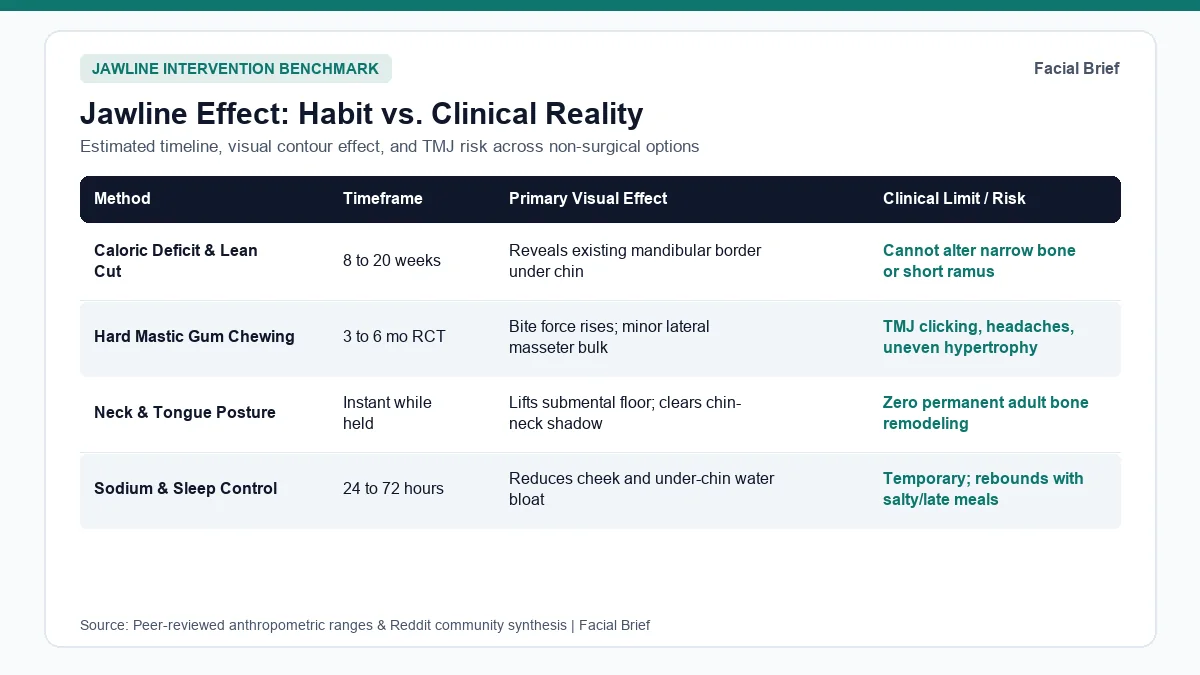
The table below compares non-surgical routines and clinical interventions across the exact anatomical layer each option reaches, along with typical timeframes and trade-offs.
| Approach | Target Layer | Realistic Timeline | Typical Cost | Primary Limits & Risks |
|---|---|---|---|---|
| Lean Body Fat Cut | Submental & cheek fat | 8 to 20 weeks | $0 | Cannot add bone width or lengthen short chin |
| Neck & Tongue Posture | Suprahyoid sling & neck | Instant while held | $0 | Relapses without habit; no adult bone shift |
| Sodium & Hydration Control | Interstitial water bloat | 24 to 72 hours | $0 | Temporary; rebounds after salty meals or alcohol |
| Hard Mastic Gum Chewing | Masseter muscle & bite force | 3 to 6+ months | $15 to $40 | Unproven hypertrophy in RCTs; TMJ click & asymmetry |
| Beard & Hairline Framing | Visual light & shadow contour | 1 to 4 weeks | $0 to $50 | Visual framing only; resets when shaved |
| Occlusal Guard / Botox | Hyperactive masseter clench | 6 to 16 weeks | $400 to $900/tx | Temporary (4 to 6 mo); can soften jowl support |
Checking how your lower face relates to midface width and upper-third balance stops you from over-correcting one area out of proportion. You can inspect all seven facial zones together inside Facial Brief's 42-Metric Full Report, or preview the layout on our sample Face Report page before testing any styling change.
Frequently Asked Questions
How long does mastic gum take to strengthen masseter muscle visibly?
Controlled clinical data suggests longer and smaller gains than viral posts claim. In a 6-month randomized trial of daily gum training, bite strength rose by month 3, while measurable masseter muscle thickness did not differ significantly from controls. Noticeable visual hypertrophy usually requires heavy multi-year clenching or chewing and often makes the lower face look wider or puffier rather than cleanly angular.
Why does one side of my jaw look bigger when I try to strengthen jawline?
Most people chew food and gum instinctively on one dominant molar side, creating unilateral masseter growth and mild jaw soreness on the overworked side. Sleeping consistently on one cheek and resting your chin on one hand at a desk reinforce that asymmetry over months. Balancing chewing evenly across both sides and stopping hard gum entirely usually lets the thicker muscle settle back gradually.
Can tongue posture or neck exercises fix a weak jawline permanently?
No. Once adolescent cranial and mandibular sutures fuse completely, resting your tongue lightly against the palate and correcting forward head posture cannot reshape or move ossified jawbone forward. Those habits still sharpen how your lower face reads immediately in side lighting because palatal suction elevates the under-chin muscles while upright ear-over-shoulder alignment smooths loose submental skin along the neck border.
How do I tell if a broader jaw comes from muscle, fat, or bone?
Clench your back molars lightly in front of a mirror while pressing two fingertips against the rear corners of your jaw. If a firm oval cushion bulges strongly outward under your fingers when biting, masseter thickness contributes to your width. Soft tissue that stays pinchable while relaxed points toward subcutaneous fat or water retention, while hard motionless contours belong to underlying bone.
Referenced Community Discussions & Sources
- r/selfimprovement: Realistic steps for getting a sharper jawline: Community consensus prioritizing overall body-fat loss, hydration, and neck posture ahead of gimmicks.
- r/trueratediscussions: How people try to increase masseter muscle size: Weighs heavy chewing hypertrophy claims against fixed bone limits and square-face trade-offs.
- r/Mewing: Advice for evening out asymmetrical masseter size: Documents how single-side chewing triggers noticeable lower-jaw imbalance.
- r/orthotropics: Fixing one-sided jawline bulk from uneven chewing: Practical user reports on breaking dominant chewing and desk-leaning habits.
- r/TMJ: Non-Botox ways to calm enlarged masseters and jaw tension: Reviews night guards, clench awareness, and stopping hard foods to relieve joint stress.
- r/PlasticSurgery: Assessing whether a weak jawline is fat, muscle, or bone: Breaks down body composition versus skeletal projection before surgical consultations.
- r/PlasticSurgery: Reducing a wide lower jaw from masseter hypertrophy: Discusses masseter botulinum toxin dosing trade-offs versus natural bone shape.
- r/malegrooming: Grooming and beard geometry tips for balancing jaw width: Covers strategic stubble tapering and neckline placement for sharper framing.
- Clinical References: Jung et al. (2024), Journal of Oral Rehabilitation 6-month randomized trial on gum-chewing training, bite force, and masseter muscle thickness; standard cephalometric mandibular angle norms (119 to 126 degrees).
Paired Facial Brief Analyzer
Measure your own proportions on-device
Run private 478-point landmark geometry in your browser with zero server photo upload on free tools.
Continue Reading