Gonial Angle Explained: Ideal Degrees, Gonions & Limits
Explore ideal gonial angle norms (119-126 deg), what gonions look like from underneath, high-angle causes, and our habit vs. clinical comparison table.
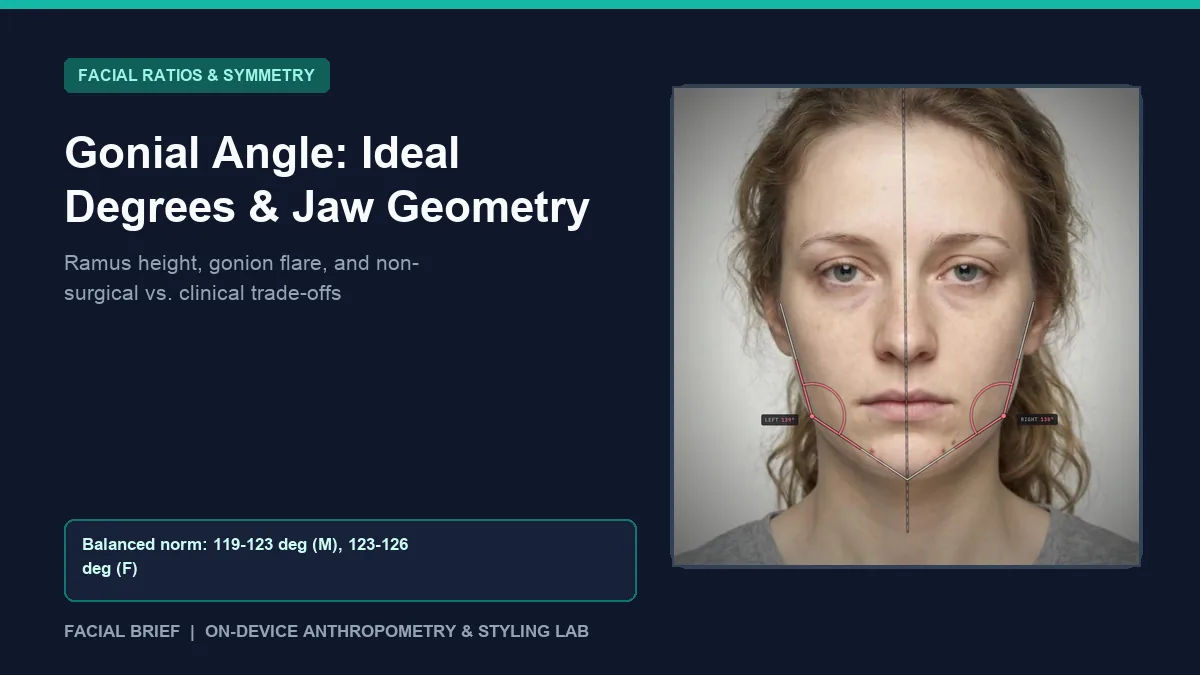
The gonial angle is the bony corner at the back of your lower jaw where the vertical mandibular branch (the ramus) turns forward into the horizontal lower jaw border (the mandibular body). In orthodontics, craniofacial anthropometry, and online jawline forums, that single bend dictates whether a lower face looks squared and horizontally supported or steeply sloped toward the neck.
A degree number alone still misleads people out of context. A jaw corner can look crisp from the side yet narrow from underneath, or read soft purely because neck posture and body fat obscure the bone border. You can estimate your lower-third outline and jaw-to-cheek taper on a straight front image using Check Jawline Score, then check lateral geometry in the Side Profile Analyzer.
Key Takeaways
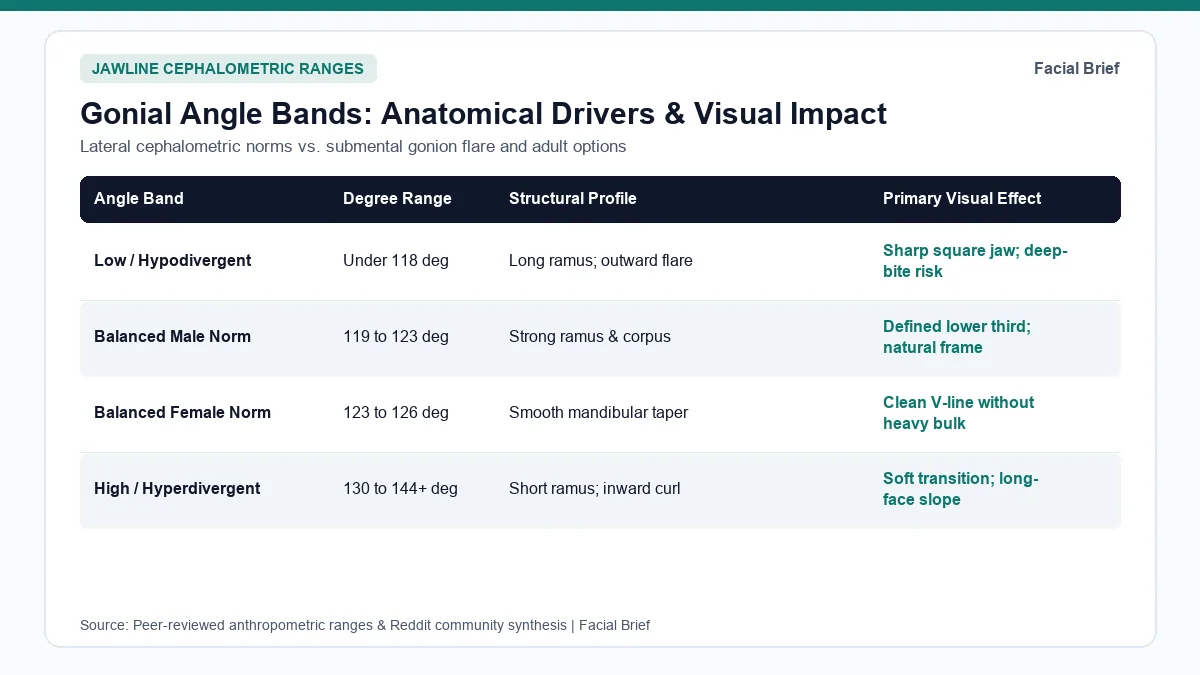
- Cephalometric norms place balanced adult gonial angles between 118 and 132 degrees overall, averaging roughly 119 to 123 degrees in men and 123 to 126 degrees in women.
- Angles under 115 degrees reflect hypodivergent (horizontal, square) jaw growth often paired with heavy bite forces, whereas a high gonial angle above 130 degrees reflects hyperdivergent (vertical, steeper) growth.
- True gonion appearance depends heavily on ramus height and outward lateral flaring viewed from underneath, not degrees alone.
- Adult skeletal bone angles do not remodel from mewing or hard gum chewing; those habits shift submental posture and masseter muscle thickness rather than ossified bone.
- Clinical jawline filler ($600 to $1,500 per session) migrates readily through moving soft tissue across repeat touch-ups, while custom screw-fixed PEEK implants or jaw surgery carry high costs and surgical risks.
What Are Gonions and How Gonial Angle Is Measured
To answer what are gonions directly, place your fingers just below your earlobes and slide slightly forward to the rear corners of your jawbone. Each corner point is a gonion. Clinicians measure this jaw angle on a lateral cephalometric X-ray by intersecting two lines: the ramus line along the posterior edge of the vertical mandible, and the mandibular line along the lower border toward the chin (menton or gnathion).
Because phone cameras cannot see through soft tissue, 2D front landmark analyzers (including Facial Brief's front tool) estimate gonial openness across a 118 to 132 degree reference range from jaw-to-cheekbone taper, whereas profile images trace the visible mandibular border slope directly. Soft-tissue padding, beard shadow, and head pitch shift a casual selfie facial angle reading by 5 to 10 degrees. Align your ear canal horizontally with your lower orbital rim (the Frankfort plane) five feet from a 2x lens before judging jaw outline.
Ideal Gonial Angle Ranges for Men vs. Women
Polls on r/QOVESStudio male angle threads and r/Vindicta female jaw analyses often praise extreme 95-degree corners that sit outside healthy orthodontic norms. Real anthropometric averages favor moderation. Men typically average 119 to 123 degrees, creating a clean lateral break paired with vertical ramus height without turning overly blocky from the front or crowding a deep dental overbite. Women typically average 123 to 126 degrees, preserving a smooth oval or heart-shaped taper toward the chin without heavy rear-jaw squareness.
Comparing cheekbone projection in our better cheekbones guide and proportion harmony in our face analysis study explains why identical jaw degrees look balanced on wide cheekbones and heavy on narrow midfaces.
High Gonial Angle vs. Good and Bad Gonions from Underneath
One key anatomical insight across r/jawsurgery and r/QOVESStudio focuses on the submental perspective: good vs bad gonions from underneath. Two adults can show the same 124-degree corner on a flat side view yet look completely different from below.
Ramus Height and Outward vs. Inward Gonion Flare
When someone shows balanced gonions from underneath, three traits line up together:
- A long vertical ramus drops cleanly below the earlobe, setting the jaw corner closer to the mouth plane instead of tucked high behind the cheek.
- Looking upward from beneath the chin, the rear jaw corners flare slightly outward past the neck muscles, forming a crisp shadow frame.
- The lower jaw border runs firmly forward toward a supported chin without curving steeply upward.
By contrast, a high gonial angle (130 to 144+ degrees) or inward-beveled gonions appear clearly in r/jawsurgery discussions on jaw width from below. Instead of flaring laterally, the rear jaw angles curl inward toward the throat, and the vertical ramus sits short near the ear. From underneath, the jawline loses its outer corner shelf and slopes upward into the neck, trapping submental shadow even at low body fat.
Why High Gonial Angles Develop
Orthodontic studies tie high-angle hyperdivergent morphology to genetics alongside childhood airway patterns. Chronic mouth breathing, nasal allergies, and low resting tongue posture during active pediatric growth correlate statistically with downward backward jaw rotation, steeper occlusal planes, taller lower-third face height, and open-bite tendencies. Once skeletal growth finishes in late adolescence, that bony angle stays fixed.
Can Exercises, Mewing, or Weight Loss Change Your Gonial Angle?
Searching for an ideal gonial angle often leads to home drills promising bone shifts. Knowing what moves soft tissue versus what cannot alter ossified bone saves time and prevents joint pain.
What Adult Habits Shift vs. Bone Limits
As reviewed in our mewing results analysis and r/orthotropics debates on gonial angle, clinical orthodontics finds zero randomized evidence that resting tongue posture bends adult jawbone. Holding light palatal suction lifts the suprahyoid muscles under the chin right away, sharpening submental shadow while active, yet underlying bone stays stationary.
Chewing tough mastic gum builds masseter muscle bulk over the gonion. Bigger masseters widen the front jaw outline, yet heavy chewing risks TMJ clicking, tooth wear, and puffy muscle volume without lowering a high bony corner.
Non-Surgical Framing That Sharpens Existing Angles
For adults, revealing existing bone definition outperforms chasing skeletal change. Dropping excess body fat and limiting late-night sodium bloating trims soft tissue along the lower border so existing bone catches directional light cleanly. Men with softer or high-set jaw corners can shape beard density slightly fuller toward the rear corner and fade cleanly one finger-width above the Adam's apple rather than shaving high onto the cheek border. Aligning ears over shoulders pulls forward head posture back and stretches submental skin smoothly.
More practical grooming details sit in our improve jawline guide, and testing lower-third taper inside the Facial Ratios Calculator keeps changes proportional to midface width.
Non-Surgical Framing vs. Fillers, Implants, and Jaw Surgery
When grooming reaches anatomical limits, Reddit threads weigh injectables against surgical implants and orthognathic jaw rotation.
| Approach | Mechanism | Typical US Cost | Longevity & Visual Realism | Primary Limitations & Risks |
|---|---|---|---|---|
| Body Fat & Grooming | Reveals existing border; beard/hair shadow framing | $0 to $50 grooming | Permanent while habits hold; natural motion | Cannot lengthen short ramus or lower steep bone |
| Masseter Hypertrophy | Hard chewing thickens overlying jaw muscle | $0 to $30 gum | Fades if stopped; widens front view mainly | TMJ clicking, tooth wear, round bulge over bone |
| Hyaluronic / CaHA Filler | Soft-tissue injection placed over periosteum | $600 to $1,500/yr | 9 to 18 months; smooths mild soft curves | Migration puffiness, blunted corners, dissolving cost |
| Custom PEEK Implants | 3D CT-milled hardware screwed directly to bone | $8,000 to $18,000+ | Permanent hard-tissue corner & lateral flare | Infection, removal surgery, masseter step-off, nerve risk |
| Orthognathic Surgery | BSSO/LeFort with counter-clockwise rotation | $20,000 to $50,000+ | Permanent skeletal + airway realignment | Months-long recovery, relapse risk, nerve numbness |
Why Filler Migration vs. Custom Implants Dominates Reddit Threads
Patients in this long-term jawline filler review point out a recurring problem with dermal filler placed over the gonion. Because the masseter contracts forcefully thousands of times daily, gel migrates gradually into surrounding cheeks or jowls across yearly refills, blurring the corner edge and pushing patients toward hyaluronidase dissolving.
On the surgical side, r/PlasticSurgery custom PEEK implant reviews and r/jawsurgery rotation discussions explain why screw-fixed 3D PEEK implants avoid shifting compared to loose silicone blocks, yet still risk infection or awkward masseter draping during smiles. When a high angle pairs with bite misalignment or airway narrowing, board-certified maxillofacial surgeons assess functional orthognathic jaw surgery rather than cosmetic surface implants alone.
To see how jaw angle works alongside facial symmetry and midface width before consulting any specialist, Facial Brief's 42-Metric Full Report organizes seven regions into one benchmark, previewed on our sample Face Report page.
Frequently Asked Questions
What is the ideal gonial angle for men and women?
Cephalometric averages for balanced adult faces cluster around 119 to 123 degrees in men and 123 to 126 degrees in women, sitting inside a broader normal clinical window between 118 and 132 degrees. Angles below 115 degrees look notably square and hypodivergent, while angles past 132 degrees slope more steeply downward toward the neck in a leveled side profile view.
Can you lower a high gonial angle naturally with mewing or chewing?
No. Once adolescent mandibular growth closes, voluntary tongue posture and hard gum chewing cannot lengthen a short vertical ramus or rotate adult jawbone downward. Pulling your head straight back over your shoulders and holding light palatal suction tighten soft tissue beneath the chin right away, while lowering overall body fat reveals the exact mandibular bone border already sitting cleanly underneath.
Why do my gonions look good from the side but weak from underneath?
A flat side profile displays the vertical bend between ramus and jaw body, whereas viewing from underneath shows lateral width and bone flare. If your gonions angle inward toward your neck muscles instead of flaring subtly outward, or if your ramus sits short high near the ear, your submental outline appears narrow and softly tapered despite a decent side shadow.
Does jawline filler at the gonial angle stay sharp permanently?
No. Temporary hyaluronic acid or calcium hydroxylapatite fillers last roughly 9 to 18 months depending on gel stiffness, placement depth, and individual metabolism. Because everyday masseter chewing motion constantly compresses soft tissue over the jaw corner, repeated touch-ups often migrate forward or upward into the jowl plane, creating soft lower-cheek puffiness that requires enzymatic dissolving before placing any fresh filler.
Referenced Community Discussions & Sources
- r/QOVESStudio: Most attractive gonial angle benchmarks in men: Examines why extreme 90-degree corners look excessive compared to balanced 118 to 124 degree proportions.
- r/Vindicta: Female gonial angle balance and lower-third taper: Explains why 120 to 128 degree soft corners pair harmoniously with feminine facial proportions.
- r/QOVESStudio: Evaluating gonion visibility and ramus height in men: Points out why vertical ramus drop changes jaw framing alongside raw degrees.
- r/jawsurgery: Jaw angles, inward vs. outward gonions, and submental width: Breaks down how outward-flaring versus inward-beveled gonions read from underneath.
- r/jawsurgery: Can orthognathic jaw surgery sharpen a high gonial angle?: Reviews counter-clockwise mandibular rotation versus functional bite priorities.
- r/orthotropics: Debates over altering gonial angle after adolescence: Weighs soft-tissue posture shifts against fixed adult bone limits.
- r/PlasticSurgery: Long-term maintenance and migration of gonial jawline filler: Real patient breakdown of filler migration, puffiness, and dissolving cycles.
- r/PlasticSurgery: Custom PEEK jaw implant review and fixation trade-offs: Covers titanium screw fixation, masseter adaptation, and recovery realities.
- Clinical References: Standard orthodontic cephalometric reference intervals (Steiner, Ricketts, and Jarabak norms for Ar-Go-Me mandibular angle ~120 to 126 degrees +/- 6 degrees) and sexual dimorphism craniofacial studies.
Paired Facial Brief Analyzer
Measure your own proportions on-device
Run private 478-point landmark geometry in your browser with zero server photo upload on free tools.
Continue Reading