Negative Canthal Tilt: Normal Degrees, Causes & Framing
See how negative canthal tilt compares with neutral and positive eye angles in degrees, what orbital anatomy drives it, and styling vs. surgical risks.
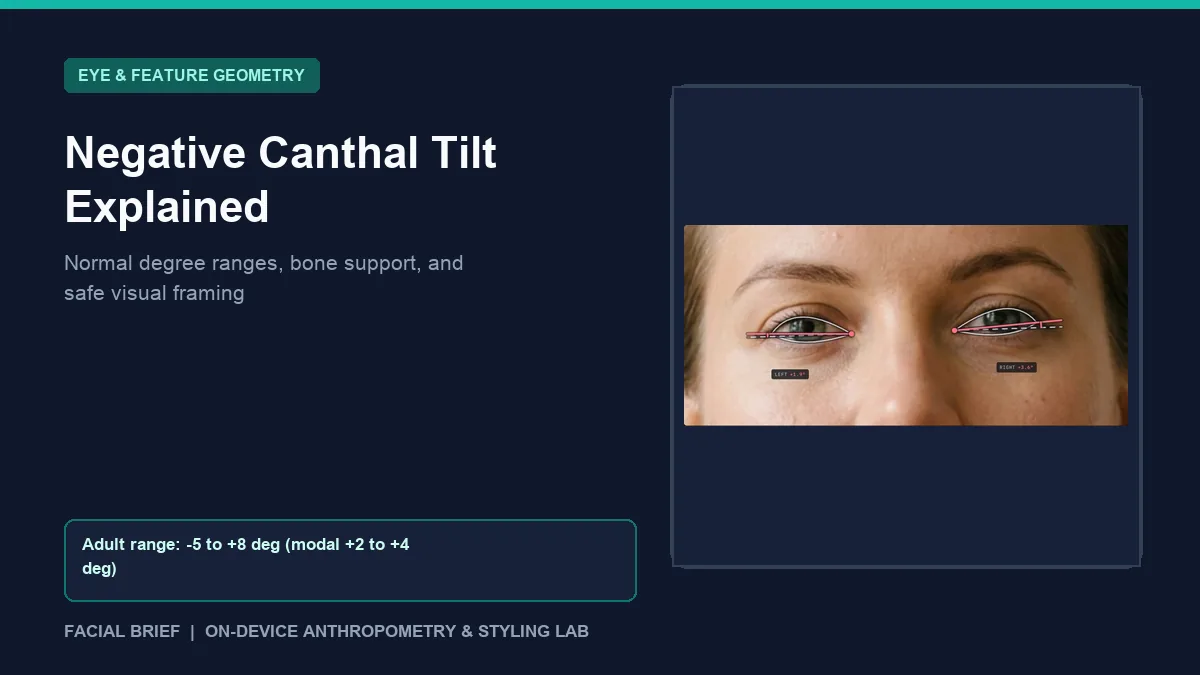
Negative canthal tilt means the outer corner of the eye (the lateral canthus) sits lower than the inner corner near the nose (the medial canthus), creating a gentle downward slope along the eye opening. Looksmaxxing forums often treat any downward eye angle as a severe flaw, yet craniofacial studies and mainstream discussions on Reddit show that mild negative or level angles sit squarely inside everyday human variation and appear on many conventionally attractive faces.
Before deciding your eyes slope downward from one casual selfie, lens perspective, camera height, and subtle head roll need to be accounted for. You can Measure Canthal Tilt in seconds with Facial Brief's browser-based landmark detector, which levels eye-corner coordinates against your horizontal pupil axis.
Key Takeaways
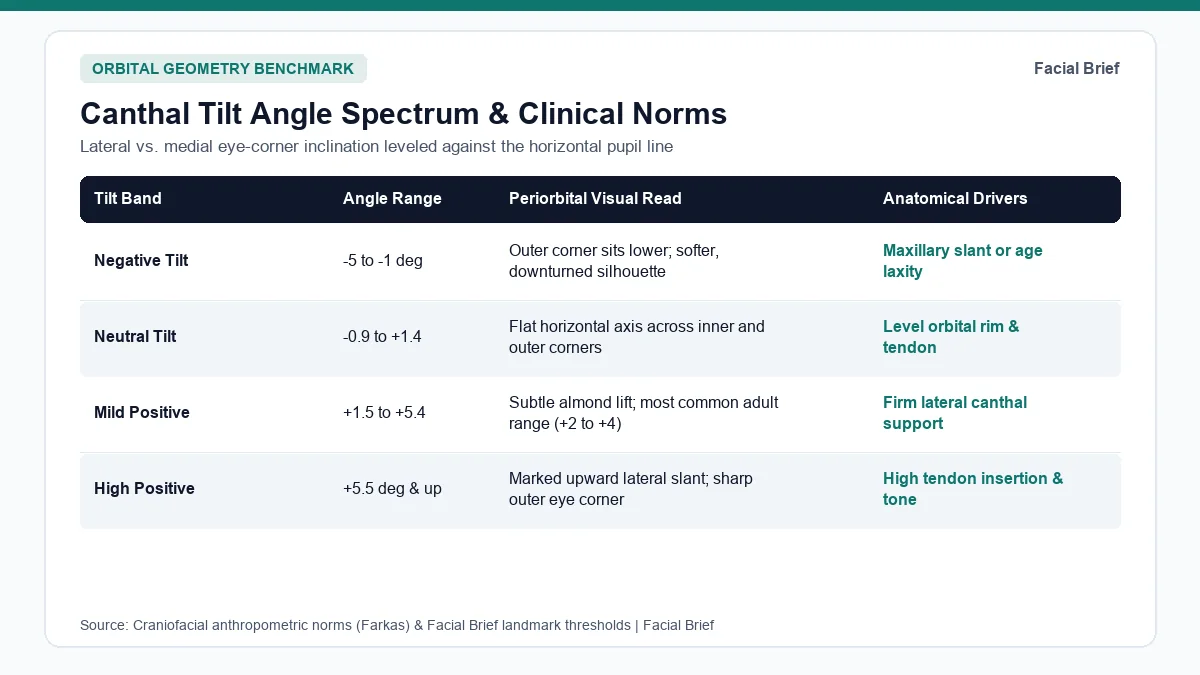
- Clinical craniofacial studies place normal healthy adult canthal tilt across -5 degrees to +8 degrees, with most adults clustering between +1 degree and +5 degrees.
- Facial Brief tags -1.0 degree or lower as downturned (negative), -0.9 to +1.4 degrees as neutral, and +1.5 degrees or higher as positive, while treating 1 to 2 mm of left-right asymmetry as routine.
- Orbital bone projection, maxillary support, and lateral canthal tendon attachment fix adult tilt; tongue posture, squinting drills, and face yoga cannot move bone-anchored tendons.
- Brow tail alignment, outer-third lash curling, upswept eyeliner wings, and corrective eyeglass frames reliably add 2 to 3 degrees of upward visual lift with zero downtime.
- Surgical procedures such as lateral canthopexy ($2,000 to $4,000 estimate) and lateral canthoplasty ($3,500 to $6,500+ in the US) carry concrete risks including scleral show, dry eye, and corner rounding.
What Is Canthal Tilt and How Degrees Are Measured
Facial anthropologists, led by craniofacial researcher Dr. Leslie Farkas, measure canthal tilt (often mistyped in searches as cathal tilt or cantal tilt) as palpebral fissure inclination. To answer what is canthal tilt accurately, trace a straight line between the endocanthion (inner corner) and the exocanthion (outer corner), then measure that angle against a true horizontal baseline across the pupils or Frankfort horizontal plane.
Three reference bands classify eye-corner alignment:
- Negative tilt falls at -1.0 degree or lower, placing the lateral canthus visibly below the horizontal axis of the inner corner.
- A neutral canthal tilt sits between -0.9 and +1.4 degrees (centered around 0 degrees), giving the eye opening a calm, level horizontal line.
- Positive tilt starts at +1.5 degrees and climbs upward, creating an almond lift that becomes sharply upturned at +5.5 degrees and higher.
Camera setup constantly fools 2D measurements. Dropping your chin toward a phone while glancing upward lowers outer corners on screen, whereas a 3-degree head tilt makes one eye read neutral and the opposite eye read negative. Checking leveled pupil geometry alongside overall eyelid opening in our Eye Shape Analyzer gives an honest baseline.
Skeletal Causes, Aging, and Why Forums Overreact
Across threads on r/orthotropics asking what causes negative canthal tilt, users correctly link eye slant to bony architecture and deep connective tissue. Three anatomical factors set your angle:
First is orbital rim and maxillary support. The lateral canthal tendon anchors directly into Whitnall's tubercle inside the lateral orbital bone. When the cheekbone and maxilla sit lower or flatter relative to the eye globe (known clinically as a negative orbital vector), the lower lid lacks forward bony support and slopes gently downward.
Second is age-related soft-tissue laxity. Someone born with a flat neutral tilt or mild positive slope gradually loses elastin and collagen in the periorbital fascia over decades. As the lateral canthal tendon loosens slowly, the outer corner settles downward toward a mild negative reading.
Third is normal congenital variation. Multi-ethnic craniofacial surveys show healthy adults spanning several degrees above and below zero, with routine 1 to 2 mm differences between left and right sides.
Online looksmaxxing spaces turn a mild variation into panic by treating sharp upturned "hunter eyes" as the sole attractive shape. Yet a r/VindictaRateCelebs thread on downturned eyes and a parallel r/NoStupidQuestions discussion show how differently everyday observers respond. Commenters point to widely admired figures like Anne Hathaway, Marilyn Monroe, and leading male actors whose mild negative or neutral tilt reads expressive, warm, and approachable alongside balanced facial thirds. Framing traits around eye openness in our hooded eyes guide and lower-face proportion in our lip shapes guide explains why one angle never defines an entire face.
Non-Surgical Eye Framing vs. Canthoplasty: Comparing Options
Once users measure a true downward angle on a leveled portrait, discussions on r/lookyourbest and r/PlasticSurgery ask which methods work versus which waste time or risk complications.
| Approach | Mechanism | Effort & Typical Cost | Effect & Longevity | Limits & Risks |
|---|---|---|---|---|
| Brow & Tail Grooming | Lifts outer brow diagonal vector above outer corner | 5 minutes grooming; $0-$25 | Shifts upper-third balance immediately | Over-plucking outer brow thins framing |
| Lash Curl & Liner Wing | Angles outer lashes and thin wing upward at 15-20 deg | 3 minutes daily; makeup basics | Adds 2 to 3 deg visual lift | Daily removal; lower-lid smudging deepens droop |
| Upswept Eyewear Frames | Browline, clubmaster, or mild cat-eye upper rims | Frame choice; $40-$250 | Instant horizontal/upward re-frame | Round wire rims echo downward slant |
| Dermatologist Skincare | Daily SPF 30+, gentle eye-safe retinoids, sleep | Daily routine; $20-$80 | Protects periorbital collagen and tone | Cannot change bone or tendon attachment |
| Lateral Canthopexy (Clinical) | Internal suture tightens intact tendon without cutting | Clinical consult; ~$2,000-$4,000 US | Subtle support; 7-10 day initial healing | Limited elevation for structural negative tilt |
| Lateral Canthoplasty (Clinical) | Detaches, shortens, and re-anchors tendon to bone | Oculoplastic surgery; ~$3,500-$6,500+ US | Permanent structural change; 3-6 mo settling | Dry eye, scleral show, asymmetry, corner rounding |
| Mewing / Face Yoga / Squinting | Tongue posture or muscle-flexing routines | Unproven drills; $0 | Zero adult tendon or bone change | Repeated squinting deepens lateral creases |
Evidence Limits of Exercises, Gua Sha, and Mewing
No adult facial exercise, gua sha stone, or tongue posture routine can lift a negative canthal tilt. The lateral canthal tendon inserts tightly into periosteum and bone, meaning skeletal anatomy remains fixed after facial growth finishes. Squinting the lower lid temporarily narrows the eye opening for photos, then snaps back the instant muscles relax. Gentle cold rollers and consistent sleep do clear morning fluid puffiness around the lower lid, making eyes look brighter without shifting the canthus itself.
Practical Non-Surgical Framing
Optical framing works because surrounding lines guide how observers read eye slant.
First, shape the outer eyebrow tail cleanly. Long downward-hooking brow tails extend past the outer eye corner and mirror the downward line directly overhead. Trimming stray tail hairs that drop lower than the inner brow head and setting a subtle arch peak lifts visual energy upward. Our eyebrow shape guide outlines balanced brow proportions.
Second, protect under-eye skin quality and use targeted lash direction. Dark shadowing beneath the outer eye creates the look of extra droop even on a level eye. Dermatologist-standard habits, including daily broad-spectrum SPF 30+ around the orbital rim, gentle peptides or low-strength eye retinoids, and reliable sleep, help slow collagen loss in thin eyelid skin. For makeup users, avoiding dark liner along the outer lower lid and drawing a slim upper wing at a 15 to 20 degree upward angle shifts perceived tilt roughly 2 to 3 degrees. Curling outer-third upper lashes creates a lighter, pigment-free lift.
Third, choose eyewear wisely. Firm top-bar frames like Wayfarers, browlines, or softly angled rectangles reset the upper horizontal line around your eyes, whereas thin circular frames echo downward outer corners. You can map how eye inclination fits with brow spacing, facial thirds, and color palette inside Facial Brief's 42-Metric Full Report.
Clinical Perspective on Canthoplasty and Canthopexy
When people investigate canthoplasty for negative canthal tilt on r/PlasticSurgery, most emphasize they want a quiet 0-degree neutral alignment without an exaggerated cat-eye look. Clinical outcomes explain why surgeons approach cosmetic elevation carefully.
Lateral canthopexy threads internal sutures to reinforce the intact tendon, healing initially in 7 to 10 days and working mainly to prevent lower-lid drooping during blepharoplasty. Lateral canthoplasty cuts, shortens, and re-anchors the tendon directly onto the orbital rim. Initial stitches dissolve or come out in 10 to 14 days, yet tight corner pulling often lasts 4 to 6 weeks, and tissues take 3 to 6 months to relax into their final contour, as patients document in 6-month post-op updates.
In surgical feedback threads, patients warn about rounded or blunted outer eye corners, webbing scars, chronic dry eyes, left-right asymmetry, and lower-lid retraction showing white sclera below the iris. If cheekbone support sits behind the eye globe, pulling a lid upward without bony support can pull the lid margin under the curve of the eye. Any functional or surgical evaluation belongs strictly with a board-certified oculoplastic specialist after an in-person snap-back laxity test.
Frequently Asked Questions
Is a negative canthal tilt unattractive?
No single angle decides facial attractiveness on its own. Mild negative tilts between -1 and -3 degrees appear on many widely admired actors and everyday people, often conveying warmth, softness, or an approachable gaze. Strong cheekbones, neat eyebrow arches, clear under-eye skin, and balanced lower-face proportions influence first impressions far more than minor downward slope at the outer corner when evaluated together in person.
Can exercises, mewing, or face yoga fix negative canthal tilt?
No. Adult eye inclination is anchored by where the lateral canthal tendon attaches inside the bony orbital rim, and exercises, facial massage, or tongue posture cannot move bone or shorten tendons. Gentle morning lymphatic massage, hydration, and steady sleep reduce lower-eyelid fluid retention so eyes look fresher and less tired, yet the underlying corner geometry returns identically once facial muscles rest.
What is the difference between canthopexy and canthoplasty for negative canthal tilt?
Canthopexy places internal sutures to tighten and stabilize the existing lateral canthal tendon without cutting it, offering lighter support suited to mild laxity with 7 to 10 days of initial recovery. Lateral canthoplasty surgically detaches, shortens, and re-anchors the tendon higher on the orbital rim for larger structural shifts, carrying 3 to 6 months of tissue settling and higher complication risks.
Why does my canthal tilt look different in selfies than in the mirror?
Small head pitch, sideways roll, and close-up phone perspective shift how eye corners project onto a flat screen. Dropping your chin while looking upward lowers outer corners, while tilting your head 3 degrees sideways makes one eye appear downturned. Shooting straight-on at eye level from 5 to 6 feet away with a 2x lens aligns camera geometry closely with what mirrors show.
Referenced Community Discussions & Sources
- r/PlasticSurgery: Seeking a neutral 0-degree result without an extreme fox-eye look: Discusses realistic anatomical limits and conservative alignment goals for pronounced negative tilt.
- r/PlasticSurgery: Can anything non-surgical turn negative tilt into neutral?: Confirms orbital bone and tendon attachment rule out exercise-based elevation.
- r/PlasticSurgery: Feedback on surgical risks and specialist selection: Covers oculoplastic specialization and risks of asymmetry, corner rounding, and dry eye.
- r/PlasticSurgery: 6-month lateral canthoplasty recovery timeline: Patient experience detailing prolonged corner tightness and gradual settling.
- r/VindictaRateCelebs: Why downturned eyes remain appealing on many faces: Contrasts looksmaxxing stigma against mainstream celebrity examples.
- r/orthotropics: Discussion on skeletal drivers behind negative canthal tilt: Examines maxillary support, orbital rim geometry, and natural variation.
- Clinical anthropometry reference: Periorbital inclination standards based on Farkas craniofacial surface landmarks (endocanthion to exocanthion against leveled horizontal axes) and oculoplastic surgical reviews.
Paired Facial Brief Analyzer
Measure your own proportions on-device
Run private 478-point landmark geometry in your browser with zero server photo upload on free tools.
Continue Reading