Best Sunglasses for Your Face Shape: Fit & Frame Guide
Choose the best sunglasses for your face shape using 125-145 mm hinge width, bridge clearance rules, and a frame comparison table by bone structure.
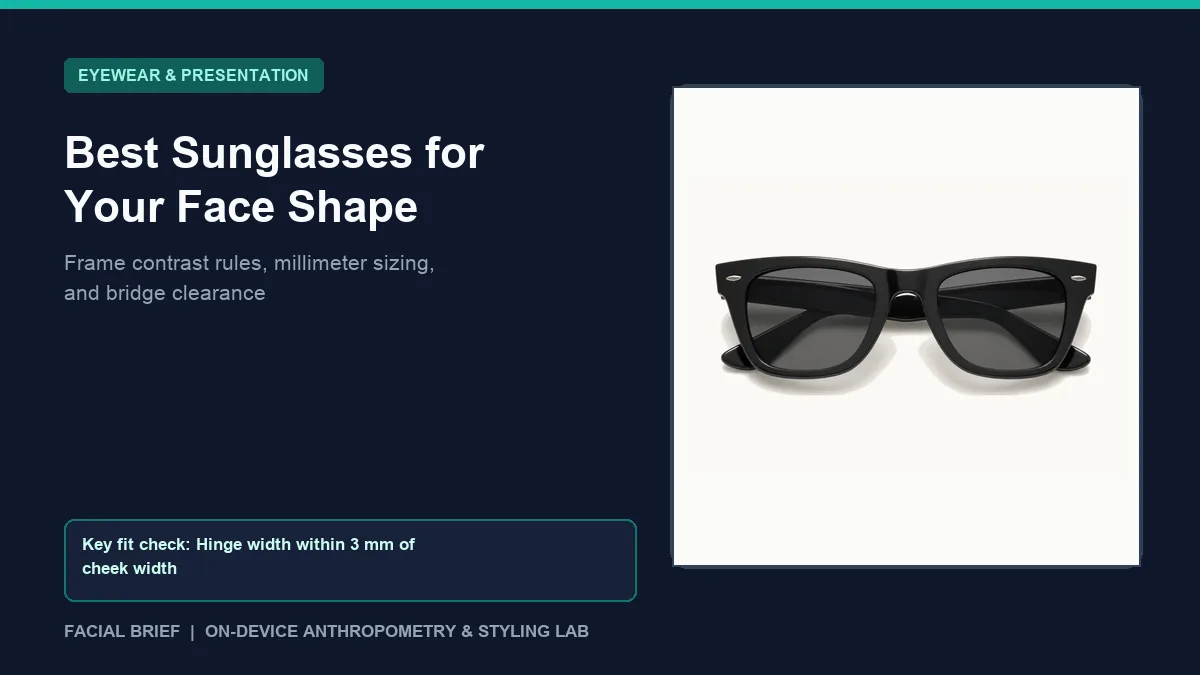
Finding the best sunglasses for your face shape starts with geometric contrast, yet almost every frustrated buyer on Reddit hits the same trap: a shape chart cannot tell you whether frames will slide down your nose, press into your cheekbones, or bow outward past your temples. Opticians and longtime eyewear collectors weigh three physical specs above style labels: hinge-to-hinge width, nasal bridge clearance, and vertical lens height relative to your brow line.
Before browsing silhouettes online, establish objective width and length ratios from a leveled front portrait. You can Detect Your Face Shape in seconds using Facial Brief's landmark mapper, which separates jaw taper from cheek width without mirror bias.
Key Takeaways
- Geometric contrast balances facial traits: curved silhouettes soften square jaws, whereas rectangular and trapezoidal frames add definition to round cheeks.
- Frame width drives fit and comfort: total hinge-to-hinge measurement should sit within 3 mm of your bizygomatic cheek width (narrow under 128 mm, medium 129 to 133 mm, wide 134 mm and up).
- Every eyewear arm carries a three-number millimeter stamp like 52-18-140 (lens width, bridge width, temple length) that lets you duplicate a well-fitting pair online.
- High cheekbones or low nasal bridges frequently make fixed acetate frames hit the cheeks during a smile; adjustable silicone nose pads or Low Bridge Fit models create clean clearance.
- Top rims should follow or sit neatly beneath your eyebrow arch without covering your eyebrows completely or slipping down your nose.
Why Millimeter Specs Beat Face-Shape Charts Alone
Most online guides reduce matching sunglasses to face shape to cartoon outlines, assuming all heads share one width. Anyone scrolling through r/malefashionadvice threads on buying sunglasses online knows the disappointment of unboxing a recommended silhouette only to see the temple arms flare outward or the frame shrink against a broad forehead.
Decoding Lens Width, Bridge Span, and Hinge-to-Hinge Fit
Check the inside of the left temple arm on any comfortable pair of sunglasses for three stamped numbers, such as 52-18-140 or 55-17-145. The first number gives single-lens width (44 to 62 mm). The second gives nasal bridge width between the lenses (14 to 24 mm). The third gives temple arm length from hinge to ear tip (135 to 150 mm).
Brands often omit the spec optical fitters check first: total hinge-to-hinge front width. A 52 mm lens set in thick beveled acetate can span 138 mm across, while a thin wire 52 mm frame might measure only 129 mm. As optical staff explain in this r/sunglasses retail fitter breakdown, frames narrower than your outer cheekbones pull the arms outward under tension, pinching behind your ears and distorting the lens plane. Excessively wide frames admit side glare and pull focus away from your eyes.
Measure a favorite pair straight across from left screw hinge to right screw hinge in millimeters. Narrow faces typically need 120 to 128 mm, medium faces fit 129 to 133 mm, and wide faces need 134 to 144 mm. Once you map your millimeter span and proportions inside Facial Brief's Custom Style Studio, online browsing becomes predictable. You can also test how camera lens flattening alters facial width perception using our true mirror setup guide.
Solving the Cheek-Hit and Low-Bridge Slide Problem
Even when hinge width fits your temples, vertical placement breaks down if bridge shape clashes with your nose and cheeks. Two complaints dominate r/femalefashionadvice advice from optical technicians and narrow-face sizing threads: bottom rims resting on the cheeks whenever you smile, and heavy acetate sliding steadily down the nose.
Molded acetate bridges sit low and assume a high nasal bridge will carry frame weight. On a flatter nasal bridge or high-set cheekbones, standard plastic drops until the lower rim touches the midface, transferring sunscreen and skin oil onto the lenses. Three mechanical adjustments prevent this:
- Metal or mixed-material frames fitted with adjustable silicone nose pads lift the bridge 3 to 5 mm and angle the bottom edge away from your cheeks.
- Low Bridge Fit (also sold as Alternative Fit or Global Fit) acetate frames mold thicker nasal pads, reduce front lens tilt, and curve the temples gently around the head.
- Limiting vertical lens height to 36 to 41 mm (avoiding 50+ mm shields) leaves breathing room above prominent malar bone.
Brow alignment offers a quick mirror check. Fitters generally place the top rim right along or just beneath your natural brow line so the eyebrows anchor the frame visually without getting swallowed or floating awkwardly far above thin lenses.
Matching Sunglasses to Different Face Shapes by Contrast
Once width and bridge clearance work mechanically, choosing sunglasses for different face shapes follows the contrast rule discussed across r/malefashionadvice frame matching threads: introduce lines that oppose your dominant facial geometry.
Round Faces: Adding Crisp Lines and Angles
Round faces pair full cheeks and a curved chin with facial length roughly equal to cheek width. Circular wire rims echo that softness. Rectangular acetate frames, Wayfarer silhouettes, and crisp geometric corners introduce flat upper lines and structure. Slightly upswept outer upper corners or keyhole bridges draw attention upward, provided hinge width matches your outer cheek boundary.
Square and Angular Faces: Softening Sharp Jawlines
Selecting glasses for angular face structures means balancing broad foreheads, prominent cheekbones, and squared jaw corners. Blocky thick rectangles double down on sharp angles. Oval shapes, teardrop aviators, panto rounds, and thin curved metal frames calm mandibular corners cleanly. Our square-face sunglasses guide examines bridge weight and brow-bar curves for wider jaws.
Heart and Diamond Faces: Balancing Upper Width
Heart-shaped faces combine a broad forehead and high cheekbones with a slender, tapered chin. Heavy browlines and oversized butterfly rims stack unwanted weight onto the upper third. Classic aviators, rimless styles, slim rounds, and bottom-curved Wayfarers draw visual balance downward toward the midface. For diamond faces with wide cheekbones and narrower foreheads and chins, ovals and gentle cat-eyes soften lateral corners without protruding past the temples, as detailed in our heart-face eyewear guide.
Oval and Oblong Faces: Managing Vertical Proportions
Oval faces hold balanced thirds and subtle cheek taper, making most sunglasses by shape wearable when hinge width matches temple span. Skip giant shields that conceal facial structure or miniature 38 mm lenses that pinch eye spacing. Oblong and long faces share straight cheeks alongside greater vertical length than width. Shallow rectangular lenses accentuate vertical length, whereas deeper lenses (42 mm height or taller), bold keyhole bridges, and thicker temple arms break up vertical lines and widen the midface visually.
Sunglasses by Shape Comparison Table
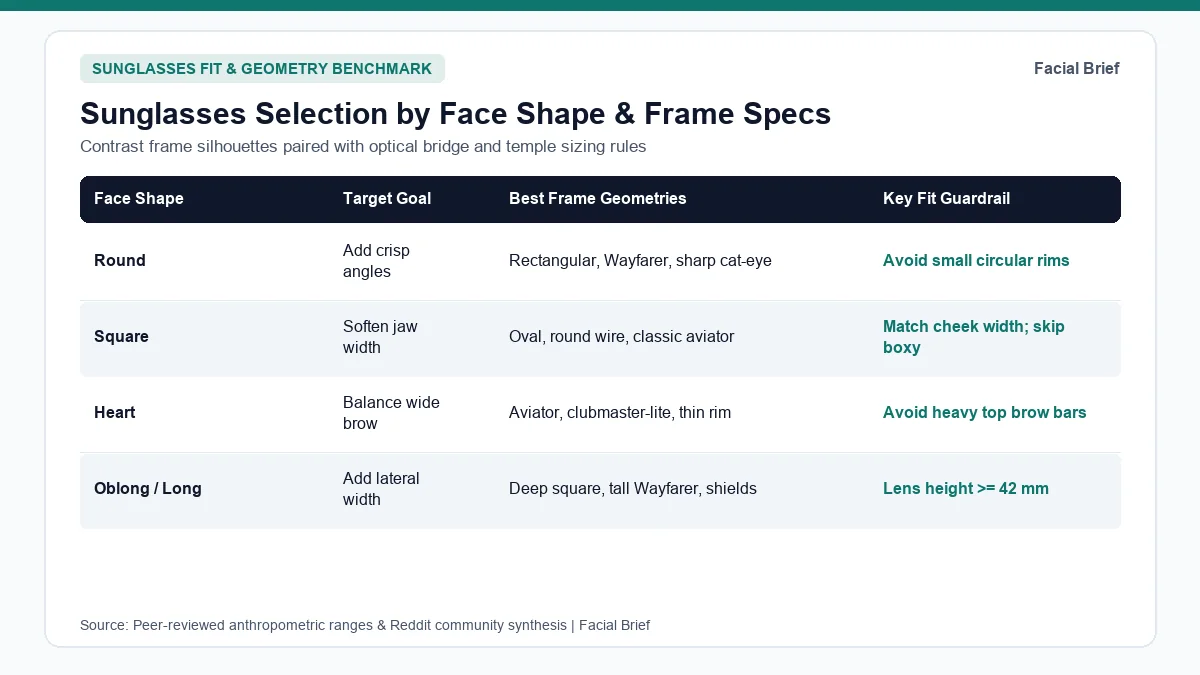
Pairing your silhouette contrast rule directly with millimeter targets turns best glasses for face selection into an exact checklist.
| Face Shape | Primary Geometry Trait | Best Sunglasses Shapes | Target Specs & Proportions | Frames to Avoid |
|---|---|---|---|---|
| Round | Full cheeks; curved chin; equal ratio | Rectangular, Wayfarer, sharp cat-eye | Bridge 17-20 mm; crisp upper corners | Small circular wire rims |
| Square | Wide jaw corners; flat forehead | Aviator, oval, round wire, soft panto | Curved lower rim; medium 2-4 mm rim weight | Heavy boxy square acetate |
| Heart | Broad brow; high cheeks; narrow chin | Aviator, thin round, rimless, light cat-eye | Slender upper bar; softer lower lens sweep | Heavy top-heavy browlines |
| Oval | Balanced thirds; gentle jaw taper | Wayfarer, navigator, clubmaster, round | Hinge width +/- 2 mm of cheek span | Extreme oversized shields |
| Oblong / Long | High length-to-width; straight sides | Deep square, tall Wayfarer, flat-top | Lens height >= 42 mm; bold side temples | Narrow shallow micro-frames |
| Diamond | Wide zygomatic bone; narrow brow/chin | Oval, rimless, soft cat-eye, clubmaster | Match temple width, not widest cheek peak | Narrow tight rectangles |
Comparing eye spacing, nasal bridge height, and facial thirds inside a full sample biometric report helps confirm whether a keyhole acetate bridge or adjustable wire nose arm suits your midface before buying.
Lens Height, Tint, UV400, and Online Buying Checks
Fit and silhouette still require proper optical protection. Confirm a genuine UV400 rating (blocking 99 to 100 percent of UVA and UVB rays up to 400 nanometers) before considering frame style. Dark tinted lenses without UV filtration dilate the pupils, allowing more ultraviolet light onto the retina than wearing bare eyes outdoors.
Polarized neutral gray or G-15 green-gray lenses reduce horizontal glare off water, snow, and wet pavement cleanly, though polarization can create dark banding on polarized car dashboards and older phone screens. Amber or warm brown lenses sharpen contrast in overcast light. For everyday sun glasses for face shape longevity, verify whether the shop offers free return shipping and note that opticians can heat and adjust acetate temple tips in minutes if frames pitch forward when you look down.
Frequently Asked Questions
What are the best sunglasses for your face shape if you fall between round and square?
Most adults blend traits from two textbook categories, such as squared jaw corners paired with fuller cheeks or a soft chin. Choose a softly angled trapezoidal frame like an Original Wayfarer or lightly rounded navigator. These hybrid silhouettes pair straight upper brow lines with curved lower lens corners, balancing softness and facial angles cleanly without pushing either trait to an extreme.
Why do my sunglasses keep hitting my cheeks when I smile?
Cheek contact occurs when deep vertical lenses drop past the upper malar crest or when an overly wide fixed acetate bridge lets the frame sink toward your midface. Switch to metal or mixed frames with adjustable silicone nose pads, look for Low Bridge Fit molded bridges with raised pads, or keep lens height near 36 to 41 mm for clean clearance during smiles.
How do I measure my face for glasses for an angular face or wide cheekbones?
Face a mirror holding a rigid millimeter ruler horizontally just beneath your eyes, and read the straight distance from your left outer temple hairline to your right outer temple hairline. Match that figure within 3 mm against a frame's published hinge-to-hinge span, since relying only on single-lens width ignores thick rim bevels and flared end pieces that distort real width.
Do low-bridge or Asian-fit sunglasses work for non-Asian buyers too?
Yes. Low Bridge Fit and Universal Fit frames solve three-dimensional nasal and cheek geometry across every demographic background and face size. Anyone with prominent high cheekbones, a narrower or flatter nasal bridge, or long eyelashes brushing against inner lenses benefits from the taller nose pads, gentler front frame curvature, and flatter vertical lens tilt engineered into these alternate-fit eyewear designs.
Referenced Community Discussions & Sources
- r/malefashionadvice: Matching sunglass frames to face shape and proportion: Breaks down contrast geometry, Wayfarer versatility, and temple alignment checks.
- r/malefashionadvice: Why sunglasses look great online and fail in person: Examines face-width mismatches, bowing arms, and measuring an existing reference pair.
- r/sunglasses: Optical retail insider tips on hinge sizing and fit: Explains why hinge-to-hinge span, bridge contact, and cheekbone clearance outrank style charts.
- r/femalefashionadvice: Frame-fitting guide from a professional glasses fitter: Details eyebrow alignment, adjustable nose pad fixes, and nasal bridge gaps.
- r/femalefashionadvice: Finding sunglasses for narrow faces and low bridges: Documents millimeter targets under 128 mm and secure low-bridge frame styles.
- Optical Standards Reference: ANSI Z80.3 / ISO 12312-1 UV400 filtration standards and standard 3-number ophthalmic frame sizing (
lens-bridge-temple).
Paired Facial Brief Analyzer
Measure your own proportions on-device
Run private 478-point landmark geometry in your browser with zero server photo upload on free tools.
Continue Reading