Facial Brief

What Is My Face Shape?

Wondering what face shape you have? Find out in seconds - no app, no measuring tape. Take a selfie or upload a front-facing photo and this free online face shape detector finds your closest face-shape profile from 478 landmarks, processed entirely in your browser, with shape-based starter recommendations for men and women.

Upload a photo

Drag and drop or choose a file

or

JPG, PNG or HEIC, up to 30MB

Your photo never leaves your device ·

The Six Face Shapes

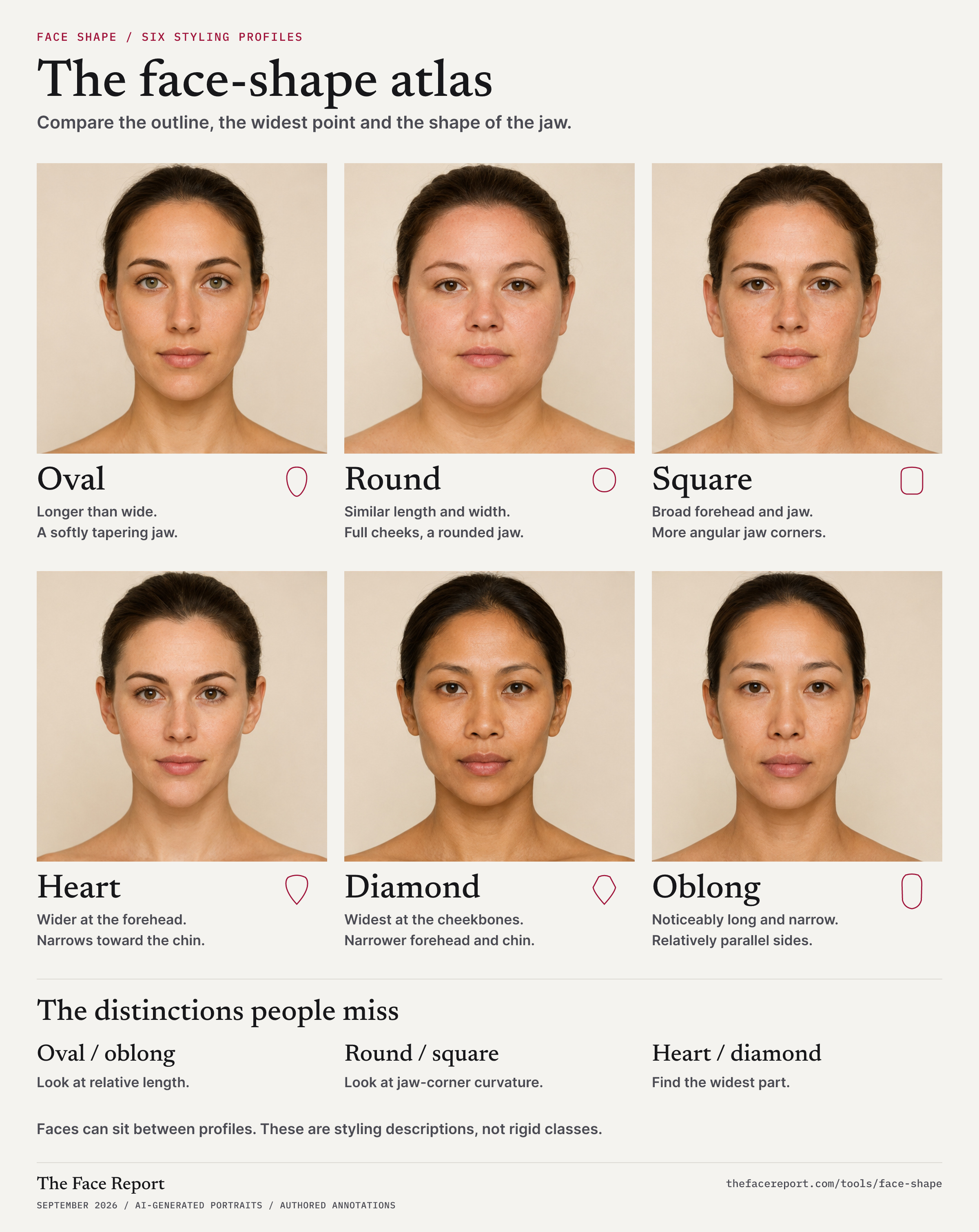
Every face is unique, but most fall into one of six standard categories defined by the relative widths of forehead, cheekbones, and jawline, plus the length-to-width ratio of the face. These are broad styling profiles rather than rigid scientific classes, so many faces sit near a boundary. The result names the closest profile and the next-closest alternative.

Six face-shape examples with outline icons: oval has a softly tapering jaw, round has fuller cheeks, square has angular jaw corners, heart narrows from the forehead, diamond is widest at the cheekbones, and oblong is long and narrow.

Compare the widest point and jaw outline, then check the often-confused pairs: oval versus oblong, round versus square, and heart versus diamond. Many faces combine traits from more than one styling profile.

Download full-size PNG

Open the image above to inspect the details at full size.

The face-shape atlas. Facial Brief (2026). https://facialbrief.com/tools/face-shape#face-shape-atlas

How this was made & reuse permission

AI-generated adult portraits with authored labels and abstract outline icons. Examples illustrate broad styling descriptions; they are not measured classification thresholds, population samples or beauty rankings. Hair, head position and camera perspective can change the apparent outline.

You may reproduce this reference graphic in articles, teaching materials and social posts. A credit to Facial Brief and a link to this source page are appreciated. If you adapt it, identify your changes and keep its illustrative context clear. This permission applies to this graphic.

Permanent source link · Published September 4, 2026 · Version 1

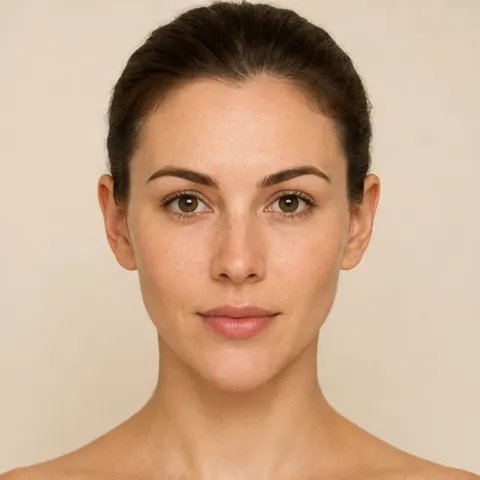
Oval face shape example: Face length is the longest dimension, with a soft taper from cheekbones toward both forehead and jaw.

Oval

~1.5 : 1

Often described as the most balanced shape. Length is roughly 1.5× width. The forehead is slightly narrower than the cheekbones, the cheekbones are the widest point but only marginally so, and the jawline curves gently with no sharp angles.

You might be oval if: Face length is the longest dimension, with a soft taper from cheekbones toward both forehead and jaw.

Styling: Most styles work because there is no dominant feature to balance. This is why oval is sometimes called the styling 'cheat code'.

The oval face shape, in full →Best hairstyles for oval faces →
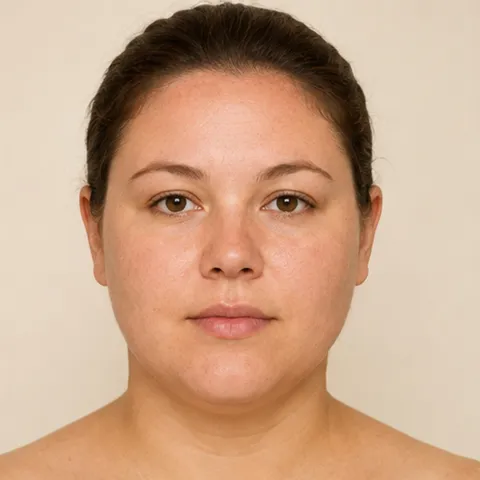
Round face shape example: Face appears circular at rest, with full mid-face and a rounded jawline.

Round

~1 : 1

Length and width are nearly equal. Cheekbones are the widest point but soft rather than sharp. Forehead and jaw are similar widths to each other and both narrower than the cheeks. The defining feature is the absence of angles - curves throughout.

You might be round if: Face appears circular at rest, with full mid-face and a rounded jawline.

Styling: Hairstyles that add height (high tops, side parts, vertical volume) elongate the face visually.

Best hairstyles for round faces →
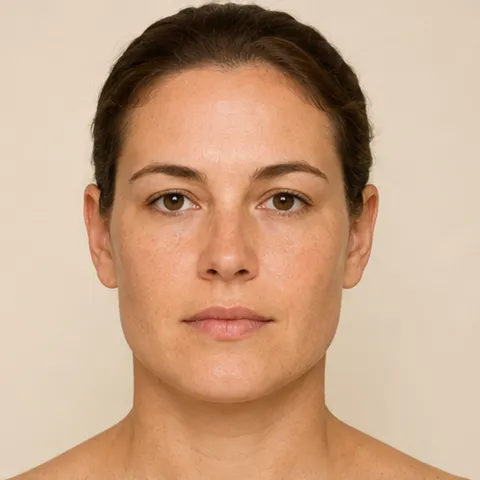
Square face shape example: Face is as wide as it is tall, with a clearly defined, angular jawline.

Square

~1 : 1

Similar proportions to round, but with strong angles instead of curves. Forehead, cheekbones, and jaw are roughly equal in width. The jawline is the defining feature - sharp, angular, and symmetric.

You might be square if: Face is as wide as it is tall, with a clearly defined, angular jawline.

Styling: Soft, layered styles balance the angular jaw. Considered a classically photogenic shape for masculine ideals.

Best hairstyles for square faces →
Heart face shape example: Wide forehead, narrow pointed chin, and a clearly tapered lower face.

Heart

~1.4 : 1

Forehead is the widest point of the face. Cheekbones are similar to or slightly narrower than the forehead. The chin tapers to a noticeable point, often producing an inverted-triangle silhouette. A widow's peak at the hairline is common but not required.

You might be heart if: Wide forehead, narrow pointed chin, and a clearly tapered lower face.

Styling: Styles with chin-length volume balance the narrow lower face. Long bobs and side-swept fringes work especially well.

Best hairstyles for heart faces →
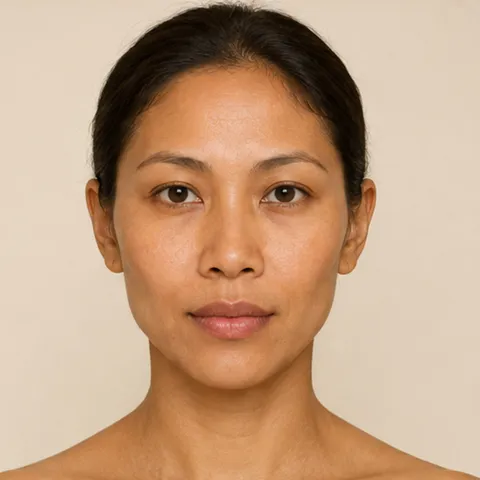
Diamond face shape example: Cheekbones jut out as the widest feature, with both forehead and jaw narrower.

Diamond

~1.4 : 1

Cheekbones are clearly the widest point and dominate the silhouette. Both the forehead and jaw are narrower than the cheekbones. The chin is pointed (similar to heart) but the forehead is also narrow (unlike heart). It is often described as one of the less common styling profiles.

You might be diamond if: Cheekbones jut out as the widest feature, with both forehead and jaw narrower.

Styling: Styles with forehead volume widen the upper face to balance the cheekbones. Side parts and curtain bangs work well.

Best hairstyles for diamond faces →
Oblong face shape example: Long face with relatively uniform width from top to bottom and straight sides.

Oblong

~1.6 : 1 or more

Also called rectangle. Face length is significantly greater than face width - the most elongated of the six shapes. Forehead, cheekbones, and jaw are similar widths, and the side lines are nearly straight rather than curved.

You might be oblong if: Long face with relatively uniform width from top to bottom and straight sides.

Styling: Hairstyles that add visual width - fringes, layered volume at the sides - counteract the length.

Best hairstyles for oblong faces →

Face Shapes Compared

A side-by-side reference for the six shapes. The fastest way to place yourself: identify which feature (forehead, cheekbones, or jaw) is the widest part of your face.

ShapeL:WForeheadCheekbonesJawDistinguishing feature
Oval~1.5 : 1Slightly narrower than cheeksWidest (gentle)Slightly narrower than cheeksGentle taper, balanced
Round~1 : 1Narrower than cheeksWidest (soft)Narrower than cheeksNo angles, full mid-face
Square~1 : 1≈ cheeks≈ forehead ≈ jaw≈ cheeks (angular)Strong, angular jawline
Heart~1.4 : 1WidestSlightly narrower than foreheadNarrowest, pointedForehead dominates
Diamond~1.4 : 1Narrower than cheeksWidest (prominent)Narrowest, pointedCheekbones dominate
Oblong~1.6 : 1+≈ cheeks ≈ jaw≈ forehead ≈ jaw≈ cheeksLong, straight sides

Face Shape Calculator (Manual Measurements)

Prefer a face shape calculator you can run with a tape measure? Four measurements - forehead width, cheekbone width, jawline width, and face length - plus the ratio rules below classify any face. (Or skip the tape and upload a photo above - the detector maps a 478-point mesh and compares related ratios from visible facial landmarks.)

  1. 1. Pull all hair away. Tie it back so the hairline and jaw outline are fully visible.
  2. 2. Measure forehead width. Horizontally across the widest part of your forehead, halfway between your hairline and your eyebrows.
  3. 3. Measure cheekbone width. Across the widest part of your cheekbones, just below your outer eye corners. This is usually the widest measurement of the face.
  4. 4. Measure jawline width. From one jaw angle (where the jaw turns up toward the ear) across to the other.
  5. 5. Measure face length. Vertically from the center of your hairline down to the tip of your chin.

Reading the numbers

  • Length ≈ width → round (curves) or square (angles).
  • Length > width × 1.5 → oval or oblong; oblong if all three widths are similar.
  • Forehead is widest with a pointed chin → heart.
  • Cheekbones widest, both forehead and jaw narrower, pointed chin → diamond.

These are classical manual reference ratios measured from the hairline. The photo detector cannot see the true hairline, so it measures from a visible upper-forehead landmark and uses separately calibrated mesh-space profiles. Do not expect the two ratio numbers to be identical.

Accuracy and Privacy

Accuracy

The tool uses MediaPipe Face Mesh to map 478 facial landmarks, then compares visible upper-forehead / cheekbone / jaw / length geometry and jaw angle with six shape profiles. It is a photo-based styling estimate, not a clinical measurement, and we do not claim a validated accuracy percentage.

Best results: front-facing photo, neutral expression, hair pulled back, even soft lighting, no glasses or hats. Accuracy drops with angled photos, partial occlusion, heavy contouring makeup, and uneven lighting.

Privacy

Your photo is processed entirely in your browser. The image itself is never uploaded to our servers - landmark detection and shape classification both run on your device.

Derived measurements and the classification are saved temporarily, including for anonymous scans, against a pseudonymous browser session so your result link can work. Free results are kept for2 days, then deleted by the next successful automated daily purge. If you answer the question under your result, that answer and your face shape are kept, and within about three days the link to your browser session is removed. A photo is sent only if you explicitly start a paid report and consent to that separate upload.

Is My Face Round or Oval? Telling Close Shapes Apart

Most people who ask "is my face round or oval?" sit between two shapes, which is why the detector names a runner-up and shows the match strength of all six. Each close pair is separated by one measurement. Check that one and the question is usually settled.

Round or oval

Check: face length against cheekbone width.

Measured from hairline to chin, a round face is about as long as it is wide; an oval face is about one and a half times as long. Both have soft jawlines, so length is the only thing that separates them.

Round or square

Check: the jaw corners.

Both are about as long as they are wide. A round face curves from the ear to the chin with no corner; a square face turns at a clear angle below the ear and the jaw is nearly as wide as the cheekbones.

Oval or oblong

Check: the sides of the face.

Both are longer than they are wide. An oval face narrows gently toward the forehead and the jaw; an oblong face keeps about the same width from forehead to jaw, with straight sides, and is the longer of the two.

Heart or diamond

Check: forehead width against cheekbone width.

Both end in a narrow, pointed chin. If the forehead is the widest part, the face is heart; if the cheekbones are wider than the forehead, it is diamond.

How to Find Your Face Shape: Men and Women

The steps are the same for a man's face shape and a woman's: one straight-on photo, or four tape measurements. The detector asks for no sex or gender and compares every photo with the same six profiles. What differs is what hides the outline, and what the result is used for.

Face shape for men

  • A beard covers the jaw angle and the chin, the two points that separate square from round and oval from heart. Judge the jaw from the bone under the beard, or use a photo taken after a trim.
  • A receding hairline makes the face look longer in a mirror. The detector measures from a point on the upper forehead, not from the hairline, so hair loss does not change its reading.
  • Men mostly use the result for a haircut, a beard style and glasses frames. The beard styles by face shape guide starts from the same six shapes.

Face shape for women

  • Hair worn down hides the width of the forehead and the jaw. Tie it back so the outline shows from the forehead to both jaw corners.
  • Contour and blush are applied to change how wide the cheekbones and jaw look. Take the photo without them, in even light.
  • Women mostly use the result for a haircut, bangs, glasses frames and where to place contour. The glasses for your face shape guide covers frames for women and men.

Face Type, Head Shape and Face Shape Filters

Face type. In haircut, glasses and makeup advice, "face type" means face shape. If you searched "what is my face type", the detector at the top of this page is the face type detector: its answer is one of the six shapes.

Head shape. Asked about a haircut or glasses, "what is my head shape?" nearly always means the outline of the face from the front, and that is what this tool measures. The skull itself (the crown and the back of the head) matters for a buzz cut, a shaved head or a hat size, and a front photo cannot measure it.

Face shape filters. The face shape filters on TikTok, Instagram and Snapchat lay an outline or a label over a moving camera picture. This page works on a still photo, taken with your camera or uploaded: it draws the measured forehead, cheekbone and jaw widths on your face and names the closest shape, with no app to install. A held, straight-on photo gives a steadier reading than a live filter, because the measured widths change as the head turns.

Face shape is one reading among several. The free face scanner reads face shape, a symmetry score and the golden ratio from one photo.

What Face Shape Is Most Attractive?

There is no single most attractive face shape. Attractiveness research consistently points to proportional balance, bilateral symmetry, and averageness mattering far more than which of the six categories a face falls into - and preferences shift across cultures and eras.

Oval is the shape most often cited as conventionally flattering, because its balanced length-to-width ratio suits the widest range of hairstyles and glasses. But that is a styling convenience, not a beauty ranking: widely admired faces exist in every category, and square, heart, round, and diamond faces are all overrepresented among celebrated faces in different eras. The practical takeaway is the reverse of the question - your shape doesn't set how attractive you are; it tells you which styling choices will balance your proportions.

If you're curious how your overall proportions measure - rather than which category you're in - the attractiveness test scores symmetry and proportional balance directly, with the formula shown.

Frequently Asked Questions

How do I find out what my face shape is?

The manual way is to measure four things in a mirror or photo - forehead width, cheekbone width, jaw width, and face length - and compare their relationships against the six standard profiles. The faster way is the detector above: upload one front-facing photo and it maps 478 landmarks and computes those ratios for you, entirely in your browser - including your runner-up shape, with borderline results flagged when you sit between two categories.

Is there an app to find my face shape?

You don't need to install one. This detector runs free in any mobile or desktop browser - no download, no account, and the photo is processed on your device rather than uploaded to a server. That's also the privacy advantage over most face-shape apps, which send your photo to their servers for analysis.

Is my face round or oval?

Compare your face length with the width across your cheekbones. Measured from hairline to chin, a round face is about as long as it is wide, and an oval face is about one and a half times as long. Both have a soft jawline, so length is what separates them. Many faces sit between the two: the detector names the closest shape and the runner-up, and shows the match strength of all six, so a round result with oval second means you are near the boundary.

How do I find my face shape as a man?

The method is the same as for anyone: one straight-on photo in the detector above, or four tape measurements (forehead, cheekbones, jaw, face length). Two things are specific to men. A beard hides the jaw angle and chin, which decide square against round and oval against heart, so judge the bone under the beard or use a photo taken after a trim. A receding hairline makes the face look longer in a mirror, but the detector measures from the upper forehead rather than the hairline, so hair loss does not change its reading.

How do I find my face shape as a woman?

Tie your hair back so the forehead and both jaw corners show, remove contour and blush (they are applied to change how wide the cheekbones and jaw look), and take a straight-on photo in even light. The detector compares the widths of your forehead, cheekbones and jaw and the length of your face with six profiles. It does not ask for sex or gender: the same six shapes and the same rules apply to every face.

What is my head shape?

When the question is about a haircut or glasses, head shape nearly always means the outline of the face from the front: oval, round, square, heart, diamond or oblong. That is what this detector measures from a front photo. The shape of the skull itself (the crown and the back of the head) matters for a buzz cut, a shaved head or a hat size, and a front photo cannot measure it.

Is face type the same as face shape?

Yes. In haircut, glasses and makeup advice, face type and face shape mean the same six categories: oval, round, square, heart, diamond and oblong. To find your face type, use the detector on this page; its answer is your face type. Skin type and the Korean animal face types (cat, puppy, fox and so on) are different classifications.

Is there a face shape filter?

TikTok, Instagram and Snapchat have face shape filters that lay an outline or a label over the live camera picture. This page does the same job on a still photo, taken with your camera or uploaded, with no app: it draws the measured forehead, cheekbone and jaw widths on your face and names the closest of six shapes. A held, straight-on photo gives a steadier reading than a live filter, because the measured widths change as the head turns.

Can I find my face shape by uploading a photo?

Yes - that's exactly how this tool works. Use a clear, front-facing photo with hair pulled back off the forehead and jawline, even lighting, and a neutral expression. Angled photos, hair covering the face outline, and strong shadows are the three things most likely to skew the result, so if your result feels off, retake with those fixed.

How do I use my face shape for hairstyles and glasses?

The principle for both is visual balance: choose frames and styles that counter your face's dominant dimension. Round faces suit angular frames and hairstyles with height; long faces suit deeper frames and styles with width or fringe; square jaws pair with rounded frames and softening layers. After the detector gives you your shape, the per-shape hairstyle and glasses guides on this site give the full breakdown, and the hairstyle finder turns your result into a specific style list.

What face shape looks good with bangs?

Bangs suit long face shapes best: oblong and oval faces gain visual width from a fringe, which shortens the apparent face length. Heart shapes suit side-swept bangs that soften a wider forehead. Round faces should be careful with full, straight-across bangs - they remove more vertical line from an already short face - and do better with long, side-swept or curtain bangs. Square faces suit soft, wispy or curtain bangs over blunt ones, which would stack a second horizontal line on top of an angular jaw.

What's the rarest face shape?

There is no dependable universal percentage: results vary with the population, definitions, and classifier used. Diamond is often described as less common in styling guides because the cheekbones must be wider than both the upper forehead and jaw. These six categories are broad styling profiles, not population statistics or medical diagnoses.

Can my face shape change over time?

Your apparent face outline can change with weight, facial hair, hairstyle, soft-tissue changes, and the way a photo is taken. Underlying skeletal proportions are generally more stable than those visible factors. For a useful comparison over time, use similar lighting, camera distance, expression, and a straight-on head position.

Is face shape genetic?

Genetics contributes to facial structure, alongside growth, development, age, and soft tissue. But labels such as oval, round, and heart compress many continuous measurements into six broad styling categories. A face-shape result should not be treated as a genetic test or a diagnosis.

How accurate are AI face shape detectors?

There is no single trustworthy accuracy percentage for every face-shape detector. This tool maps a 478-point face mesh and compares several visible-mesh ratios with six shape profiles, but it has not been independently validated against a large human-labelled photo set. Treat the output as a styling estimate; angled photos, hair over the face, glasses, hands, strong contouring, and uneven lighting can change the result.

What's the difference between an oval face and a round face?

The main visual difference is elongation. In classical hairline-to-chin measurements, oval faces are often described as about 1.5 times as long as they are wide, while round faces are closer to equal length and width. Both have soft contours. The detector's on-screen mesh ratio uses an upper-forehead point rather than the hairline, so its number is lower than the classical tape-measure ratio.

What's the difference between a heart face and a diamond face?

Both have pointed chins, but they differ at the top of the face. Heart faces have a wide forehead, sometimes with a widow's peak; diamond faces have a narrow forehead with the cheekbones as the dominant widest feature. If your forehead is wider than your cheekbones, you're heart-shaped. If your cheekbones are wider than your forehead, you're diamond.

Does face shape matter for choosing a hairstyle?

It's one factor among several - hair texture, density, lifestyle, and personal preference all matter as much. Face-shape-based recommendations are really about visual balance: round faces benefit from styles that add length, oblong from styles that add width, and square from styles that soften the jawline. These are useful starting points, not strict rules - many people look great in styles outside their recommended set.

How does AI detect face shape from a photo?

The standard approach uses facial landmark detection. MediaPipe supplies a 478-point mesh, and this tool selects stable points around the visible upper forehead, cheeks, jaw, and chin. It compares their relative widths, visible height, and jaw angle with six shape profiles. The mesh does not detect the true hairline, which is why its ratio is different from a manual hairline-to-chin measurement.

Do men have different face shapes than women?

The same six categories - oval, round, square, heart, diamond, and oblong - can be used for everyone. This detector does not ask for sex or gender and applies the same geometric profiles to every photo. Hairstyle, facial hair, and makeup can change the perceived outline, so use the result as a starting point for styling rather than a rule about how someone should look.

What's the difference between a face shape analyzer, detector, finder, and calculator?

They're four names for the same job - working out which of the six shape profiles your face is closest to. 'Calculator' usually implies typing in manual tape measurements, while 'analyzer', 'detector', and 'finder' usually imply a photo tool. This page is both: upload a photo for the AI analysis, or scroll to the manual calculator section and use the four-measurement method with the same classification rules.

Which face shape is the most attractive?

There is no single 'most attractive' face shape. Attractiveness research points to proportional balance, symmetry, and averageness mattering far more than which of the six categories you fall into. Oval is the shape most often cited as conventionally flattering - its balanced length-to-width ratio suits the widest range of hairstyles and glasses - but every shape has widely admired examples, and many celebrated faces are square, heart, or round. Beauty standards also shift across cultures and eras, so treat your shape as information for styling choices, not a ranking.
References

  • Lugaresi, C., et al. MediaPipe: A Framework for Building Perception Pipelines. Google Research, 2019.
  • Farkas, L. G. Anthropometry of the Head and Face. Raven Press, 1994 - the original anthropometric framework still used in surgical planning.

Related Guides