Skin texture
↓ youngerSmooth, even-toned skin reads younger by 3–7 years. Visible pores, sun damage, and fine lines all push perceived age up. Skin texture is the single strongest visible age signal in vision research.
Free AI face age test and calculator. Upload a photo and vision AI estimates how old you look from the same skin texture, jawline, and periorbital signals human observers use - with the factors driving it.
No account, no password - your results show on screen in seconds.
You can withdraw this consent and delete the data linked to your account or this browser yourself, at any time, from Delete my data.
No login required. Photo processed by Google Gemini, not stored.
The free face age test returns four things, three of them built on your device:
Perceived Age
27
The AI's best single estimate of how old you look, with a 5-year range
Age Map
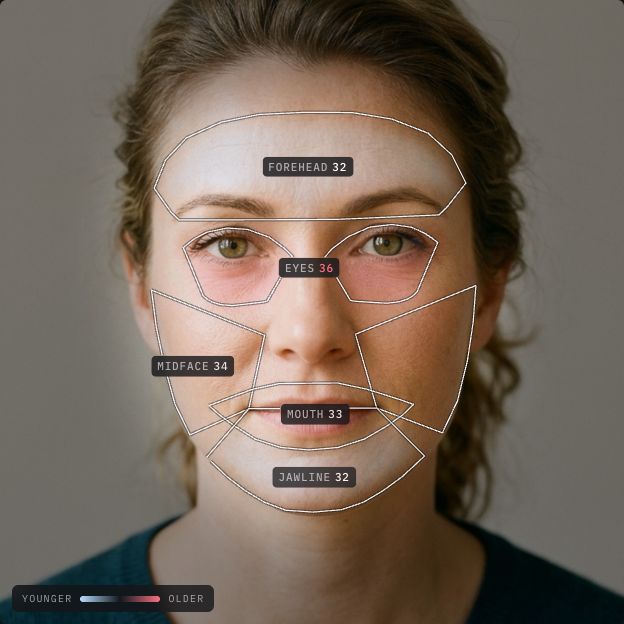
Eyes 24 · Forehead 26 · Mouth 27 · Midface 28 · Jawline 30
Five zones outlined over your photo, each tagged with the age it reads on its own
Lines and Tone Maps
Where fine lines and uneven pigment concentrate
The two strongest visual age signals, mapped relative to your own skin in that photo
Age-Linked Geometry
Eye aperture · Brow height · Canthal tilt · Lips · Midface · Nose
Six measurements placed against thousands of faces measured on this site, with the direction each moves with age
Most online face-age tests use one signal. This one uses two engines. Age is read mostly from the skin - wrinkles, pores, sun spots, tone evenness, hair density, lip volume - so the estimate itself comes from a vision model (Google Gemini) that evaluates the photo, not just coordinates. It returns the overall age, the age each of five zones reads on its own, and what reads younger or older.
The map is built on your device. The same 478-point face mesh our other tools use finds the zones, draws the plate over your photo, maps where lines and uneven tone concentrate, and measures five pieces of age-linked geometry - eye aperture, brow height, canthal tilt, lip fullness and nose length - against thousands of faces measured here. Geometry alone cannot estimate age; it shows where your face sits on the measurements that move with it. The photo leaves your browser once, for the vision read, and is not stored.
The vision AI evaluates eight visible features in roughly this order of effect size. Two faces of the same chronological age can differ by 10+ perceived years based on these factors alone.
Smooth, even-toned skin reads younger by 3–7 years. Visible pores, sun damage, and fine lines all push perceived age up. Skin texture is the single strongest visible age signal in vision research.
Dark circles, hollowing, and crepiness under the eyes are among the earliest aging signals - often visible from the late 20s. Volume loss here adds 5–10 perceived years more than equivalent changes anywhere else on the face.
A defined jawline reads younger because the mandibular margin softens with age (loss of facial fat pad firmness, skin laxity). Strong gonial angles and a clear chin contour can subtract 4–6 years.
Full hair volume and an absence of greys can subtract 5–8 years; visible thinning at the temples or crown adds 3–7. Hair greying alone can add 4–10 years independent of skin condition.
Upper eyelid hooding from skin laxity and lower eyelid puffiness or descent both push perceived age up. The eyelid skin is the thinnest on the body and shows aging earliest.
Full lips with a defined vermillion border read younger. Lips lose volume and the cupid's bow flattens with age - this can subtly add 3–5 years even when skin is otherwise youthful.
Youthful faces have fat pads in the cheeks, temples, and lower eyelid that descend or atrophy with age. Volume preserved in these areas reads as younger; volume loss reads as gaunt or aged.
Hyperpigmentation (sun spots, melasma), uneven skin tone, and a leathery texture from chronic UV exposure are powerful aging signals. Two faces of the same chronological age can differ by 10+ perceived years based on cumulative sun damage alone.
The free face age test tells you how old you look. Our paid Full Analysis report tells you what's adding years and what to do about it - personalized to your specific face and current condition.
What the Full Analysis adds
Soft, diffused lighting
Window light or overcast outdoor light is most flattering and most accurate. Direct overhead light (kitchen ceiling fixture, midday sun) exaggerates shadows under the eyes and around the mouth and inflates apparent age.
Neutral or gently smiling expression
A relaxed expression with a soft smile is the most accurate. Big forced smiles activate every facial line; locked-down neutral can read as tense and sometimes older. A genuine soft smile is the sweet spot.
No heavy filters
Beauty filters that smooth skin will dramatically reduce the estimated age - sometimes by 10+ years - without reflecting your actual visible age. Use an unfiltered photo for the most useful estimate.
Recent photo, current grooming
Use a photo that reflects your current hair (color, length, style), facial hair, and skin condition. An old photo gives you the age you were then, not now.
The only honest answer comes from measurement: upload a photo above and the AI estimates your perceived age from the visible signals human observers use - skin texture, under-eye area, jawline definition, hair density, lip volume, and sun damage. Friends and family are poor judges (they're biased toward your chronological age because they know it); an AI sees only what a stranger would see.
You don't need an app. This test runs free in your browser on any phone or laptop - no download, no login, no subscription. Older tools like Microsoft's how-old.net used earlier-generation computer vision; modern vision AI (Google Gemini) evaluates far more signals and is typically accurate to within 3–5 years for adults.
The test uses Google's Gemini vision AI to estimate how old you look based on the same visible features human observers use: skin texture, jawline definition, periorbital aging signs, hair density, lip volume, and overall facial proportions. Unlike landmark-based tools (which only see geometry), vision AI evaluates the actual skin and feature appearance - the things that actually change with age.
On average, AI vision age estimation is accurate to within 3–5 years for adults - comparable to or slightly better than human estimates. Individual results vary substantially: same-age people can look 10+ years apart based on skincare, sun exposure, sleep, stress, smoking, and genetics. The test gives you both a single estimate and a 5-year range to reflect this uncertainty.
Tools that only use facial landmarks (478-point face mesh detection) measure geometry - distances, angles, ratios. But age signals are mostly in skin texture and color: wrinkles, pores, sun spots, evenness of tone. These are not in the geometry. A landmark-only tool can guess age from jawline definition or eyelid descent, but it would miss the strongest signals (skin condition, hair density, sun damage). A vision AI evaluates the photo itself, not just landmark coordinates.
Five evidence-based interventions, ordered by effect size: (1) Daily SPF - sun damage is the largest controllable factor, 80%+ of visible facial aging is photoaging. (2) Sleep - 7–9 hours; poor sleep visibly shows in periorbital puffiness and skin tone. (3) Retinoids (tretinoin or retinol) - the only over-the-counter ingredient with strong RCT evidence for reducing visible aging. (4) Hydration + moisture barrier care - plump, well-hydrated skin reads significantly younger. (5) Don't smoke - smoking accelerates collagen breakdown by ~40% over a decade.
Chronological age is how many years you've been alive. Perceived age is how old you LOOK to an observer (or to AI). They often differ by 5–10 years; people who consistently look 5+ years younger than their chronological age are sometimes called 'super-agers' in the dermatology and longevity literature. Looking younger correlates with better health outcomes in long-term studies - there's something to it beyond vanity.
Yes - face age estimation requires the photo to be analyzed by a vision AI model (Google's Gemini), so it leaves your browser temporarily for processing. The photo is not stored on our servers and is not used for training. This is different from our landmark-based tools (jawline-score, canthal-tilt, etc.), which measure the photo in your browser.
Yes - the test on this page is completely free and gives you your estimated age, a confidence range, and the visible factors driving it. The paid report goes further: it identifies which specific features are adding perceived years and gives you a personalized skincare protocol, a 4-week plan, and hairstyle previews on your own photo.
Three common reasons. First, photo conditions: harsh overhead lighting exaggerates wrinkles and shadows; soft front lighting flatters and reduces apparent age. Second, expression - smiling photos often read 2–4 years younger than neutral photos. Third, the AI evaluates the photo, not the person - recent illness, poor sleep, or makeup choices can all push the estimate. Run the test on 2–3 different photos to see the range.
The age map is drawn on your device by the same 478-point face mesh our other tools use. It outlines five zones - forehead, eyes, midface, mouth and jawline - and tags each with the age that zone reads on its own, so you can see which area is pulling your estimate up or down. Two extra views show where fine lines and uneven tone concentrate on your face, relative to your own skin in that photo. Rose means a zone reads older than your overall; an ice tint means it reads younger.
In perceived-age research the eye area usually leads: crow's feet, under-eye hollowing and upper-lid laxity are read from the late 20s onward. Skin texture and tone across the midface come next, then the mouth (thinning lips, perioral lines) and the jawline (softening contour, jowls). The forehead often reads younger than the rest for people who keep an even, matte surface. The age map shows this order for your face rather than the average one, and the five geometry rails place your eye aperture, brow height, canthal tilt, lip fullness and nose length against thousands of faces measured on this site.
Full Analysis (with face age)
The actual tool - perceived age included free
Attractiveness Score
Symmetry and proportions scored, with separate jawline and face-shape measurements
Jawline Rating Test
Real gonial angle measurement, taper, symmetry
Skin Analysis
Texture, tone, hydration, and photoaging signs - the age drivers, read directly
How to Glow Up
Evidence-based interventions to look younger
Personal Color Analysis
What season am I? Free AI verdict from a selfie