Looksmaxxing Pyramid: Every Tier, Softmaxxing & Reports
Explore the 4-tier looksmaxxing pyramid from base health and softmaxxing to surgical limits, plus how looksmax report apps compare on pricing and bias.
Independent Editorial & Trademark Notice: This guide is an independent research analysis published by Facial Brief and is not affiliated with, endorsed by, or sponsored by any third-party apps, platforms, or brands discussed below. All trademarks belong to their respective owners.
Browse self-improvement threads on Reddit for ten minutes and two opposite extremes emerge: beginners asking whether they need jaw surgery after one harsh selfie, and long-time forum members telling them to get eight hours of sleep and a proper haircut first. That priority system sits at the center of the looksmaxxing pyramid (originally popularized on r/Vindicta as the Beauty Hierarchy of Needs).
The pyramid puts cheap, reversible habits at the bottom and reserves expensive, risky clinical interventions for the narrow apex. Before spending money on an automated looksmax report or assuming bone structure holds you back, you can run Facial Brief's Try Free PSL Score Test inside your browser to measure baseline symmetry, vertical thirds, and facial ratios with zero sign-up.
Key Takeaways
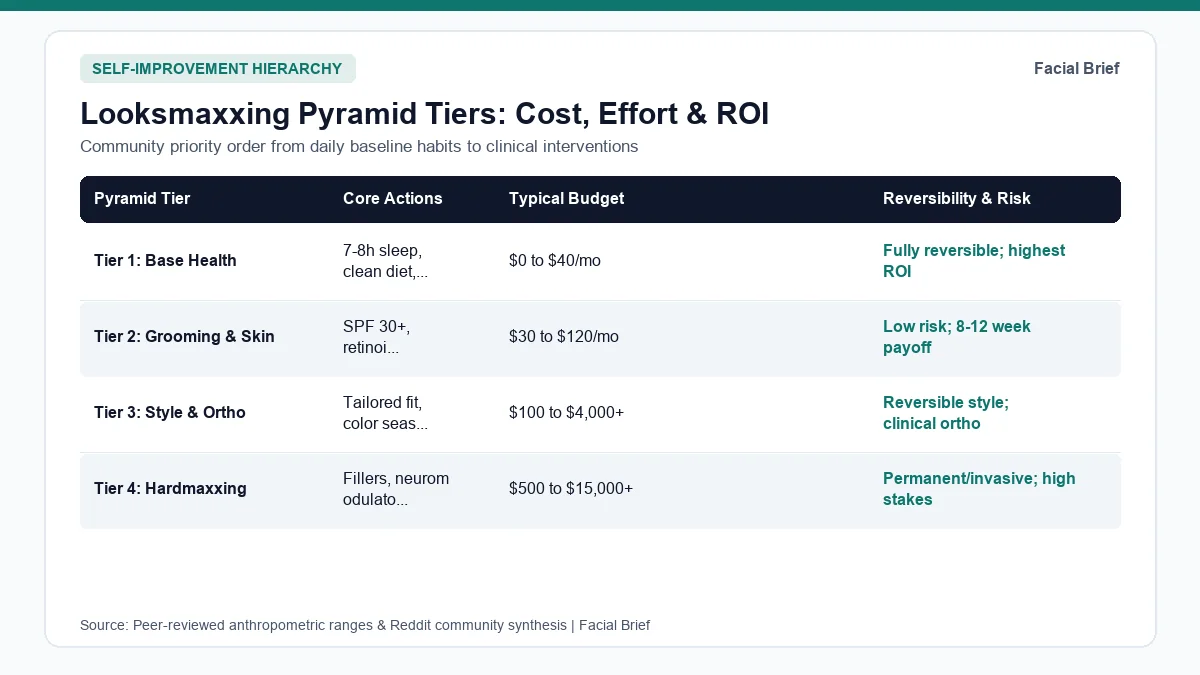
- Tier 1 (7 to 8 hours of sleep, hydration, clean dental hygiene, and a healthy body composition around BMI 19 to 24) removes facial bloating and under-eye dullness faster than any cosmetic purchase.
- Tier 2 softmaxxing (daily broad-spectrum SPF 30+, consistent retinoid or active skincare over 8 to 12 weeks, face-shape haircut, and tidy brows) accounts for most controllable day-to-day visual polish.
- Tier 3 covers clothing silhouette fit, seasonal color palette alignment, upright neck posture, and teeth whitening or orthodontic alignment.
- Tier 4 ("hardmaxxing" such as fillers or facial surgery) carries substantial cost ($500 to $15,000+) and permanent trade-offs, so Reddit guides advise exhausting Tiers 1 through 3 completely first.
- Popular looksmax report apps such as Umax and LooksMax AI commonly lock results behind $3.99 to $8.99 weekly subscriptions (~$80+/year) and swing unpredictably with lighting and 24mm lens distance.
The Four Tiers of the Looksmaxxing Pyramid
Community discussions such as r/Vindicta's foundational Beauty Hierarchy of Needs and r/Vindicta's tier mapping guide organize self-improvement from highest return per dollar to highest risk. Moving out of sequence usually fails because surgical tweaks on an inflamed, poorly groomed face still read neglected in person.
Tier 1: Biological Foundation (Sleep, Weight, and Hygiene)
The base layer costs nearly nothing and dictates how every higher tier lands. Steady 7 to 8 hours of sleep lowers periorbital fluid pooling and restores even skin tone. Reaching a sustainable healthy weight (often cited in forum threads around BMI 19 to 24 or a lean athletic body-fat range) naturally sharpens cheek and jawline contours that excess facial adiposity hides. Daily brushing, flossing, trimmed nails, and shower consistency round out the base so nothing distracts negatively up close.
Tier 2: Core Softmaxxing (Skincare, Hair, Brows, and Fitness)
Once baseline health stays steady, Tier 2 targets reversible maintenance routines, a point reinforced repeatedly in r/vindictapoc reminders on mastering basics first. Dermatologist-standard habits keep routines simple: gentle cleanser, moisturizer suited to oiliness, broad-spectrum SPF 30+ every morning, and one evidence-backed active (such as a mild retinoid or salicylic acid) run consistently for 8 to 12 weeks to clear texture and hyperpigmentation.
Hair and eyebrow geometry deliver the fastest visual shift here. Matching hair volume and fringe lines to forehead width and jaw angles balances facial thirds cleanly, while removing stray hairs between or beneath the brow tail sharpens eye framing. Adding two to four weekly strength sessions improves upper-body posture and neck carriage simultaneously.
Tier 3: Presentation and Structural Polish (Style, Color, and Teeth)
Tier 3 refines framing around the face. Tailored collars, shoulder seams that align cleanly, and clothing hues matching your skin undertone prevent sallow shadows beneath the eyes and chin. Professional whitening strips or clear orthodontic aligners address smile balance gradually.
If you want to preview realistic hairstyle, grooming, skin clarity, and wardrobe tone adjustments on your own portrait before committing to a salon change, Facial Brief's Glow-Up Pack generates five isolated and combined previews from one photo for 5 tokens (~$3.33 in the Pro pack), keeping your actual facial structure intact.
Tier 4: Clinical and Surgical Interventions (Hardmaxxing)
The narrow peak covers medical aesthetics (botulinum toxin, hyaluronic fillers, clinical lasers) and permanent surgical alteration (rhinoplasty, blepharoplasty, orthognathic jaw surgery). Because fillers can migrate over years and facial surgery carries anesthesia, nerve, scarring, and asymmetry risks, informed forum threads reserve Tier 4 strictly for verified functional issues or major structural imbalances remaining after months of Tier 1 to 3 consistency. Our looksmaxxing chart guide and PSL scale guide explain how communities classify bone structure separately from daily grooming.
How Looksmax Report Apps Work and Where They Mislead
Alongside the pyramid, mobile downloads offering an instant looksmax report surged across TikTok and Reddit. Reviews across r/selfimprovement threads dissecting Umax and r/Splendida's analysis of glow-up apps flag recurring billing traps and technical limits.
Most mobile scanners ask users to snap front and side selfies, run a brief progress bar, and then lock the numerical rating behind a $3.99 to $8.99 weekly subscription (~$79.99 annually) or referral codes requiring friends to install the app. Users who pay frequently discover generic checklist advice ("drink water, chew mastic gum, sleep earlier") paired with volatile scores that jump two full points between bathroom lighting and outdoor shade.
| Platform / App | Pricing Structure | Report Scope | Photo Processing | Main Community Critique |
|---|---|---|---|---|
| Facial Brief | 25 free local tools; $17.49 report or $3.33+ Glow-Up Pack | 478 landmarks, thirds, fifths, color season, 4-wk plan | Browser-only for free geometry tools | Static photo still sensitive to 24mm lens tilt |
| Umax (iOS / Android) | Free scan preview; $3.99-$8.99/wk or friend referrals | Overall score, potential, skin, jawline bars | Cloud server scan | Weekly auto-renewals and generic routine tips |
| LooksMax AI | Freemium; ~$3.99-$9.99 weekly/monthly tiers | Harmony, masculinity, cheekbones, skin ratings | Cloud server scan | Wide score variance across lighting changes |
| Lookist / FirstVibe | Freemium with subscription unlock | 15-21 sub-scores, haircut ideas, daily checklist | Cloud server scan | Paywalled habit trackers replicate free advice |
| FaceIQLabs | Partial free preview; $24.99-$49.99/mo plans | 100+ harmony, angularity, dimorphism metrics | Server upload | Expensive recurring sub and strict celebrity quirks |
| QOVES Studio | Annual membership (~$150/yr) | Long-form researcher-guided anatomical audit | Private portal | Slow turnaround and high price for casual users |
See our FaceIQLabs alternative guide for a deeper breakdown of web analyzers versus mobile subscriptions. On any software platform, remember that front-facing phone cameras held at arm's length use wide 24mm lenses that distort the midface and nose relative to the ears. Shooting at five to eight feet with a rear 2x lens provides a consistent reference before tracking progress.
Building a Realistic 12-Week Softmaxxing Plan Without Burnout
In r/LooksmaxingAdvice practical cheat sheets and r/AskWomenOver30 reflections on looksmaxxing and mental health, commenters draw a clean boundary between useful grooming habits and harmful fixation. Checking an automated score every morning or picking apart millimeter-scale orbital asymmetries fuels anxiety while adding zero real-world appeal.
A grounded 12-week cycle focuses purely on controllable Tier 1 to 3 inputs:
- During weeks 1 to 4, stabilize Tier 1 basics: lock a consistent sleep schedule of 7 to 8 hours, drink steady water while trimming late-night sodium, pair morning broad-spectrum SPF 30+ with an evening cleanser, and establish three weekly resistance workouts.
- During weeks 5 to 8, tune Tier 2 framing: book a haircut calibrated to your forehead and cheekbone ratio, tidy stray eyebrow and facial hair lines without over-thinning, and take one level daylight photo from six feet away to audit posture.
- During weeks 9 to 12, refine Tier 3 details: evaluate skin texture changes from steady cleansing and active care, replace poorly fitting collars or faded tees with structured basics suited to your undertone, and archive rating apps altogether once routines run automatically.
Skip internet gimmicks promoted in extreme corners of the community. Aggressive hard-chewing gums strain temporomandibular (TMJ) joints without enlarging the mandible, bone-tapping ("bonesmashing") risks bruising and soft-tissue injury with zero clinical benefit, and crash dieting strips facial collagen faster than it reveals cheekbones.
Frequently Asked Questions
What is the looksmaxxing pyramid and why do tiers matter?
The looksmaxxing pyramid is a four-tier priority roadmap adapted from Reddit self-improvement communities. It orders appearance upgrades from foundational health (sleep, hydration, fitness, daily hygiene) and reversible softmaxxing (skincare, face-shape haircuts, tailored clothing) up to clinical or surgical options at the apex. Following the sequence ensures low-cost habits deliver full cosmetic value before anyone evaluates invasive, expensive, or irreversible procedures.
Are paid looksmax report apps accurate or worth weekly fees?
Most automated looksmax report apps read lighting contrast and surface facial proportions inconsistently, shifting composite ratings by 10% to 20% whenever head angle, camera focal length, or bathroom shadows change. Paying $3.99 to $8.99 per week rarely unlocks tailored guidance beyond generic sleep, water, and skincare checklists, making transparent on-device geometry checks a much steadier baseline for personal tracking.
What counts as softmaxxing versus hardmaxxing?
Softmaxxing covers non-invasive, reversible habits and daily styling adjustments: morning broad-spectrum sunscreen SPF 30+, evidence-based topical retinoids, face-shape haircuts, tidy eyebrow grooming, consistent resistance training, fitted wardrobe colors suited to your undertone, and gentle teeth whitening. Hardmaxxing refers to medical or permanent structural interventions, including hyaluronic dermal fillers, neuromodulator injections, orthodontic jaw alignment, rhinoplasty, blepharoplasty, and orthognathic bone surgery performed by licensed specialists.
How long does Tier 1 and Tier 2 softmaxxing take to show results?
Improved daily hydration, lower late-night sodium intake, steady 7 to 8 hour sleep, and a well-proportioned haircut noticeably sharpen under-eye clarity and facial framing within 7 to 14 days. Dermatologist-standard topical skincare actives, targeted sun protection, and progressive strength training typically require 8 to 12 weeks of steady consistency before delivering visible skin texture improvements and leaner cheek-to-jawline facial definition.
Referenced Community Discussions & Sources
- r/Vindicta: Beauty Hierarchy of Needs and softmaxxing priorities: Original tier model placing general health, weight balance, and skincare ahead of surgical options.
- r/Vindicta: Community meta breakdown mapping all looksmaxxing tiers: Clarifies boundaries between routine maintenance, style upgrades, and clinical procedures.
- r/vindictapoc: Why lower tiers deliver the majority of visual improvements: Warns against jumping straight to surgery before locking in hair, skin, and fitness basics.
- r/LooksmaxingAdvice: Practical softmaxxing cheat sheet: Separates actionable daily grooming habits from speculative forum trends.
- r/selfimprovement: User critique of Umax and subscription looksmax apps: Reviews referral walls, recurring weekly charges, and repetitive automated tips.
- r/Splendida: Comparative analysis of glow-up and face-rating apps: Evaluates pricing models, feature breadth, and score volatility across mobile trackers.
- r/AskWomenOver30: Mental health perspectives on looksmaxxing culture: Notes the psychological risk of reducing personal worth to automated rating tiers.
- Clinical dermatology and craniofacial guidance: American Academy of Dermatology daily photoprotection and retinoid timeline norms alongside orthognathic risk boundaries.
Paired Facial Brief Analyzer
Measure your own proportions on-device
Run private 478-point landmark geometry in your browser with zero server photo upload on free tools.
Continue Reading