Best PinkMirror Alternative: 6 Face Analyzers Compared
Compare the top pinkmirror alternative across pricing, 478-landmark math, photo privacy, and lens drift. Includes a 6-tool benchmark comparison table.
Independent Editorial & Trademark Notice: This guide is an independent research analysis published by Facial Brief and is not affiliated with, endorsed by, or sponsored by any third-party apps, platforms, or brands discussed below. All trademarks belong to their respective owners.
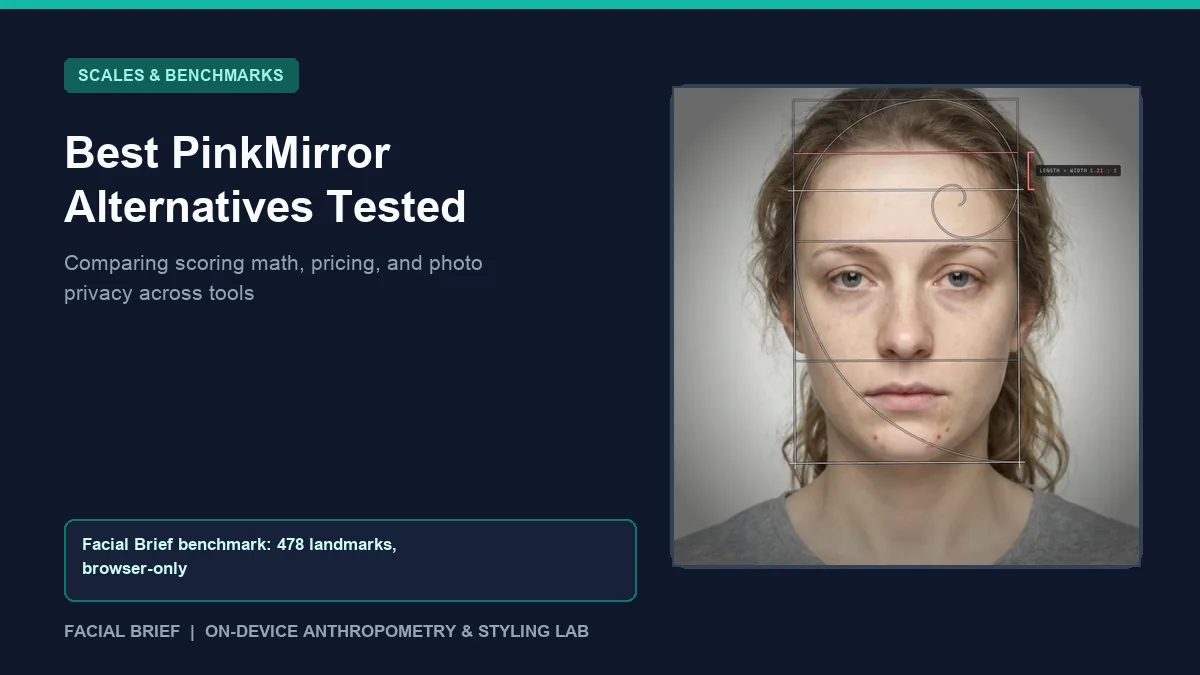
Searching for a pinkmirror alternative usually begins after uploading a selfie to PinkMirror and hitting two immediate trade-offs: a 2010s-style web interface that sends your photo to remote servers alongside upsells for AI-retouched "prettier" simulations and full styling reports. While pinkmirror introduced mainstream users to automated attractiveness scores, face-shape labels, and makeup tips, modern users on r/HowToBeHot, r/Splendida, and r/ugly increasingly want transparent scoring math, modern computer-vision landmarks, and stricter control over personal portrait data. If you want an instant 0 to 100 proportion score with the exact mathematical weights shown openly inside your browser, run Facial Brief's Try Attractiveness Test first with zero server upload or account wall.
Key Takeaways
- PinkMirror provides quick symmetry checks and automated retouching previews, yet locks deeper styling reports behind credit packs ($5.99 for 80 credits or $9.99 for 200 credits) and relies on dated 2D server uploads.
- Legacy free tool PrettyScale runs fast in a browser without payment walls, though manual landmark placement and strict neoclassical ideals make scores swing wildly across head tilt and lens focal length.
- Mobile apps like Umax and Glam Up deliver rapid AI ratings for jawline, canthal tilt, and skin quality, while drawing regular Reddit criticism for weekly subscription paywalls and opaque black-box scoring.
- QOVES Studio offers detailed clinical-style reports reviewed by human specialists across 1,200+ metrics, priced at $150 or more per report with turnarounds lasting up to 28 days.
- Facial Brief computes 478 facial landmarks entirely client-side in your browser using a disclosed 35/25/25/15 formula free, with a one-time $17.49 full breakdown option.
How PinkMirror Works and Why Users Look Elsewhere
PinkMirror operates as an automated web beauty analyzer built around four steps: users upload a straight-on portrait, computer vision maps facial landmarks across the eyes, nose, lips, and jaw, the site renders an optional AI-retouched preview simulating smoother skin or tweaked proportions, and an attractiveness rating out of 10 accompanies basic face-shape notes. Free previews give a surface verdict, whereas deeper reports covering contour tips, hair suggestions, and frame styles run on credit bundles around $5.99 for 80 credits or $9.99 for 200 credits.
Across r/HowToBeHot discussions of PinkMirror, commenters note two opposing experiences. Many appreciate receiving concrete styling suggestions (like side parts or eyebrow arches) instead of vague compliments. Yet others point out three clear friction points that drive searches for a modern replacement.
First, unclear scoring weights and perceived inflation frustrate analytical users. Commenters in r/ugly comparisons of automated face raters frequently report getting generous scores in the 7.5 to 8.5 range compared with strict bell-curve communities, creating confusion over whether a rating reflects symmetry or engagement-friendly padding. Second, PinkMirror uploads portraits to external servers for processing, whereas modern browser tools evaluate images locally. Privacy-conscious Redditors advise against sending identifiable photos to legacy utilities whose retention terms feel vague. Third, auto-retouched "ideal" previews alter skin texture or bone lines algorithmically without showing which real-world grooming changes improve harmony.
Facial Brief replaces opaque black-box scoring with disclosed geometry. Free scans evaluate 478 landmarks directly in local browser memory using a published equation: 0.35 x Symmetry + 0.25 x Facial Thirds + 0.25 x Horizontal Fifths + 0.15 x Golden Ratio (Phi), outputting both a 0 to 100 harmony reading and separate face-shape and gonial angle estimates. When you want a structured styling plan rather than a quick score, the 42-Metric Full Report ($17.49 one-time, no subscription) compiles 40+ measurements across seven facial regions, 12-season color swatches, and six AI hairstyle previews on your photo, or you can browse a complete sample report before deciding. Users weighing premium human-reviewed audits can also check our QOVES alternative guide.
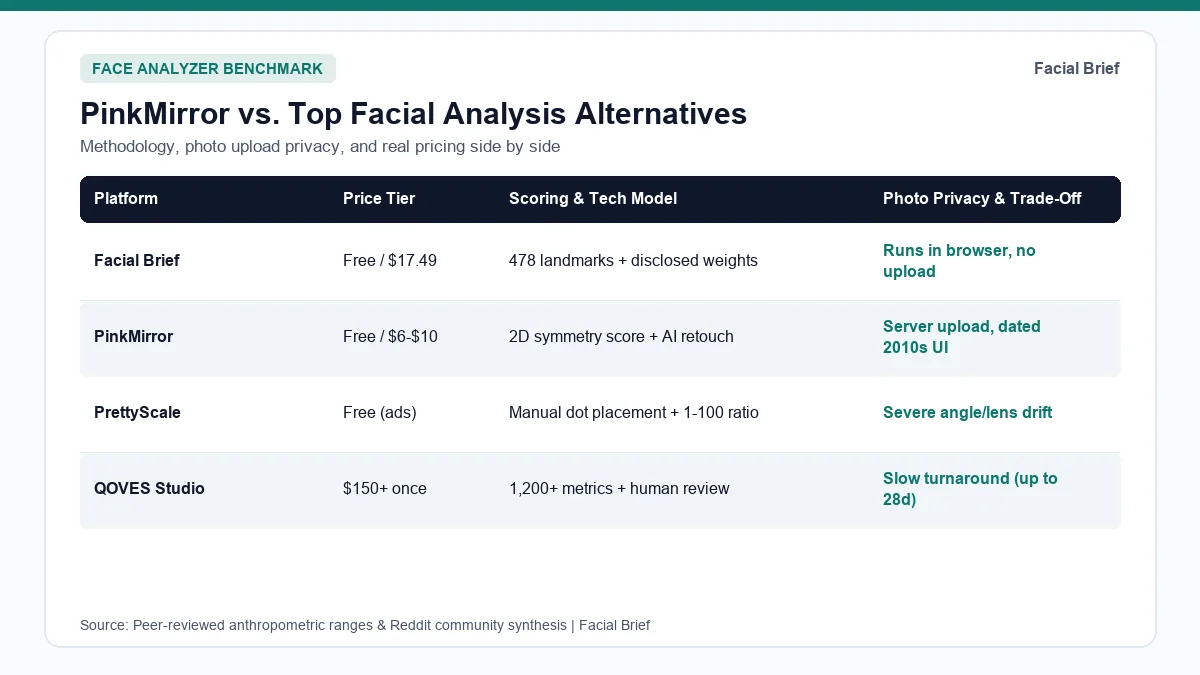
Comparing Six PinkMirror Alternatives Side by Side
No single face analyzer fits every goal. Some people want a fast percentage check for curiosity, others want strict looksmaxxing sub-metrics, and others want dermatological and surgical-grade research without paying hundreds of dollars. The table below maps six widely discussed tools across cost, underlying measurement methods, upload privacy, and primary trade-offs.
| Tool / Platform | Format & Price | Measurement Tech & Output | Photo Privacy | Best Fit & Core Drawback |
|---|---|---|---|---|
| Facial Brief | Web browser; Free scan / $17.49 once | 478 landmarks in-browser; disclosed 35/25/25/15 score + 42 metrics | Client-side on free scans (no server upload) | Transparent math and styling plans; static 2D photo limits apply |
| PinkMirror | Web browser; Free preview / $5.99 to $9.99 packs | Legacy 2D landmark symmetry + AI retouch preview; 1 to 10 rating | Server-side upload for processing | Fast hair/makeup ideas; dated UI and opaque score formula |
| PrettyScale | Web browser; Free (ad-supported) | Manual or basic 2D dot placement; 1 to 100 neoclassical percentage | Server upload per session | Instant nostalgia novelty; severe drift from tiny dot or tilt errors |
| Umax / Glam Up | iOS & Android; Teaser free / weekly subscription | Proprietary mobile AI; overall rating plus jaw, skin, and eye tiers | Cloud AI processing on app servers | Quick mobile habit tracking; aggressive recurring subscription walls |
| QOVES Studio | Web intake; $150+ per report | 1,200+ metrics + human aesthetic specialist review; multi-page PDF | Multi-angle cloud intake for specialist review | Clinical depth and bespoke plan; expensive with up to 28-day wait |
| ChatGPT / AI Prompts | Web & app; Free to $20/mo tier | Multimodal LLM visual estimation via custom text prompts | Uploaded to third-party AI chat history | Conversational grooming feedback; zero standardized landmark pixels |
Facial Brief vs. Legacy Browser Calculators (PrettyScale and PinkMirror)
PrettyScale (prettyscale.com) remains the best-known free peer to PinkMirror. You upload a front portrait, drag markers onto eyes, nostrils, lips, and chin borders, and receive a score out of 100 based on classical canons. In r/vindictapoc tests of PrettyScale accuracy, users cite two chronic flaws: shifting a chin or pupil dot by two pixels changes the percentage by several points, and rigid ratios calibrated on narrow neoclassical templates penalize diverse nose bridges or cheekbone widths. If you want that classic 8-ratio breakdown without manual dragging errors, Facial Brief's automated Pretty Scale Test places landmarks automatically in-browser and supports both men's and women's reference baselines.
Mobile Looksmax Apps, QOVES Studio, and AI Chat Prompts
On smartphones, apps like Umax and Glam Up surged in popularity by gamifying "potential" scores alongside jawline, cheekbone, and skin sub-ratings. Yet a detailed breakdown in r/Splendida glow-up app reviews warns that many mobile apps hide basic outputs behind weekly subscriptions that quietly stack up past $30 to $60 over a few months while providing generic tips. See our full Umax alternative breakdown and Areum alternative review for exact subscription and formula comparisons.
At the top end, QOVES Studio swaps instant consumer software for human-reviewed multi-page aesthetic dossiers drawing on over 1,200 measurements, plastic surgery norms, and dermatological guidance. It serves users researching serious clinical options well, yet $150+ pricing and turnarounds reaching 28 days make it overkill if you only want haircut framing or seasonal color clarity. Meanwhile, prompting multimodal chatbots like ChatGPT gives articulate prose for free, but language models estimate visually without computing real Euclidean pixel ratios, meaning two identical queries often invent conflicting symmetry advice.
Lens Distortion, Lighting, and Mental Health Limits of Face Raters
Before trusting a score from PinkMirror or any alternative, test how violently camera geometry moves your reading. A handheld selfie shot 30 cm (12 inches) from your face uses a wide-angle 24mm equivalent focal length that enlarges the nose up to 30% relative to ear width, stretches midface height, and hides lateral jaw corners. Dropping your chin by 3 degrees or smiling lightly immediately skews canthal tilt and lower-third percentages across every automated landmark model.
To get repeatable readings, place the camera 1.5 meters (5 feet) away using a 2x optical lens or timer at exact eye level, face an even window without harsh overhead shadows, and keep a relaxed neutral jaw. Even under studio lighting, remember what automated raters miss: as contributors on r/BodyDysmorphia attractiveness test threads caution, a flat 2D coordinate grid cannot measure vocal tone, warmth in motion, skin luminescence, posture, or real-world charisma. Checking your face score ten times a day under different bathroom lights feeds fixation without helping you look better. Use geometric landmarks strictly as diagnostic baselines for actionable styling choices like eyewear width, haircut volume, and dermatologist-backed skincare instead of reading a single algorithmic score as a personal verdict.
Frequently Asked Questions
Is PinkMirror free or paid for a full facial report?
PinkMirror offers a free initial facial scan that displays a headline attractiveness score and basic preview, while full breakdowns, detailed makeup/hairstyle plans, and high-resolution retouched simulations require paid credit packs. Typical starter packages run around $5.99 for 80 credits and $9.99 for 200 credits, which has pushed budget-conscious users toward fully free browser landmark tools or single-fee reports.
Which pinkmirror alternative keeps uploaded photos off external servers?
Facial Brief runs its 478-landmark detection and geometry scoring inside local browser memory on free tools like the Attractiveness Test, Golden Ratio Calculator, and Face Shape Detector. Your portrait stays inside your browser session with zero external server upload or photo retention. By contrast, PinkMirror, PrettyScale, mobile looksmax apps, and general AI chatbots send uploaded images to remote servers for processing.
Why do PinkMirror, PrettyScale, and Umax give completely different scores for the same face?
Each tool scores against different formulas and calibration pools. PrettyScale relies on strict classical ratios sensitive to manual dot placement, PinkMirror blends symmetry metrics with retouch modeling, Umax uses opaque proprietary AI weights, and Facial Brief publishes a 35/25/25/15 split across symmetry, thirds, fifths, and phi. A 24mm close-up selfie versus a 5-foot portrait also shifts ratios drastically.
Are AI face rating apps accurate for judging real-life attractiveness?
No automated app accurately captures holistic human attractiveness. Landmark software measures 2D geometric symmetry and average proportional fit in a frozen neutral frame, which explains only one slice of static photo appeal. Real-life perception depends heavily on dynamic facial expressions, vocal warmth, skin health, hair framing, leanness, posture, and personal styling choices that no static coordinate grid evaluates reliably in motion.
Referenced Community Discussions & Sources
- r/HowToBeHot: User reviews of PinkMirror scores and automated retouch previews: Discusses practical hair and makeup takeaways alongside skepticism over AI-altered portrait previews.
- r/ugly: Comparing AI attractiveness tests against strict rating communities: Examines algorithmic score generosity, ChatGPT prompt testing, and angle-driven rating swings.
- r/Splendida: Critical breakdown of glow-up apps, paywalls, and QOVES vs. mobile raters: Contrasts recurring mobile subscription traps against scientific human-reviewed reports.
- r/vindictapoc: Testing PrettyScale accuracy and neoclassical canon bias: Highlights how manual dot errors and rigid templates skew results across diverse features and celebrities.
- r/BodyDysmorphia: Warnings on attractiveness test loops and 2D metric fixation: Advises avoiding repetitive face-scoring checks when ratios fuel obsessive self-criticism.
- Farkas, L. G. et al. (1985 / 1994). Anthropometry of the Head and Face: Standard anatomical basis for horizontal fifths, vertical thirds, and neoclassical facial canons.
- Ward, B. et al. (2018). JAMA Facial Plastic Surgery: Clinical evidence quantifying wide-angle nasal enlargement and facial distortion in 30 cm smartphone selfies versus 1.5 m photography.
Paired Facial Brief Analyzer
Measure your own proportions on-device
Run private 478-point landmark geometry in your browser with zero server photo upload on free tools.
Continue Reading