How Much Is a PD? Adult Norms & Printable Ruler Guide
Learn how much is a PD in millimeters (54-74 mm), when single vs. dual PD matters, and compare printable ruler options, phone apps, and optician checks.
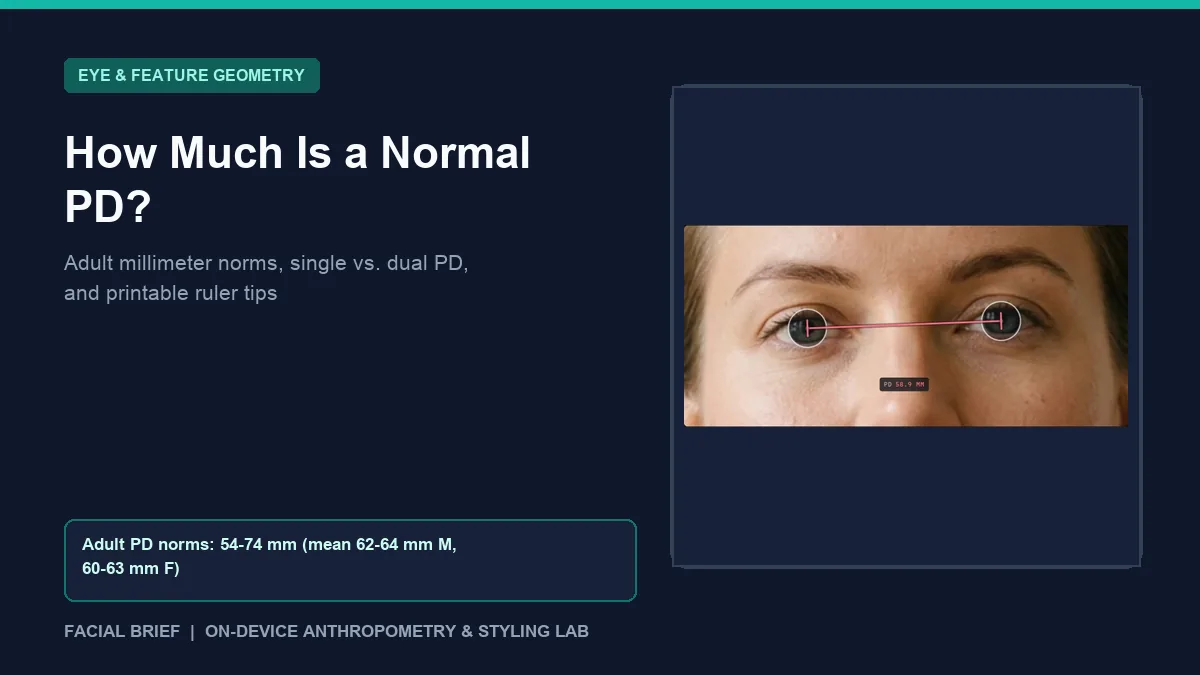
If you have ever stared at an online eyewear checkout box wondering how much is a pd, the short answer is a millimeter number measuring the straight distance between the centers of your two pupils. Most healthy adults fall between 54 mm and 74 mm, with men averaging 63 to 64 mm and women averaging 60 to 63 mm. The practical frustration begins when your eye clinic leaves that measurement off your printed prescription, forcing you to decide between walking back into an optical shop, trusting a phone camera, or downloading a sheet of paper ruler lines. You can Measure Your PD Free right in your browser to see where your eye spacing sits before ordering frames online.
Key Takeaways
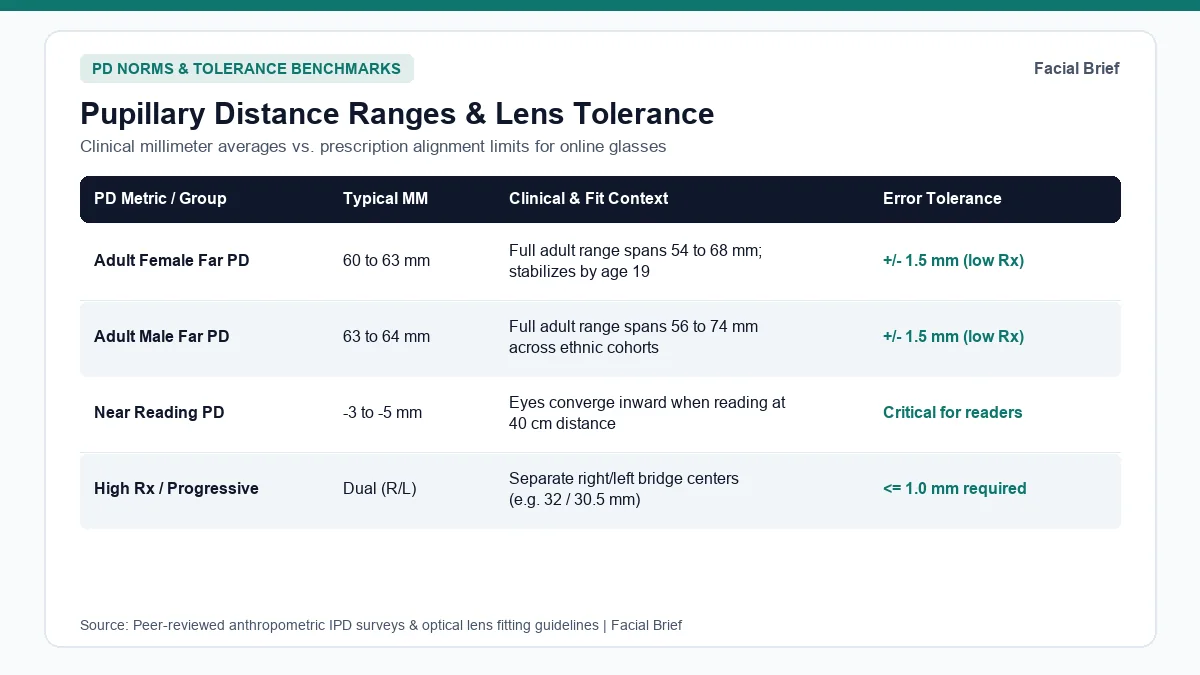
- Clinical anthropometric studies place normal adult far pupillary distance between 54 and 74 mm, averaging 63.0 to 64.2 mm in adult men and 60.3 to 63.1 mm in adult women.
- Far PD (looking at a distant wall) measures 3 to 5 mm wider than near reading PD (focusing at 40 cm) because your eyes converge inward for close reading.
- Single binocular PD splits one total number evenly across the nose bridge, while dual monocular PD separates right and left eyes (such as 32 / 30.5 mm) to match natural facial asymmetry.
- Low single-vision prescriptions under +/- 2.00 diopters tolerate a 1.5 mm offset, whereas strong prescriptions, high astigmatism, and progressives need alignment within 1.0 mm.
- Printing a millimeter strip works within 1 to 1.5 mm only when set to 100% scale, verified against a credit card, and read while looking past a mirror.
Normal Adult Millimeter Ranges and Single vs. Dual PD
Eye care providers measure interpupillary distance (IPD or PD) from the geometric center of the right pupil to the left pupil in straight-ahead gaze. Craniofacial growth stops near age 18 to 19, locking adult eye spacing steady for life. Adult males measure 2 to 3 mm wider on average than adult females, while healthy adults across North American, East Asian, and South Asian cohorts span 54 to 74 mm.
First-time buyers often worry when a home ruler reads 57 mm or 68 mm. Threads on r/glasses asking whether a PD measurement is normal show opticians reassuring shoppers that values in the high 50s and upper 60s sit comfortably inside typical anatomy. Readings below 52 mm or above 75 mm on an adult almost always come from ruler parallax error or close-up camera distortion.
Single Binocular PD vs. Dual Monocular PD
Online optical carts ask for either one combined number (like 63 mm) or two split numbers (like 32 mm right and 31 mm left). Single PD takes the full pupil-to-pupil span and splits it evenly across the middle of the nose bridge. Dual or monocular PD measures from the center of your nasal bridge to each pupil separately. Because mild nasal asymmetry of 0.5 to 2.0 mm is standard across human faces, r/LifeProTips threads on asking for a two-number PD recommend monocular readings whenever available. If your true bridge offsets are 30.5 mm and 33.5 mm, entering a single 64 mm leaves each optical center 1.5 mm off target.
Far PD vs. Near Reading PD
Looking from a street sign down to a phone screen at 40 cm turns both eyes inward, pulling near PD 3 to 5 mm narrower than far PD. Distance lenses and progressives require your far PD at checkout, while dedicated single-vision reading glasses use your near PD so each lens sweet spot lines up when reading.
Why Clinics Omit PD and How Much Error Hurts Your Eyes
Under the US FTC Eyeglass Rule, eye doctors must provide refractive lens numbers (sphere, cylinder, and axis), yet most states omit PD from required prescription fields because staff record it when fitting frames. Shoppers describe this hurdle in r/glasses threads where a clinic withheld PD after a $450 exam, while opticians in optometrist vs. optician PD discussions explain that optical dispensaries assume fit liability when grinding lenses.
Optical tolerances follow Prentice's rule: unwanted prism power equals lens power in diopters multiplied by optical center offset in centimeters. Feedback across r/glasses debates over a 2 mm PD difference aligns closely with optical math:
- Mild powers between
-1.50and+1.50diopters create under0.30prism diopters from a 2 mm offset, so wearers usually adapt easily. - Moderate prescriptions (
+/- 2.00to+/- 4.00) can trigger mild eye pull or headaches when shifted 2 mm. - Strong powers past
+/- 4.50, astigmatism over1.50CYL, and progressives lose clarity past1.0 mmof error, as buyers warn in r/optometry ordering miscalculation threads.
Cross-check how eye spacing pairs with outer-corner eye slant in our negative canthal tilt guide and hooded eyes framing guide.
How to Use a Printable PD Ruler Without Parallax Skew
Downloading a pupillary distance ruler printable sheet costs nothing, yet printer software quietly ruins readings when set to "Fit to page." A 5% scale shrink turns a true 64 mm span into 60.8 mm. Start with a calibrated Printable PD Ruler and follow four steps:
- Print the PDF at 100% Actual Size and test the scale bar against a standard 85.6 mm credit card or physical ruler, reprinting if it misses by even 1 mm.
- Ask a friend to read the strip while you stare past their shoulder at a distant wall object, preventing the 3 to 4 mm inward pupil convergence caused by mirror focus.
- Rest the strip horizontally across your brow bridge with
0 mmcentered over your right pupil, avoiding backward tilt along the nose. - If measuring solo in a mirror, stand 8 inches back, close your right eye to align
0 mmwith your left pupil center, hold steady, switch eyes, and read the mark opposite your right pupil center. This method mirrors r/glasses Zenni PD measurement tips.
Whether using a branded pd ruler printable PDF or a pupil distance ruler printable strip, average three readings across separate lighting setups.
Comparing PD Measurement Methods: Accuracy, Cost, and Limits
Comparing a printable pupillary distance ruler against phone apps and clinical pupilometers clarifies where each option works best.
| Measurement Method | Typical Accuracy | Cost & Turnaround | Setup Pitfalls | Best For |
|---|---|---|---|---|
| Digital Pupilometer (Optical Shop) | +/- 0.5 mm (Dual & Far/Near) | $0-$50 USD; 2 minutes | Some clinics charge fee without frame purchase | Strong Rx, progressives, high astigmatism |
| Friend + Verified Printed Ruler | +/- 1.0 to 1.5 mm | $0 USD (home printer); 5 minutes | Printer scaling, tilted strip, wrong gaze target | Standard single-vision orders online |
| Solo Mirror One-Eye Method | +/- 1.5 to 2.0 mm | $0 USD; 5 minutes | Hand wobble, head rotation, near eye focus | Low Rx backups under +/- 2.00 diopters |
| LiDAR / TrueDepth Phone App | +/- 1.0 to 2.0 mm | $0-$5 USD; 1 minute | Poor front lighting, dark iris detection errors | Quick checks and repeating readings |
| Standard Webcam + Card Strip | +/- 2.0 to 4.0 mm | $0 USD; 2 minutes | Wide-angle lens barrel distortion under 50 cm | Rough baseline before retail confirmation |
Standard phone cameras distort distances whenever users hold a pd ruler print card 30 cm from the lens, because foreground objects look magnified and shrink calculated PD by 2 to 3 mm. Stepping 1.5 meters back with a 2x lens removes that skew. For quick clinical verification, Costco Optical, Target Optical, and Warby Parker often run a digital pupilometer check free. Inspect full facial spacing inside a sample biometric report or check lower-third ratios in our lip shapes guide.
Ordering Glasses Online Safely With Your PD
Once your measurement repeats within 1 mm, compare it against the frame specs stamped inside the left temple arm, such as 52-18-140 (52 mm single lens width, 18 mm bridge, 140 mm temple). Adding lens width to bridge width (52 + 18 = 70 mm) gives the frame's geometric center-to-center distance. Subtracting your 64 mm PD leaves 6 mm total decentration, or 3 mm inward per eye, which keeps minus lenses thin at the outer edges. Putting a narrow 57 mm PD inside a wide 55-20 frame (75 mm span) forces 9 mm of inward shift per lens, making edges thick and exaggerating minification around your cheekbones.
Frequently Asked Questions
How much is a PD measurement on average for an adult?
Clinical anthropometric studies place average adult far pupillary distance at 63.0 to 64.2 mm for men and 60.3 to 63.1 mm for women. About 95% of healthy adults fall between 54 mm and 74 mm overall. Measurements under 52 mm or above 75 mm are rare in adults and usually reflect mirror convergence or close-up wide-angle phone lens distortion during home testing.
Is a printable pupillary distance ruler accurate enough for prescription glasses?
A pd ruler print template is accurate within 1.0 to 1.5 mm when printed at 100% actual size, checked against a credit card calibration box, and read by a friend while you focus on a distant wall. That tolerance works cleanly for low single-vision prescriptions under +/- 2.00 diopters, while strong powers or progressive multifocal lenses benefit from a 0.5 mm digital pupilometer check.
Should I enter a single PD or dual PD when buying glasses online?
Use a dual (monocular) PD whenever an optician provides separate right and left bridge numbers, such as 31.5 mm and 33.0 mm. Most adults have 1 to 2 mm of natural nasal bridge asymmetry. Entering separate monocular measurements centers each lens directly over its pupil, preventing mild prism pull and eye fatigue in moderate prescriptions, astigmatism, and progressive lenses.
Can an optometrist legally refuse to give me my pupillary distance?
In the United States, the FTC Eyeglass Rule requires clinics to hand over your refractive lens power (sphere, cylinder, and axis), yet most states omit PD from mandatory medical prescription rules. Some clinics withhold dispensary PD notes or charge a small fitting fee if you buy frames elsewhere, though retail optical counters and warehouse optical shops routinely measure it free on walk-in visits.
Referenced Community Discussions & Sources
- r/glasses: Is my pupillary distance measurement normal?: Opticians and everyday buyers compare outlier home readings against typical 57 to 68 mm adult spans.
- r/LifeProTips: Why you should always ask for a two-number dual PD: Explains how nasal bridge asymmetry causes single binocular PD averages to miss optical centers.
- r/glasses: Does a 2 mm difference in PD matter for prescription lenses?: Breaks down tolerance limits between mild single-vision prescriptions and stronger powers.
- r/glasses: Practical tips for Zenni printable PD rulers and mirror tricks: Covers scale calibration, avoiding mirror convergence, and single-eye alignment steps.
- r/glasses: Navigating clinics that withhold PD after an eye exam: Discusses FTC Eyeglass Rule boundaries and getting free digital checks at retail optical counters.
- r/optometry: Why miscalculating PD causes strain in online orders: Details unwanted prism side effects and lens edge distortion from home measurement errors.
- r/glasses: Difference between optometrist exams and optician PD checks: Clarifies optical lab liability, near vs. far PD adjustments, and frame bridge fitting.
- Clinical anthropometry reference: Normative adult interpupillary distance (IPD) surveys documenting sex dimorphism (male 63.0 to 64.2 mm vs. female 60.3 to 63.1 mm) and Prentice's rule optical decentration limits.
Paired Facial Brief Analyzer
Measure your own proportions on-device
Run private 478-point landmark geometry in your browser with zero server photo upload on free tools.
Continue Reading