Eye Shape Chart: Measure Your Eye Type, Tilt & Lashes
Use our eye shape chart to spot upturned, almond, round, hooded, and monolid eyes via EAR and canthal tilt, plus a 6-type lash and liner table.
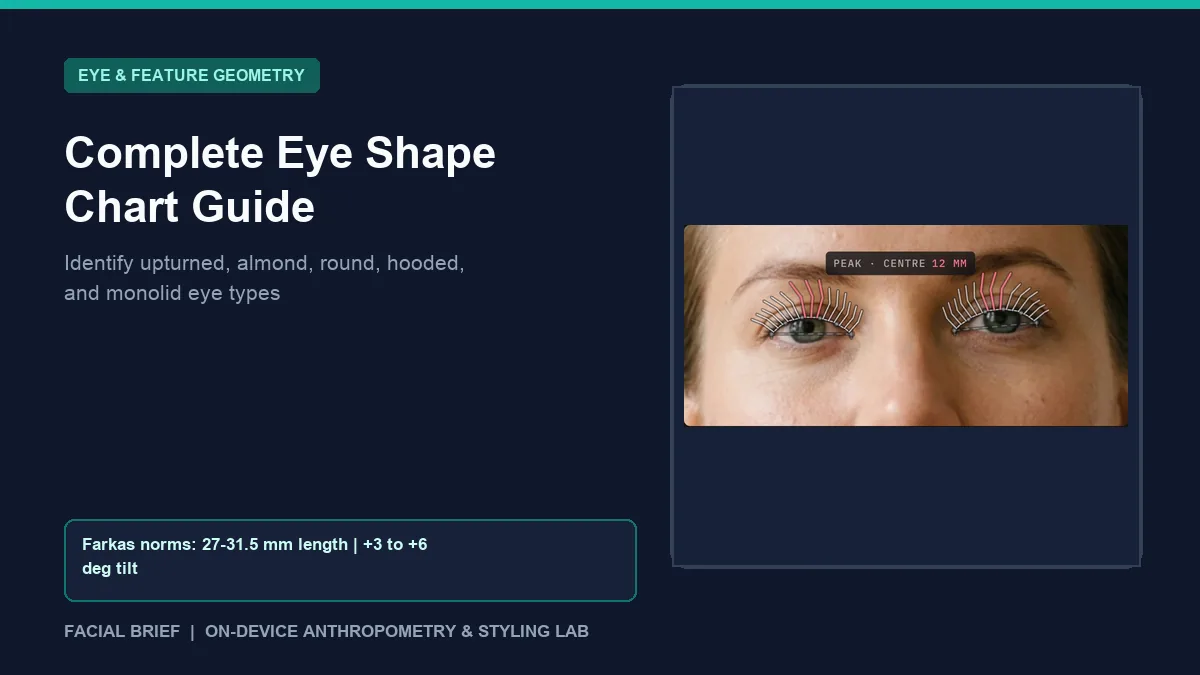
Comparing your eyes to a standard six-box eye shape chart leaves most readers torn between two or three labels. Magazine diagrams present almond, round, hooded, monolid, deep-set, and upturned eyes as strict separate buckets, even though anatomy layers three independent traits together: eyelid crease depth, vertical opening ratio, and outer-corner angle. Across r/MakeupAddiction and r/BeautyDiagrams, users asking what eye shape do I have usually discover they carry a combination profile rather than one isolated icon, especially when upper-lid skin folds meet a lifted outer corner. Measuring opening height against width (Eye Aspect Ratio) alongside pupil-leveled corner tilt takes the guesswork out of mirror comparisons: Detect Your Eye Shape directly in your browser using a straight-on daylight photo.
Key Takeaways
- Craniofacial norms from Farkas place healthy adult palpebral fissure width at
27.0 to 31.5 mm, vertical opening height at8.0 to 12.0 mm, and average upward inclination near+3 to +6 degrees. - Facial Brief classifies aperture proportions by Eye Aspect Ratio (
EAR >= 0.36Round,0.26 to 0.35Almond,<= 0.25Elongated) and corner orientation by canthal tilt (>= +1.8 degreesupturned,<= -1.0 degreedownturned). - An eye type label usually combines three axes: opening shape, crease anatomy (visible, hooded, monolid, or deep-set), and horizontal spacing (
0.91x to 1.09xeye width). - No global medical registry tracks percentages for the most common eye shape; almond proportions serve as the baseline in Western tutorials, while hooded folds and monolid-to-tapered creases span large global populations.
- Matching 5-zone lash lengths (
7 to 13 mm) and liner angles to measured EAR and tilt prevents outer-corner droop or pinched wings on upturned lids.
How to Know Your Eye Shape Using Geometry and the Mirror Check
Figuring out how to know your eye shape becomes simple once you replace single-word guessing with four sequential checks. Both craniofacial anthropometry and crowdsourced guides like this r/coolguides step-by-step checklist and this r/MakeupAddiction flowchart follow the same order while keeping eyebrows completely relaxed at eye level.
- Check eyelid crease and socket depth. Look dead straight into a mirror. A crisp strip of visible mobile lid (
5 to 8+ mm) from corner to corner points to a standard double crease. If upper brow skin folds down over that crease at rest, you have hooded eyes. A smooth lid-to-brow plane without an indented fold marks a monolid, whereas deep-set sockets sit behind a projecting brow bone while keeping mobile lid visible inside the shadow. - Check vertical opening (EAR) and white sclera exposure. Look centered at the mirror. When upper and lower lids meet the top and bottom iris borders cleanly (
EAR 0.26 to 0.35), the opening is almond. Visible sclera above or below the iris (EAR >= 0.36) indicates round eyes, while narrower horizontal openings (EAR <= 0.25) read elongated. - Run the horizontal straight-edge tilt test. Align a ruler across both inner eye corners. Outer corners rising clearly above that line (
+1.8 degreesor higher, with+5.5 degreesserving as Facial Brief's dedicated upturned cutoff) classify as upturned eyes. Corners near0 degreessit level, while-1.0 degreeor lower marks downturned tilt, covered in our negative canthal tilt guide. Verify exact left-right degrees with Facial Brief's Canthal Tilt Calculator. - Check horizontal spacing between inner corners. A gap near one eye width (
0.91x to 1.09x) is balanced;<= 0.90xis close-set and>= 1.10xis wide-set. Measuring inter-eye geometry alongside Pupillary Distance also simplifies eyewear bridge sizing.
Avoiding Selfie Distortion and Inclusive Crease Blind Spots
Two mistakes skew self-checks quickly. Holding a phone below chin height forces a downward glance that hides hooded folds while exaggerating upward corner tilt, so always shoot level from 4 to 5 feet away with a rear lens. Second, mainstream Western charts miss East Asian and Southeast Asian lid variety. Contributors in this r/MakeupAddiction 20-type eye guide document how tapered creases (merging into the inner corner fold) and parallel double creases behave differently under eyeshadow than classic deep-set sockets. Separating lid crease from opening shape solves that blind spot cleanly.
Eye Type Chart: Comparing All Seven Primary Profiles
Visual matrices on r/BeautyDiagrams solve what is my eye shape faster when each category pairs directly with liner angles and lash lengths. Facial Brief's Open Lash Map Tool scales five upper-lid zones in millimeters against the adult 11.7 mm iris diameter.
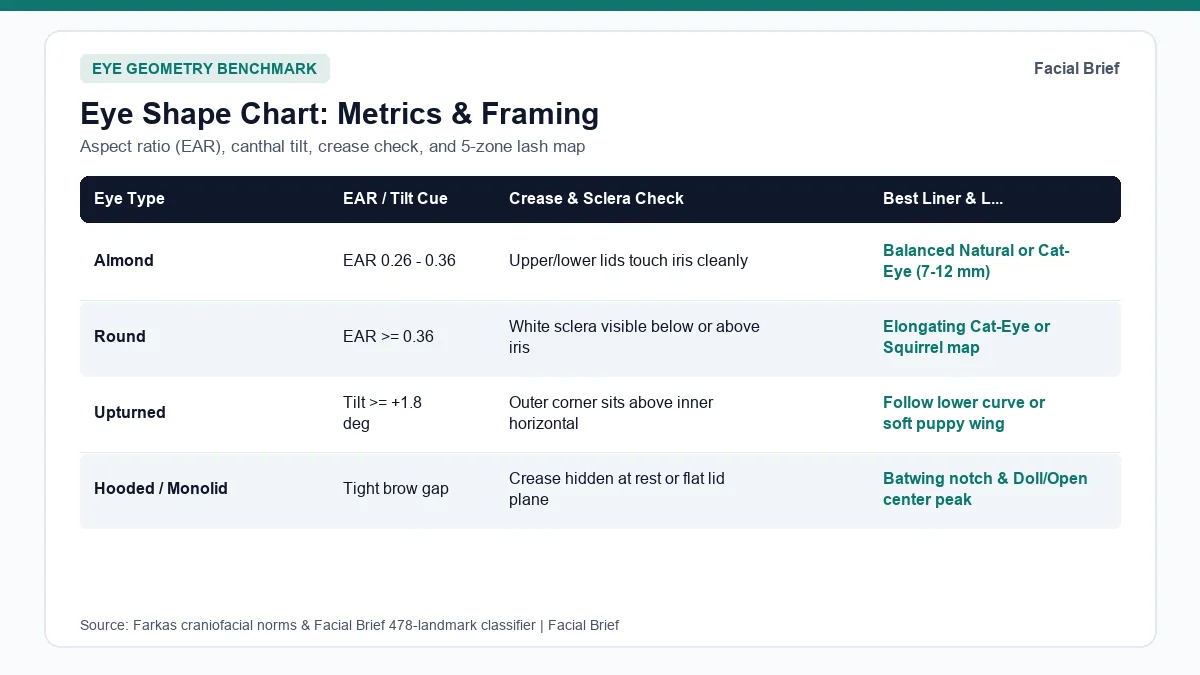
| Eye Type | EAR & Tilt Cue | Crease & Sclera Marker | Recommended Liner & Shadow | 5-Zone Lash Map (mm) |
|---|---|---|---|---|
| Almond | EAR 0.26 to 0.35; near-level or mild lift | Upper and lower lids touch iris margins cleanly | Thin classic wing; balanced crease shading | Natural (7-8-10-10-8) or Cat Eye (7-9-10-12-11) |
| Round | EAR >= 0.36; broader vertical opening | White sclera visible below or above iris | Outer-third tightline and horizontal extension | Cat Eye (7-9-10-12-11) or Squirrel (7-9-11-13-10) |
| Upturned | Canthal tilt >= +1.8 deg (>= +5.5 deg primary) | Outer corner sits noticeably above inner corner | Low-angle outer wing or soft horizontal puppy liner | Natural (7-8-10-10-8) or Doll (8-10-12-10-8) |
| Downturned | Canthal tilt <= -1.0 deg | Outer corner drops below medial horizontal | 15 to 20 deg upward wing; skip lower-outer liner | Squirrel (7-9-11-13-10) lifting zone 4 peak |
| Hooded / Deep-Set | Any EAR; tight brow-to-lid gap | Brow skin covers crease at rest, or deep orbital shadow | Open-eye transition shade + stepped batwing liner | Open Eye (8-11-12-11-9) or Doll (8-10-12-10-8) |
| Monolid / Elongated | EAR <= 0.25 or absent crease fold | Smooth lid-to-brow plane; minimal upper-lid shadow | Tightline lash base + soft gradient above open pupil | Doll (8-10-12-10-8) or Open Eye (8-11-12-11-9) |
Check how your eye type balances against brow arches and facial thirds inside a sample facial report or explore all 42 geometry metrics in the 42-Metric Full Report.
Upturned Eyes, the Most Common Eye Shape Myth, and Combination Lids
Searches asking for the most common eye shape rarely find reliable statistics because clinical ophthalmology tracks millimeter fissure length (27 to 31.5 mm), vertical opening height (8 to 12 mm), and inclination angles rather than cosmetic chart labels. No medical census assigns global percentages across beauty types.
Across r/Makeup101 classification threads and r/QOVESStudio eye proportion posts, almond proportions function as the common Western baseline, while hooded creases and monolid-to-tapered lids represent massive global cohorts across East Asian, Southeast Asian, Northern European, and aging adult demographics as upper-lid elastin relaxes after age 35.
More importantly, this r/HoodedEyes identification thread shows that combination eyes are ordinary. You can easily have upturned eyes paired with hooded upper folds, or almond apertures inside deep-set sockets. When traits overlap, let crease behavior govern liner placement (batwing notch mapped with relaxed eyes) and let EAR plus tilt guide lash length distribution.
Styling Rules for Upturned, Round, and Hooded Combinations
- Upturned eyes (
+1.8 degreesand above): Because outer corners already tilt upward toward the temple, sharp 45-degree cat-eye wings often appear pinched. Extend a thin line following the lower lash trajectory softly outward, or flatten the tail slightly like puppy liner when you want a softer round effect. Keep lash extensions balanced with Natural (7-8-10-10-8 mm) or center-peaked Doll (8-10-12-10-8 mm) maps rather than heavy outer zone 5 spikes. - Round eyes (
EAR >= 0.36): Skip dark eyeliner along the center lower waterline, which accentuates vertical openness. Focus smudge or crisp liner along the outer third, curl outer lashes firmer than center lashes, and choose Cat-Eye (7-9-10-12-11 mm) or Squirrel (7-9-11-13-10 mm) maps peaking at zone 4 to lengthen horizontally. - Elongated or monolid eyes (
EAR <= 0.25): Tightline directly between upper lash roots so liner leaves limited vertical lid space uncluttered, and blend soft matte shadow just above the visible fold while looking straight ahead. Pair with Doll or Open Eye peaks to expand center height. - Brow framing and orbital care: Clean outer brow tails elevate eye balance cleanly; measure start, arch peak, and tail coordinates with Facial Brief's Eyebrow Mapping Tool and our eyebrow framing guide. Around the eye socket, consistent sleep, sunglasses, broad-spectrum SPF 30+, and gentle eye moisturizers support skin hydration and reduce morning fluid puffiness, whereas facial exercises cannot alter orbital bone depth or tendon angle.
Frequently Asked Questions
How do I know what eye shape I have from a selfie?
Take a straight-on photo at exact eye height from four to five feet away with relaxed eyebrows and even front lighting, then check three markers in order. First see whether upper skin drapes over your crease at rest (hooded or monolid). Next check whether white sclera shows above or below your iris (round vs. almond or elongated). Finally trace a horizontal line across both inner corners to spot upturned, level, or downturned tilt.
What is the most common eye shape globally?
No clinical survey records exact global percentages across beauty categories because eyelid anatomy overlaps across populations. In everyday makeup guides, almond eyes (balanced aspect ratio with upper and lower lids meeting the iris cleanly) serve as the widest baseline shape, while hooded eyelids and monolid-to-tapered creases are also widespread across multi-ethnic groups and become increasingly common as upper-lid elastin softens after age 35.
Can I have both upturned eyes and hooded eyelids?
Yes. Eye shape categories describe separate anatomical axes rather than mutually exclusive boxes, so upturned corners regularly appear alongside partially or fully hooded upper folds. Your lateral canthal tendon sets the upward corner angle relative to the inner tear duct, whereas brow-bone skin controls visible mobile lid height at rest. Pair open-eye batwing crease placement with a subtle, low-angle outer wing tail.
What eyeliner and lash map work best for upturned or round eyes?
For upturned eyes, skip steep upward wings that exaggerate natural corner lift; trace a thin line out from the lower lash curve and pair with a Natural (7-8-10-10-8 mm) or center-peaked Doll (8-10-12-10-8 mm) lash map. For round eyes (EAR >= 0.36), avoid dark liner along the center lower lid and choose a Cat-Eye or Squirrel lash map peaking at outer-arch zone 4 (12 to 13 mm) for horizontal elongation.
Referenced Community Discussions & Sources
- r/coolguides: Visual straight-edge and crease checklist for eye shape identification: Details the three-step crease, tilt, and iris-sclera verification workflow.
- r/MakeupAddiction: Community flowchart for sorting overlapping eye shapes: Walks through layered decision branches while critiquing rigid Eurocentric beauty diagrams.
- r/MakeupAddiction: Inclusive 20-eye-shape guide covering tapered and parallel lids: Maps East Asian monolid, tapered crease, and parallel double-lid variations omitted from standard charts.
- r/BeautyDiagrams: Comprehensive eye-type visual matrix and liner placement guide: Compares almond, round, upturned, downturned, deep-set, and hooded framing rules.
- r/HoodedEyes: Identifying combination upturned and hooded eye anatomy: Shows why outer-corner tilt and lid hooding frequently appear together on the same eye.
- r/Makeup101: Practical classification tips for uncertain first-time self-checks: Addresses everyday misclassifications caused by downward phone angles and raised brows.
- r/QOVESStudio: Eye-region geometry, scleral show, and lid exposure proportions: Summarizes anthropometric eye markers including canthal tilt, palpebral height, and intercanthal spacing.
- Farkas, L. G. et al. (1985 / 1994). Anthropometry of the Head and Face: Reference standards for adult palpebral fissure length (
27.0 to 31.5 mm), vertical opening height (8.0 to 12.0 mm), and fissure inclination.
Paired Facial Brief Analyzer
Measure your own proportions on-device
Run private 478-point landmark geometry in your browser with zero server photo upload on free tools.
Continue Reading