Mewing Results: Timelines, Age 40 Limits & Scientific Evidence
What do mewing results show? Review adult timelines, age 40 limits, NHS and orthodontic evidence, and our clinical vs. Reddit comparison table before starting.
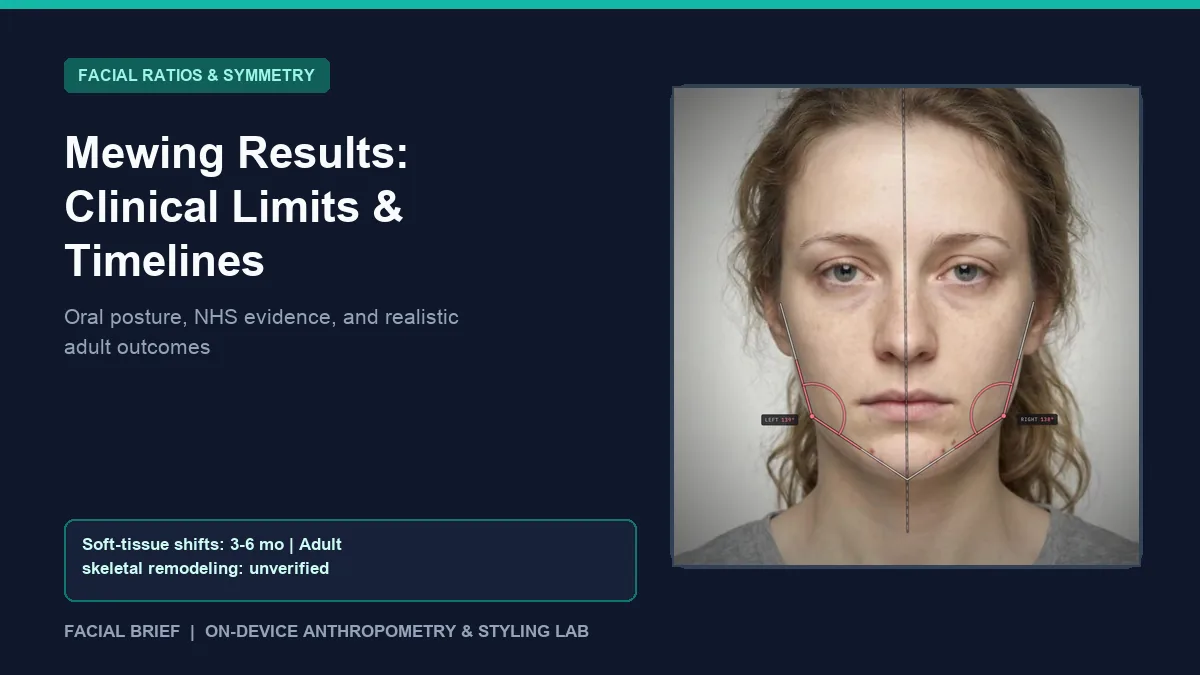
Viral transformation clips routinely promise dramatic bone remodeling from resting your tongue against the roof of your mouth, turning mewing results into one of the most contested topics in facial aesthetics. On one side sit TikTok edits labeled "mewing god" showcasing razor-sharp jawlines within months; on the other sit dental regulators, clinical orthodontists, and skeptical adult practitioners pointing out that fused facial sutures do not shift like adolescent clay.
Separating real soft-tissue and airway benefits from camera illusion starts with measuring your current lower-face baseline under repeatable lighting. You can run a quick on-device jaw-angle and symmetry scan using Check Jawline Score or test side proportions with the Side Profile Analyzer before tracking any habit changes over time.
Key Takeaways
- Mainstream orthodontic bodies (AAO, British orthodontic authorities, and UK dental regulators) find zero randomized controlled trials proving voluntary tongue posture reshapes adult jaw bone.
- Early visual improvements reported within 1 to 3 months on r/Mewing and r/orthotropics reflect submental muscle lifting, neck chin-tuck posture, and nasal breathing instead of skeletal bone growth.
- Adults asking how long for mewing results at 40 generally see no bone remodeling; positive reports over 1 to 5 years come from fat loss, reduced mouth-breathing puffiness, and tighter under-chin tone.
- Aggressive "hard mewing" (forcefully pressing the tongue upward) carries documented risks of temporomandibular joint (TMJ) pain, tooth flaring, and bite disruption.
- Standardized lighting, focal length (50mm to 85mm equivalent), and consistent body weight account for a large share of dramatic online before-and-after jawline photos.
What Mainstream Science and NHS-Aligned Guidance Say About Mewing
Searching for nhs mewing evidence jawline or mewing effectiveness scientific evidence jawline leads quickly to one unambiguous clinical consensus. While the UK National Health Service does not endorse mewing as an aesthetic jawline procedure, UK dental regulators, the British Orthodontic Society, and the American Association of Orthodontists address the underlying claims directly.
Why Adult Facial Bones Do Not Readily Remodel
Mewing takes its name from British orthodontists John Mew and his son Mike Mew, who promoted a philosophy called orthotropics centered on oral posture, palatal width, and nasal breathing. In children and early adolescents whose cranial sutures and midpalatal suture remain open and actively growing, chronic mouth breathing and low tongue posture can correlate with narrower dental arches and steeper mandibular planes. Orthodontists routinely evaluate airway and oral habits in pediatric patients for that reason.
Once puberty concludes and facial growth plates ossify, the biology shifts sharply. No peer-reviewed randomized controlled trial demonstrates that light or moderate voluntary tongue pressure advances an adult maxilla or expands a fused adult palate. In the United Kingdom, regulatory scrutiny over unproven orthotropic claims and potential patient harm culminated in Mike Mew's expulsion from the British Orthodontic Society and eventual removal from the General Dental Council register. Clinical consensus remains straightforward: genetics, developmental history, and body composition drive adult jaw structure, while structural malocclusions require licensed orthodontic appliances or orthognathic evaluation.
What Posture Changes Immediately
Skeptics sometimes miss why millions of people swear they see an immediate mirror difference when lifting their tongue. When the tongue drops to the floor of the mouth during slack mouth breathing, the suprahyoid and mylohyoid muscles underneath the chin relax downward, softening the cervicomental angle beneath the mandible. Lifting the entire tongue gently against the palate raises the hyoid bone and tightens that submental floor instantaneously.
Hold a profile mirror while resting your tongue flat on the palate, closing your lips lightly, and aligning your ears over your shoulders. The under-chin shadow sharpens immediately without shifting a single millimeter of bone. That mechanical lift, paired with nasal breathing and better neck alignment, explains a major share of short-term positive feedback in adult threads.
Realistic Mewing Timelines Across Age Brackets on Reddit
Browse thousands of progress threads on r/orthotropics and r/Mewing and the question how long does mewing take yields wildly different answers depending on the poster's age and body fat.
1 to 3 Months: Posture, Nasal Airway, and Submental Lift
Practitioners logging consistent suction holds in the first 90 days almost never report skeletal changes. What they report instead are functional adjustments: fewer morning dry-mouth episodes, steadier nasal breathing during light exercise, and noticing when forward head posture collapses during desk work. Some Redditors add nighttime habits such as side-sleeping posture adjustments or nasal strips after realizing mouth breathing returns overnight.
6 to 12 Months: Soft-Tissue Tone and the Body-Fat Illusion
Most viral "mewing god" posts come from teenagers and men or women between 17 and 23 posting 6-month to 12-month comparisons. Reading the comment sections carefully reveals two recurring confounders. First, adolescents between 14 and 19 undergo natural late-stage mandibular growth and facial fat redistribution regardless of tongue posture. Second, young adults frequently combine oral posture with gym training, cutting body fat from 18% down to 12% or 13%. Losing subcutaneous facial fat exposes existing mandibular bone and hollow cheeks that were already present underneath, as covered in our gonial angle guide.
How Long for Mewing Results at 40 and Beyond?
Users searching how long for mewing results at 40 deserve candid expectations. Across long-term adult threads on r/Mewing and r/orthotropics covering ages 30 to 45, posters tracking progress over 1 to 5 years almost uniformly state that dramatic skeletal advancement did not happen. What adults in their late 30s and 40s generally report are subtle functional gains: easier daytime nasal breathing, slightly firmer submental tone when paired with chin-tuck posture, less facial water retention after cleaning up sleep and hydration, and better tongue space awareness. When an adult over 35 wants sharper jaw framing, lowering overall body fat, reducing high-sodium bloating, grooming beard lines intentionally, or checking symmetry imbalances via our facial symmetry guide produces far more reliable results than pressing harder on the palate.
Comparing Clinical Evidence vs. Reddit Anecdotes
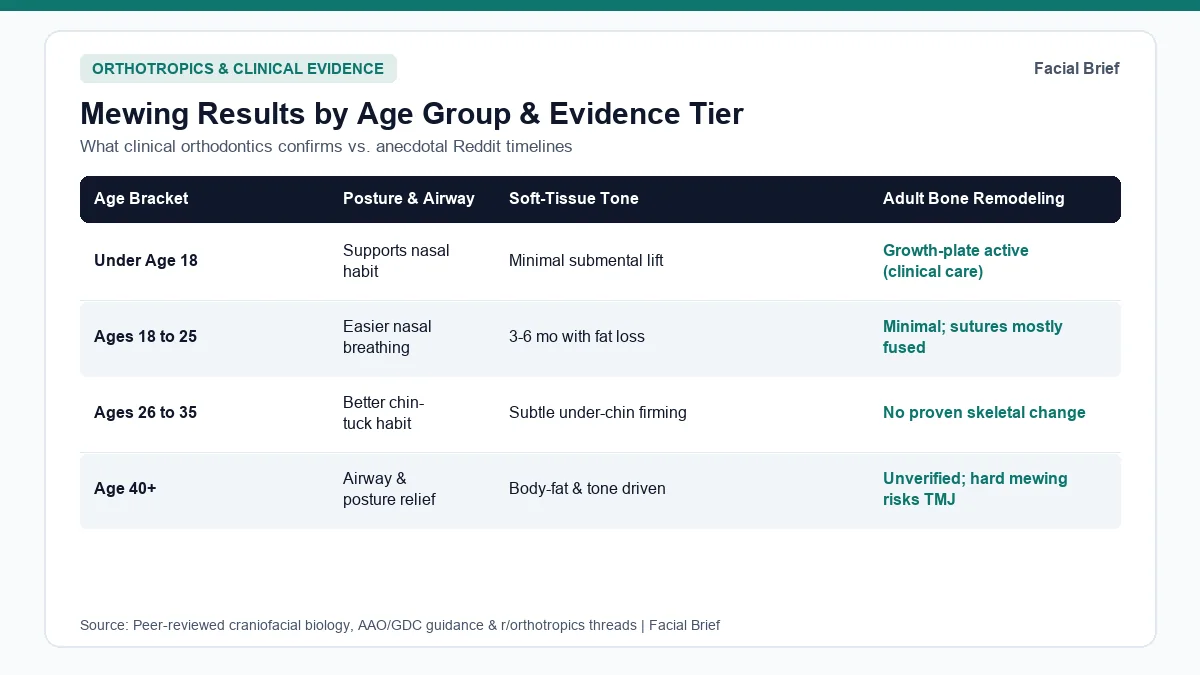
The table below lines up what orthodontic science supports alongside the exact timelines and confounders reported in Reddit progress threads.
| Dimension | Clinical Orthodontic Consensus | Typical Reddit Anecdotal Report | Primary Confounder or Risk |
|---|---|---|---|
| Under Age 18 Bone Guidance | Oral posture and nasal airway affect growing arches | Dramatic forward jaw changes in 6 to 18 months | Normal puberty growth and mandibular lengthening |
| Adult (18-29) Bone Shift | No RCT proof of skeletal remodeling after suture fusion | Sharper jawline in 6 to 12 months | Body-fat drop, beard growth, 24mm vs. 50mm lens angle |
| Adult (30-40+) Bone Shift | Maxillary suture ossified; bone shift unverified | Multi-year slight tightening, airway comfort | Neck alignment, hydration, lower facial puffiness |
| Submental Under-Chin Lift | Instant mechanical elevation of hyoid muscles | Immediate profile boost when holding suction | Reverts when posture fatigues unless habitual |
| Hard Mewing Force | Risks TMJ strain, tooth tipping, and bite collapse | Sometimes credited for fast changes, then warned against | Enamel wear, jaw clicking, headaches, dental shifting |
If you want to understand how lower-face geometry interacts with your midface, eyes, and hair balance instead of obsessing over one metric, Facial Brief's 42-Metric Full Report maps 40+ front and profile-related ratios across seven regions and turns them into non-surgical styling and grooming priorities. You can inspect a full breakdown on our sample Face Report page first.
Safe Oral Posture vs. Harmful "Hard Mewing" Mistakes
One of the sharpest divides inside Reddit communities sits between relaxed suction posture and forceful "hard mewing." Recognizing that distinction prevents preventable dental bills.
Why Forceful Pressing Backfires
Hard mewing means actively driving the tongue upward with muscular force for hours a day, sometimes paired with heavy jaw clenching or aggressive gum chewing. Dentists and r/orthotropics veterans routinely warn against it for three reasons:
- Unbalanced tongue pressure against the upper incisors can tip front teeth forward, creating spacing gaps or flaring an otherwise aligned bite.
- Chronic clenching overloads the temporomandibular joint, triggering morning jaw stiffness, clicking sounds, earaches, and tension headaches.
- Overworking masseter muscles without balanced occlusion can widen the lower jaw unevenly if you chew predominantly on one side.
If you already notice jaw clicking, facial pain, snoring, sleep apnea symptoms, or malocclusion, stop self-directed force experiments and consult a licensed dentist, orthodontist, or sleep specialist.
Auditing Progress Photos Without Lens Deception
If you choose to track natural nasal breathing, relaxed suction posture, and fitness changes over 6 to 12 months, avoid deceiving yourself with mismatched photos. Wide-angle selfie cameras held at arm's length exaggerate chin narrowness and nose prominence; overhead bathroom lights carve artificial cheek shadows. Shoot progress checks in the same soft indirect daylight, stand five feet from a rear 2x lens at eye height, keep teeth lightly apart or barely touching without clenching, and maintain the same facial hair and weight log. Measuring repeatable landmarks through Facial Brief's Facial Ratios Calculator keeps comparisons grounded in fixed coordinates instead of flattering shadows.
Frequently Asked Questions
What does the NHS or clinical dentistry say about mewing?
Mainstream dental authorities, UK orthodontic bodies, and the American Association of Orthodontists state that no randomized controlled trials prove voluntary tongue posture alters adult jaw bone structure. While nasal breathing and relaxed resting tongue posture support healthy pediatric development and daytime airway comfort, adults seeking structural bite alignment or noticeable jaw correction require licensed orthodontic appliances or clinical evaluation by an oral surgeon.
How long does mewing take to show noticeable results?
An immediate mechanical lift under the chin appears within seconds whenever your tongue rises into a relaxed palatal suction seal, tightening the suprahyoid muscles beneath the jaw. Longer visual differences reported over 3 to 12 months in Reddit progress logs almost always overlap with overall body-fat loss, improved forward-head neck posture, facial hair framing, or late adolescent bone growth instead of adult skeletal remodeling.
Can you get mewing results at 40 years old?
Adults at 40 should not expect maxillary expansion or mandibular bone remodeling because the cranial and palatal sutures are ossified. Practitioners in their late 30s and 40s who report useful outcomes cite steadier nasal breathing, reduced morning dry mouth, subtle submental firming from better neck posture, and sharper jaw visibility achieved by trimming excess facial weight, cutting sodium retention, and refining beard or hair proportions.
Is hard mewing safe if you want faster jawline results?
No. Orthodontists and experienced r/orthotropics moderators advise against forceful upward pushing or sustained clenching to speed up results. Driving heavy muscular force against your teeth and joints increases the risk of temporomandibular joint (TMJ) clicking, morning facial soreness, chronic tension headaches, enamel stress, and unwanted anterior tooth flaring that can disrupt your bite and require costly orthodontic braces to repair.
Referenced Community Discussions & Sources
- r/Mewing: Scientific proof check on whether mewing restructures adult bone: Community members examine peer-reviewed limits and why clinical RCT evidence remains absent.
- r/orthotropics: Evaluating scientific evidence behind oral posture claims: Thread breaking down childhood growth data versus adult bone stability.
- r/Mewing: Progress timeline from age 34 to 40: Long-term adult practitioner details realistic soft-tissue, weight, and posture factors over six years.
- r/orthotropics: Starting mewing after your 30s and late-30s expectations: Older practitioners weigh subtle airway and submental changes against bone limits.
- r/orthotropics: Late-30s experience with suction hold vs. airway comfort: User summarizes breathing benefits and realistic appearance expectations past age 35.
- r/Mewing: Six-month adult timeline and lighting/posture lessons: Detailed breakdown separating early under-chin tone from dramatic viral claims.
- r/Mewing: Common mewing mistakes made during the first months: Practitioner warns against clenching, hard pushing, and ignoring neck alignment.
- Clinical References: American Association of Orthodontists consumer advisories on unverified DIY jaw exercises; UK General Dental Council regulatory guidance on evidence-based orthodontic practice.
Paired Facial Brief Analyzer
Measure your own proportions on-device
Run private 478-point landmark geometry in your browser with zero server photo upload on free tools.
Continue Reading