Asymmetrical Face Exercises: Evidence, Limits & Habits
Can asymmetrical face exercises fix facial asymmetry? See mm masseter variances, Reddit posture trials, and our soft-tissue vs. bone comparison table.
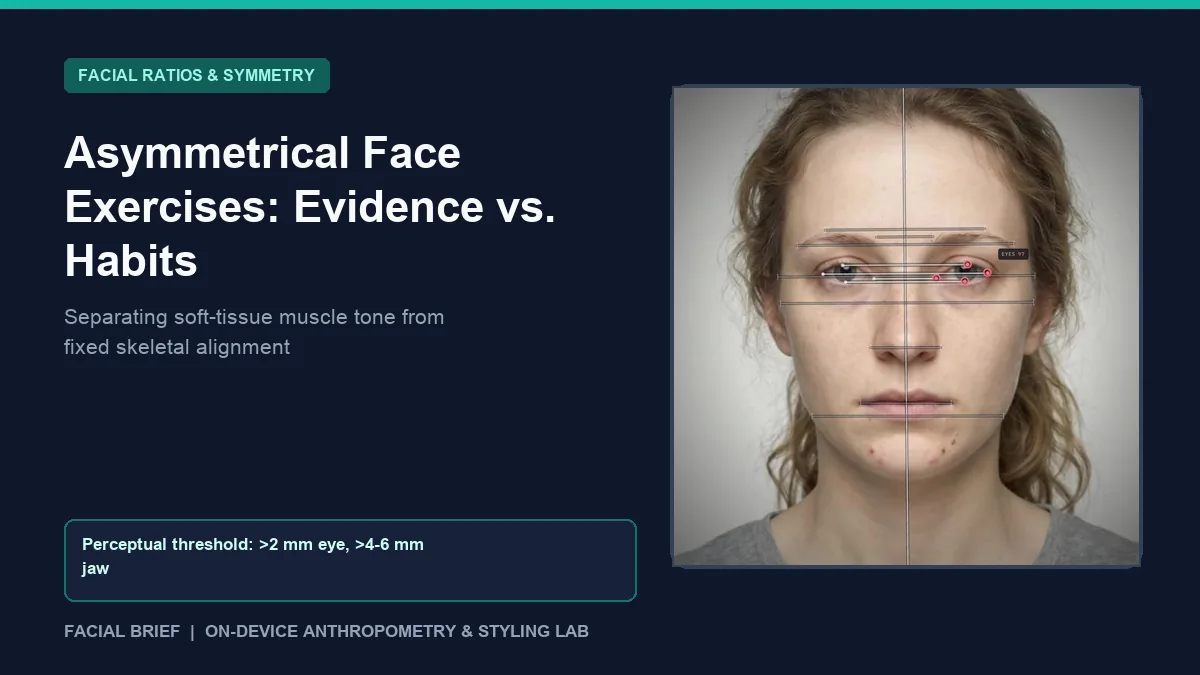
People searching for asymmetrical face exercises usually arrive after flipping a front-facing selfie or trying an inverted camera filter and suddenly feeling like one eye sits higher or one jaw corner hangs wider than the other. Across beauty, posture, and jaw forums on Reddit, one pattern repeats: exercises get marketed as a universal way to move bone, yet what shifts in adults is soft-tissue tension, masseter bulk, fluid retention, and camera angle.
Before starting any unilateral chewing or face-yoga drill, measure whether your imbalance is genuine anatomy or a tilted head and side lighting. You can Test Facial Symmetry directly in your browser using 478 landmarks leveled across your eye axis, with mirrored left-half and right-half previews.
Key Takeaways
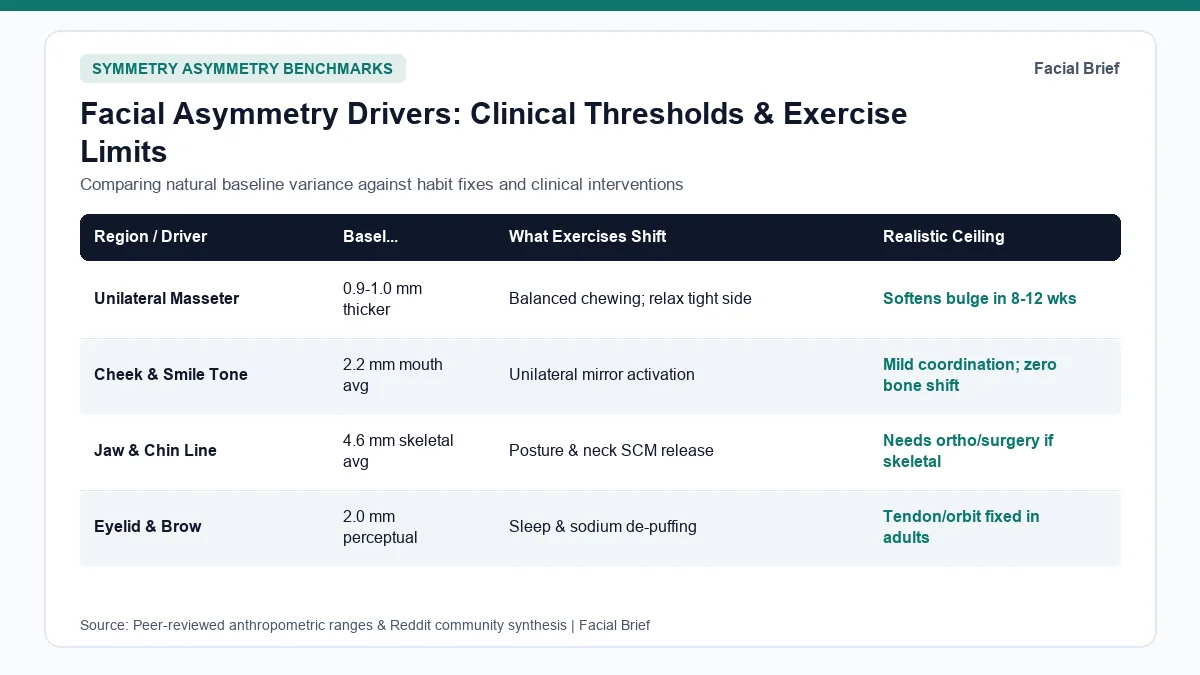
- Clinical 3D facial scans show normal adult left-right asymmetry averages roughly 2.2 mm at the mouth corners, 3.3 mm at the cheekbones, and 4.6 mm along the mandibular angle.
- Casual observers rarely notice asymmetry until differences cross roughly 2 mm around the eyelids, 3 mm at the lips, or 4 to 6 mm along the chin and jawline.
- Habitual single-side chewers develop measurable masseter differences around 0.9 to 1.0 mm at rest (12.2 mm vs. 11.3 mm on ultrasound), which respond better to balanced chewing or targeted clinical relaxation than aggressive face workouts.
- Bilateral face yoga trials show mild cheek fullness gains over 20 weeks, yet practicing symmetrical exercises on an uneven face cannot selectively erase skeletal tilt or dental crossbites.
- Posture adjustments such as back-sleeping, releasing a tight sternocleidomastoid, and checking TMJ alignment prevent acquired soft-tissue drift from worsening over years.
Why Your Face Looks Uneven in Selfies vs. Everyday Life
Two optical traps exaggerate asymmetry online before you ever touch a facial muscle: photographic inversion and perspective distortion. Your brain sees your mirror reflection thousands of times a year and treats that orientation as normal. When an app flips your photo horizontally to match what other people see, every natural 2 mm variance looks doubled to you because your mental template is reversed. To friends and coworkers, that unflipped version has always looked ordinary.
Lens focal length compounds the problem. Holding a 24 mm wide-angle phone camera 12 inches from your nose stretches whichever cheek sits closer to the glass. Rotating your head just 3 degrees sideways pulls one ear closer, drops the opposite brow tail on screen, and mimics midline drift. Testing a leveled photo five feet from a 2x lens removes lens distortion before you plan how to fix facial asymmetry in daily life.
Anatomical Thresholds: Bone vs. Muscle vs. Fluid
Clinical imaging divides facial imbalance into three layers, and exercises only reach the middle one. Skeletal and dental geometry sits first: uneven mandibular ramus height, tilted occlusal planes, deviated nasal septa, and crossbites live in hard bone and tooth contact, where manual drills have zero effect.
Muscular volume sits second. Chewing tough foods mostly on one side thickens the working masseter. Ultrasound measurements in habitual unilateral chewers document roughly 12.2 mm resting thickness on the preferred side compared to 11.3 mm on the resting side, widening to 14.6 mm vs. 13.6 mm under clenching. Fluid retention and sleep compression sit third, when seven hours on one pillow slows lymphatic drainage on one cheek until midday.
Our deeper face analysis study breaks down why small bilateral offsets often score high in attractiveness ratings when skin texture and facial thirds stay balanced.
What Clinical Studies and Reddit Show About Face Exercises
Whenever threads ask how to fix asymmetrical face habits without surgery, users split between structured physical therapy habits and viral face-yoga clips. Clinical literature backs up the skepticism. Systematic reviews of cosmetic facial exercises report a lack of randomized controlled trials measuring left-right symmetry correction. A 2018 Northwestern University pilot trial did record modest mid-cheek fullness after 20 weeks of daily resistance drills, yet participants trained both sides equally and measured volume rather than symmetry.
By contrast, a controlled MRI study tracking targeted masseter relaxation over eight weeks measured roughly a 7.37% drop in overactive muscle volume. Relaxing an overworked muscle changes lower-face contour far more reliably than trying to pump up soft tissue over a recessed bone.
Targeted Muscle Isolation vs. Overtraining Risks
In this r/beauty thread on face yoga experiences, longtime practitioners note that generic smiling or cheek-puffing routines tend to crease dynamic lines while leaving cheek offsets untouched. Worse, performing symmetrical resistance drills recruits the stronger dominant side harder, which widens existing imbalance.
Users in r/orthotropics chewing asymmetry threads and r/Mewing gum warnings warn against chewing hard mastic gum exclusively on the smaller side to catch up. Forcing heavy loading onto a neglected side often exposes why you avoided it: an uneven bite contact or sensitive temporomandibular joint (TMJ). Joint inflammation, clicking, and myofascial tension headaches can follow within weeks.
Gentle Unilateral Drills for Mild Soft-Tissue Imbalance
When asymmetry comes from mild muscular coordination differences, such as one cheek lifting less in a smile, gentle mirror awareness beats heavy resistance:
- Rest two clean fingers lightly over the stronger cheek and mouth corner to keep it quiet, then lift only the weaker cheek muscle for 8 to 10 slow repetitions with teeth slightly apart.
- Switch normal meal chewing evenly between left and right molars instead of clamping tough gum on one side.
- Keep your tongue resting evenly against the palate without pressing sideways against one dental arch, and rest lips softly closed without clenching.
Posture, Sleeping Position, and Neck Tension Habits
One practical takeaway across this r/orthotropics asymmetry guide and r/Posture threads looks below the jawline. Your mandible hangs inside a muscular sling tied directly to the neck, hyoid bone, and upper shoulders. Leaning habitually on one elbow at a desk or holding one shoulder elevated shortens the sternocleidomastoid (SCM) on that side, tilting the head slightly and pulling lower-face fascia unevenly at rest.
Sleeping position adds mechanical bias overnight. Side and stomach sleepers press one cheekbone and masseter against a pillow for hours every night. Switching to back sleeping with a supportive cervical pillow will not reshape bone, as commenters in r/PlasticSurgery asymmetry discussions point out, yet it clears unilateral morning puffiness and stops prolonged tissue folding on the compressed cheek.
Daily Morning De-Puffing and Neck Release Routine
For how to fix face symmetry issues driven by neck stiffness and overnight fluid retention, stick to low-force skincare and stretching habits. Turn your chin 45 degrees toward your tighter shoulder and tilt your ear gently back for 20 seconds per side to ease SCM pull, then massage the tender masseter belly with gentle circular fingertips rather than grinding knuckles across bone. Apply a basic moisturizer and sweep light strokes from under your cheekbones down the neck for 60 seconds to clear fluid pooling. Finally, wear broad-spectrum SPF 30+ daily, because window-side UVA exposure over decades thins collagen unevenly on one cheek.
Comparing midface projection in our cheekbones proportion guide and jaw angle framing in the gonial angle guide helps place soft-tissue shifts in context.
Comparing Asymmetry Drivers and Practical Interventions
To judge how to make your face more symmetrical safely, match the method to the tissue layer instead of treating every offset as weak muscle.
| Root Cause | Typical Signs on Camera | Exercise or Habit Impact | Safe Practical or Clinical Path |
|---|---|---|---|
| Unilateral Masseter Bulk | One jaw corner widens when clenching | Stops worsening once balanced; slow taper | Even meal chewing; clinical masseter neuromodulator |
| Sleep Fluid Compression | One cheek and lid puff up every morning | High same-day improvement from position change | Back sleeping, less late sodium, gentle drainage |
| Neck and Shoulder Tilt | Head tilts 2 to 4 deg in candid shots | Moderate alignment shift over 4 to 8 weeks | Ergonomic desk setup, SCM stretches, physical therapy |
| Dental Crossbite or TMJ | Chin shifts sideways closing molars | Exercises fail; hard chewing adds pain | Licensed orthodontic exam, nightguard, myofunctional care |
| Skeletal Bone Variance | Asymmetry stays identical across lighting | Zero adult bone shift from manual drills | Hair parting, beard taper framing, or specialist consult |
Facial Brief's 42-Metric Full Report organizes eyebrow, eye, nose, mouth, and jaw symmetry alongside healthy population ranges, and you can inspect an example output on our sample Face Report page.
When to Skip Exercises and See a Specialist
Knowing when how to fix face asymmetry requires clinical assessment protects joint health. If you feel jaw clicking, ear fullness, limited opening, or chin deviation while closing your molars, stop self-directed resistance drills immediately. Threads on r/TMJ myofunctional therapy explain why dentists, orthodontists, and certified myofunctional therapists screen for occlusal canting or tongue-tie before recommending targeted exercises.
For adults with healthy bites who dislike a clear masseter bulge on one side, experienced injectors sometimes place asymmetric units of botulinum toxin to relax the enlarged muscle over four to six weeks, as users share in r/Mewing masseter threads. Sudden facial drooping, inability to close one eyelid, or abrupt slurred speech is never a cosmetic exercise problem and needs urgent medical care to rule out Bell's palsy or stroke. For minor variances under 3 mm, visual framing remains the easiest lever for how to make your face symmetrical on camera: an off-center hair part, leveled eyebrow grooming, and symmetric beard cheek lines balance proportions immediately.
Frequently Asked Questions
Can asymmetrical face exercises change my jawbone structure?
No. Adult facial bones and cranial sutures are ossified and do not shift from finger pressure, face yoga, or tongue pressing. Low-load exercises and posture work can only refine muscle coordination, ease one-sided masseter tension, stretch tight neck muscles that tilt your head, and move fluid out of puffy soft tissue. Noticeable skeletal differences require licensed orthodontic or surgical evaluation.
Why did chewing on my weaker side give me jaw pain?
Most people favor one chewing side automatically because of a subtle bite interference, sensitive molar, or slightly uneven joint track. Forcing tough gum onto the neglected side concentrates mechanical stress on the temporomandibular joint and can inflame surrounding ligaments within days. Stop unilateral resistance right away and ask a licensed dentist to examine your occlusion if clicking, ear fullness, or chewing ache persists.
How long do posture and sleeping changes take to improve facial symmetry?
Overnight fluid puffiness from side sleeping often eases within three to seven mornings once you transition onto your back, use a supportive cervical pillow, and moderate evening sodium intake. Neck-driven head tilt tied to desk posture typically takes four to eight weeks of consistent ergonomic screen positioning and sternocleidomastoid stretching before resting head alignment looks noticeably steadier across unposed daytime photographs.
What is a normal facial symmetry score?
No human face is mathematically 100% symmetrical, and mirrored composite faces often look uncanny in everyday motion. Clinical perception studies report that casual observers rarely notice jaw deviations under 4 to 6 mm or eye-height differences under 2 mm. On 478-landmark detectors like Facial Brief, straight-on readings in the mid-80s to low-90s represent typical healthy variation when camera roll stays minimal.
Referenced Community Discussions & Sources
- r/orthotropics: Full guide to posture and facial asymmetry: Covers neck tension, back sleeping, and balanced chewing.
- r/orthotropics: Risks of single-side chewing for asymmetry: Warns about TMJ aggravation and crossbite strain.
- r/Mewing: Evening out an asymmetric masseter muscle: Compares balanced chewing against clinical muscle relaxation.
- r/Mewing: Warning against single-side gum chewing: Shows how one-sided gum worsens masseter bulk.
- r/beauty: Real experiences with face yoga: Separates mild muscle tone from structural claims.
- r/TMJ: Myofunctional exercises and jaw guidance: Explains dental screening before oral exercises.
- r/PlasticSurgery: Non-surgical vs. structural options: Compares drainage, neuromodulators, orthodontics, and bone limits.
- r/Posture: Neck alignment and soft-tissue symmetry: Discusses shoulder leveling and resting head alignment.
- Clinical References: Ultrasonographic unilateral masseter thickness data (12.2 mm vs. 11.3 mm), 3D asymmetry thresholds, and Alam et al., JAMA Dermatology (2018).
Paired Facial Brief Analyzer
Measure your own proportions on-device
Run private 478-point landmark geometry in your browser with zero server photo upload on free tools.
Continue Reading