Receding Hairline Chart: Norwood Scale and NW0 Hairline
Compare every stage on the receding hairline chart from NW0 hairline myths to Norwood 1-7, 2 cm mature borders, and hair framing in one guide table.
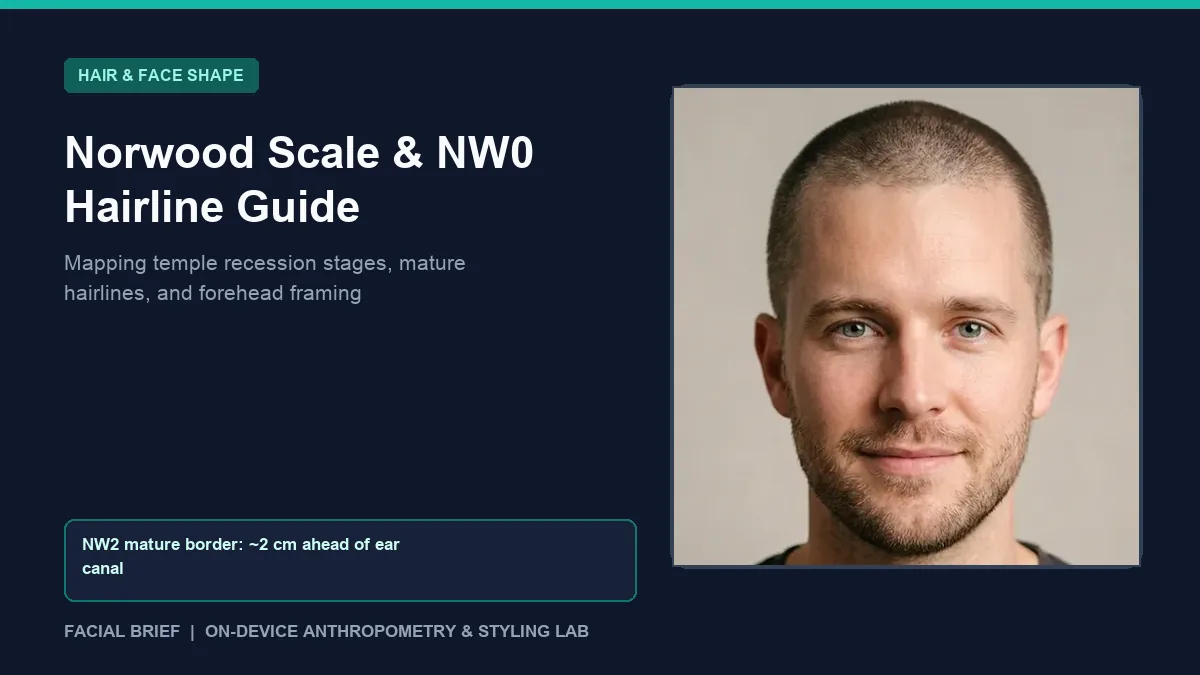
Open any hair loss forum and you will see twenty-year-olds zooming into harsh bathroom selfies beside a receding hairline chart. Clinically, that diagram is the Hamilton-Norwood scale, a seven-stage visual system used by dermatologists and hair restoration surgeons to classify male androgenetic alopecia. Yet online communities routinely add an unofficial eighth step at the bottom called an nw0 hairline to describe a flat, low juvenile outline with zero temple indentation. Mixing up that idealized teenage starting point with normal adult bone and hairline maturation drives unnecessary panic. If your forehead feels slightly taller in photos, you can Check Bangs Fit Free to measure how much of your vertical face height your upper third occupies before changing your cut.
Key Takeaways
- The medical Hamilton-Norwood scale starts at Stage 1 (NW1), meaning NW0 is community slang for a low, straight adolescent hairline with untouched corners.
- Clinicians draw the normal adult mature hairline border (NW2) roughly 1.5 cm to 2 cm above the upper brow crease and no further back than 2 cm in front of a vertical line from the external ear canal.
- Stage 3 (NW3) marks the formal diagnostic entry into clinically significant recession, where deep bare triangles carve past that 2 cm ear-canal boundary.
- Wide-angle smartphone front lenses (24mm equivalent) held 30 cm away bend forehead curvature and exaggerate temple angles, while wet hair under overhead LEDs hides real density.
- Matching haircut geometry to temple depth keeps facial thirds balanced: moving a hairline up by 1.5 cm expands the upper facial third from roughly 33% toward 38% to 42%.
What NW0 Hairline Means vs. the Clinical Norwood Scale
Dr. James Hamilton introduced the first standardized male pattern baldness taxonomy in 1951, and Dr. O'Tar Norwood refined it in 1975 into the chart clinicians still reference today. Nowhere in either paper does Stage 0 appear. Both medical illustrations begin at Type I, defined as minimal or zero recession along the frontotemporal border. Because young teenagers often carry dense, rounded hairlines sitting low over the brow ridge, users across r/tressless and r/MtF invented the label NW0 to distinguish untouched juvenile density from a standard adult NW1.
Reading r/tressless definitions of Norwood 0 shows how narrow that standard really is. True NW0 hairlines sit nearly horizontal across the forehead with closed, rounded temporal peaks and dense baby hairs along the lower margin. Less than 5% of men past age 30 keep that adolescent contour intact. Comparing yourself against a teenage celebrity frame often triggers what forum regulars call hairline dysphoria, especially when everyday adult hairlines naturally sit 1 cm to 1.5 cm higher.
The Mature Hairline vs. Active Recession Debate
No topic divides r/tressless more sharply than whether a "mature hairline" is normal biology or early baldness. In r/tressless clinical scale summaries and mature hairline boundary threads, users fall into two opposing camps. The biological maturation camp points out that roughly 95% of Caucasian men experience a symmetrical 1.5 cm to 2 cm upward shift at the temples between ages 17 and 29, shifting a straight line into a mild M or V shape that frequently holds steady for life. The opposing camp, voiced across the NW0 ideal vs. cope debate, argues that any terminal hair loss at the temples reflects dihydrotestosterone (DHT) sensitivity and should count as early miniaturization.
Medical dermatology sits between both extremes. A mature hairline aligns cleanly with NW2 geometry: symmetric, slight triangular notches at the temples whose deepest point stays within roughly 2 cm anterior to the vertical plane of the external auditory meatus (ear canal), accompanied by thick terminal shafts along the front edge. When users ask about regrowing NW0 from NW1.5 or NW2, long-term members consistently caution that reviving lost juvenile corners on medical therapy alone is rare; stabilizing at a crisp NW1.5 or NW2 over multiple years counts as a strong outcome.
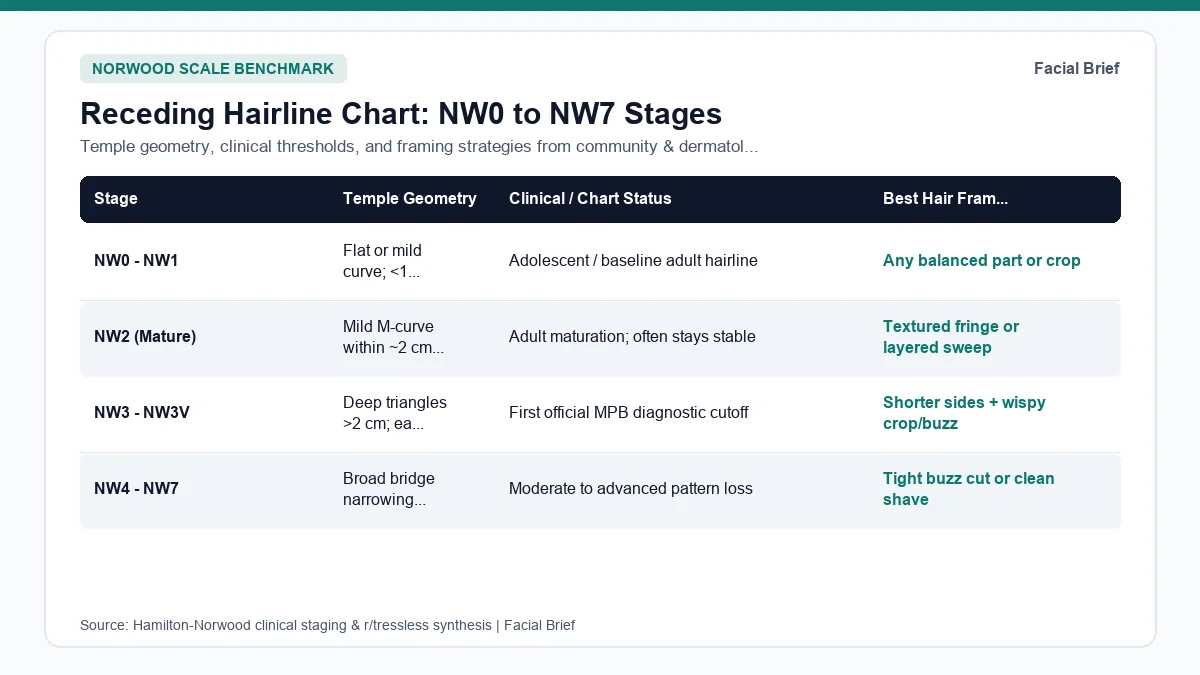
Reading Every Stage on the Receding Hairline Chart
Classifying your pattern reliably requires checking three landmarks together: frontal midpoint height above the eyebrows, deepest temporal recession distance relative to the ear line, and vertex (crown) swirl density. Relying on frontal temple angles alone misses crown thinning, while looking only at the forehead misses diffuse miniaturization across the mid-scalp.
At NW1, the hairline curves gently with minimal temple indentation. NW2 adds modest symmetric M-shaped corners at the temples without thinning at the crown. Between NW2 and NW3 sits an anterior variant (NW2A) where the central forelock retreats slightly backward across the entire front band instead of sharpening only at the corners.
NW3 marks the first true clinical balding threshold on the receding hairline chart. Bare or sparse temple zones push deeper than 2 cm toward the crown, sharpening the central forelock into a distinct peninsula. In NW3 Vertex, frontal recession pairs with a widening circular thin spot at the upper back crown. NW4 deepens both frontal and crown loss while leaving a solid bridge of terminal hair separating them. By NW5, that mid-scalp bridge narrows to thin wispy strands; NW6 removes the bridge completely into one open zone; and NW7 leaves only a low horseshoe band wrapping from above the ears around the lower occiput.
Receding Hairline Chart Comparison Table
The table below aligns clinical Hamilton-Norwood cutoffs with upper-third facial proportions and practical haircut adjustments for each stage.
| Scale Stage | Temple & Crown Geometry | Upper Facial Third Effect | Progression & Chart Status | Recommended Haircut Strategy |
|---|---|---|---|---|
| NW0 (Community Term) | Flat or rounded corners, zero indentation | Upper third sits near 28% to 32% | Pre-pubertal / rare adult genetics | Virtually any short, medium, or parted style |
| NW1 | Gentle contour, under 1 cm temple curve | Balanced ~32% to 34% upper third | Normal adult baseline, zero pattern loss | Textured crops, slick backs, or curtain parts |
| NW2 (Mature Border) | Mild M-shape within 2 cm of ear plane | Upper third widens slightly to 34% to 36% | Adult maturation; often stable for decades | Textured fringe, brushed quiff, or soft side sweep |
| NW3 / NW3 Vertex | Deep bare triangles >2 cm; optional crown spot | Upper third stretches past 37% | First official androgenetic alopecia stage | Tight faded sides with choppy forward crop |
| NW4 to NW5 | Separate front and crown zones; narrowing bridge | Hairline loses clear horizontal anchor | Moderate progression; thinning mid-scalp | Short French crop (3-4 cm) or #3 guard buzz |
| NW6 to NW7 | Bridge gone; low lateral horseshoe band | Forehead merges seamlessly into scalp dome | Advanced stable pattern loss | #0.5-#1 guard buzz or clean razor shave |
If your temple corners sit near NW2 or NW3 and you want to balance a wider jaw or lengthening forehead before sitting in a barber chair, inspect your geometric profile in our face shape hairstyle guide, compare angular cuts in our square face hairstyles guide, or see how landmarks track upper-third ratios in a sample facial report.
Avoiding Camera Distortion and Tracking Real Change
Smartphone optics frequently make users misread their stage by two Norwood steps. Across r/tressless tracking guides and stage evaluation threads on r/bald, commenters flag three common traps:
- Close selfie optics: Holding a 24mm front phone lens 25 cm to 35 cm away stretches forehead curvature and pulls temples backward. Stepping back 1.5 m to 2 m (5 to 6 feet) with a 2x rear lens restores flat proportions.
- Wet clumping and overhead LEDs: Damp hair clumps into thick strands that expose pale scalp under direct 4000K bathroom fixtures, mimicking Stage 3 thinning on dense scalps. Photograph dry, unstyled hair beside side-window daylight.
- Short-window checks: Per r/tressless timeline discussions, hairline movement happens over months and years, not week to week. Matching four reference angles (front, left temple, right temple, crown) every 90 to 180 days reveals real change. Only a licensed dermatologist using trichoscopy (>20% shaft-diameter miniaturization variance) can diagnose androgenetic alopecia or prescribe finasteride or minoxidil.
How Hairline Recession Shifts Facial Thirds and Best Haircuts
Craniofacial anthropometry splits vertical face height into three thirds: trichion (hairline midpoint) to brow, brow to nose base, and nose base to chin. Lifting the hairline 1.5 cm to 3 cm from NW1 to NW3 stretches the upper third from 33% toward 39%, elongating oval faces toward oblong proportions.
At NW0 and NW1, almost any cut balances evenly. At NW2, a textured crop, curtain cut, or messy forward fringe breaks deep M corners cleanly while avoiding tight slicked-back styles that expose bare temples. Once triangles cross into NW3, ask your barber for tapered #1 to #3 sides so width stays low while 3 cm to 5 cm of point-cut texture moves forward on top. You can preview six face-matched cuts on your own photo inside Facial Brief's AI Hairstyle Try-On. At NW4 through NW7, clean #1 buzz cuts or smooth shaves remove uneven contrast between thin crown zones and thick sides.
Frequently Asked Questions
Is an NW0 hairline normal for adult men?
No. A true NW0 hairline is informal online slang for an untouched teenage contour with low, flat corners and thick baby hairs along the entire brow edge. Clinical dermatology begins the Hamilton-Norwood scale at Stage 1 (NW1), and roughly 90% to 95% of adult men naturally shift slightly upward to an NW1 or mature NW2 border after adolescence without advancing into extensive balding.
How can I tell a mature NW2 hairline from receding NW3?
Check your deepest bare temple corner against two anatomical landmarks. A mature NW2 contour stays roughly 1.5 cm to 2 cm above the top forehead crease and stops within 2 cm in front of a vertical line drawn upward from your external ear canal. Once deep bare triangles push past that 2 cm ear plane or show wispy miniaturized hairs, staging moves into NW3.
Why does my hairline look much worse in phone selfies than in mirrors?
Front smartphone cameras use wide-angle 24mm lenses held within arm's length, magnifying the central forehead while stretching temple corners visually backward toward the ears. Wet hair clumps and direct overhead bathroom bulbs intensify pale scalp show-through. Taking dry-hair reference photos from 5 to 6 feet away with a rear 2x zoom lens in soft window light gives a far more reliable comparison.
Which haircuts hide a receding NW2 or NW3 hairline best?
Short textured crops, choppy French crops with wispy forward fringe, and tapered scissor cuts with closely faded sides consistently outperform long slicked-back cuts or dense comb-overs that split apart outdoors. Trimming side bulk neatly around the ears eliminates horizontal contrast beside the temples, while 3 cm to 6 cm of matte texture on top subtly lowers perceived upper-third forehead height.
Referenced Community Discussions & Sources
- r/tressless: Clinical definitions behind each Norwood scale stage: Clarifies the 2 cm external ear-canal landmark separating an NW2 mature contour from diagnostic NW3 recession.
- r/tressless: Defining what NW0 actually looks like: Breaks down community usage of NW0 for flat adolescent hairlines versus clinical NW1 starting points.
- r/tressless: Mature hairlines vs. early pattern hair loss: Contrasts physiological post-puberty temple migration with early androgenetic miniaturization.
- r/tressless: Realistic regrowth expectations from NW1.5 or NW2: Explains why restoring a completely juvenile NW0 edge is rare and why long-term stability at NW1.5-NW2 is considered a win.
- r/tressless: Standardized photo tracking to avoid lighting panic: Recommends dry hair, neutral side lighting, and 3-to-6-month intervals instead of daily close-up selfie checks.
- r/bald: Assessing borderline Norwood stages with community feedback: Shows how crown lighting and hairline angles create wide disagreement in single-photo assessments.
- Hamilton, J. B. (1951) and Norwood, O. T. (1975): Original male pattern baldness anatomical staging classifications referenced in clinical dermatology and hair restoration surgery.
Paired Facial Brief Analyzer
Measure your own proportions on-device
Run private 478-point landmark geometry in your browser with zero server photo upload on free tools.
Continue Reading