How to Get Higher Cheekbones: Anatomy, Fat Loss & Limits
See how to get higher cheekbones visually using 70-78% jaw-to-zygo ratios, body fat thresholds, de-bloating, and a styling vs clinical table.

People searching how to get higher cheekbones run into conflicting claims online: either bone placement is locked forever and nothing helps, or tongue posture and chewing gum will reshape your skull in three months. Craniofacial anthropometry and candid Reddit threads point to a grounded middle truth. You cannot move adult zygomatic bone upward without surgery, yet you can reveal latent bone projection and cleaner cheek shadows by addressing the fat pads, fluid balance, muscle bulk, and lighting angles sitting directly over the bone.
Before altering diet, skincare, or training habits, check whether your midface already has solid width beneath soft tissue. You can Calculate Facial Ratios on Facial Brief to compare your bizygomatic cheek span against your lower jaw width and facial height.
Key Takeaways
- Cheekbone height depends on the vertical placement and lateral projection of the zygomatic arch; in Dr. Leslie Farkas's adult norms, bizygomatic width averages 135 to 145 mm in men and 125 to 135 mm in women.
- Cheekbone prominence reads sharpest when bigonial jaw width sits at 70 to 78 percent of bizygomatic width, creating clear midface-to-lower-third taper.
- Most adults who assume they lack bone structure have soft-tissue coverage hiding it; cheek hollowing becomes visible around 10 to 14 percent body fat in men and 18 to 22 percent in women.
- Adult mewing, face yoga, and hard mastic gum do not lift zygomatic bones; heavy chewing thickens the lower-third masseter muscles, reducing midface taper.
- Non-surgical definition relies on gradual fat reduction, steady hydration and sodium control, targeted under-arch shading, and daily SPF 30+ sun protection to preserve malar skin firmness.
The Anatomy of Defined Cheekbones and Zygomatic Width
Understanding defining cheekbones starts with separating deep bone from soft tissue. Paired zygomatic bones sit beneath the outer eye corners and sweep back toward the ears as the zygomatic arches. In anthropometric landmarks, the widest lateral point on each arch is the zygion.
Bizygomatic Width, Bigonial Taper, and Midface Light
Observers rarely judge cheek height in raw millimeters. Instead, the eye compares midface span against jaw-corner width (bigonial width between the gonion landmarks) and midface height (facial width-to-height ratio, or fWHR, centering around 1.80 to 2.00). When jaw width sits at 70 to 78 percent of cheek width, overhead light strikes the upper malar crest while casting a crisp shadow into the hollow beneath, forming a defined cheek line.
Superficial fat pads soften or sharpen that step. Above the arch rests the malar fat pad; slightly lower sits the deep buccal fat pad. Elevated body fat or extracellular water thickens the overlying layer, smoothing away the shadow transition. You can explore these baseline ratios in our facial measurement norms guide and see how midface balance shapes visual impressions in our facial harmony study.
Why Selfies Flatten or Exaggerate Cheek Prominence
Before assuming flat midface bones, inspect how photos distort your skull. Front phone cameras use 24 to 28 mm wide lenses that shrink lateral cheek projection while enlarging the central nose. Overhead bathroom bulbs also flatten cheek planes. Shooting straight-on from five feet away using a 2x rear lens beside window daylight shows honest cheek-to-jaw taper.
What Defines Cheekbones in Practice vs. Online Myths
Searching how to get cheekbones across fitness, skincare, and orthotropics forums yields sharply divided advice. Filtering physiological mechanisms from internet folklore keeps expectations realistic.
Body Fat Reduction and Fluid Balance
Across this r/AskMen thread on uncovering cheek and jaw structure and r/beauty discussions on cheek projection, experienced posters converge on systemic fat loss. Spot-reducing cheek fat is impossible, yet facial volume responds to a modest 300-to-500-calorie daily deficit paired with strength training over 8 to 24 weeks. Noticeable sub-malar hollowing often appears around 10 to 14 percent body fat in men and 18 to 22 percent in women, reinforced by natural facial fat thinning between ages 20 and 28.
Daily fluid shifts also conceal defined cheekbones. High-sodium takeout, alcohol, poor sleep, and irregular hydration hold interstitial water directly over the malar pads. Steady water intake, 7 to 9 hours of sleep, potassium-rich produce, and lower evening sodium visibly reduce midface puffiness within 24 to 72 hours.
Mewing, Hard Chewing, Gua Sha, and Bone-Smashing Myths
Queries about how to make zygos bigger frequently lead to debates on r/orthotropics and r/Mewing threads on hard chewing and zygo width. Adult cranial sutures fuse after adolescence. Resting the tongue against the palate improves submental neck posture under the chin, yet controlled research does not show adult tongue posture widening or raising zygomatic bone.
Dense mastic gum creates an unintended consequence. Hard chewing hypertrophies the masseter muscles over the lower jaw angles, widening bigonial breadth relative to the midface and flattening cheek-to-jaw taper. Stepping back from hard chewing and checking mandibular balance in our jawline definition guide keeps facial thirds proportional.
Gua sha stones and cold rollers offer brief, honest gains: light outward sweeping moves pooled lymph fluid toward the ears for two to four hours without shifting fat or bone. Extreme trends like "bone smashing," criticized heavily on r/LooksmaxingAdvice, risk zygomatic fracture, chronic swelling, sensory nerve injury, and permanent asymmetry.
Strategic Grooming, Beard Lines, and Directional Contour
When how to get better cheekbones matters immediately for lighting or photos, directional contrast creates fast visual definition. In makeup, blending a cool-toned matte taupe shadow directly under the palpable zygomatic arch (stopping vertically below the outer iris) simulates natural sub-malar hollowing, while light satin luminizer along the upper lateral crest catches skylight cleanly. For facial hair, tapering cheek beard lines diagonally from the upper ear toward the mustache corner sharpens the cheek shadow just above the beard edge.
Cheekbone Definition Methods Compared
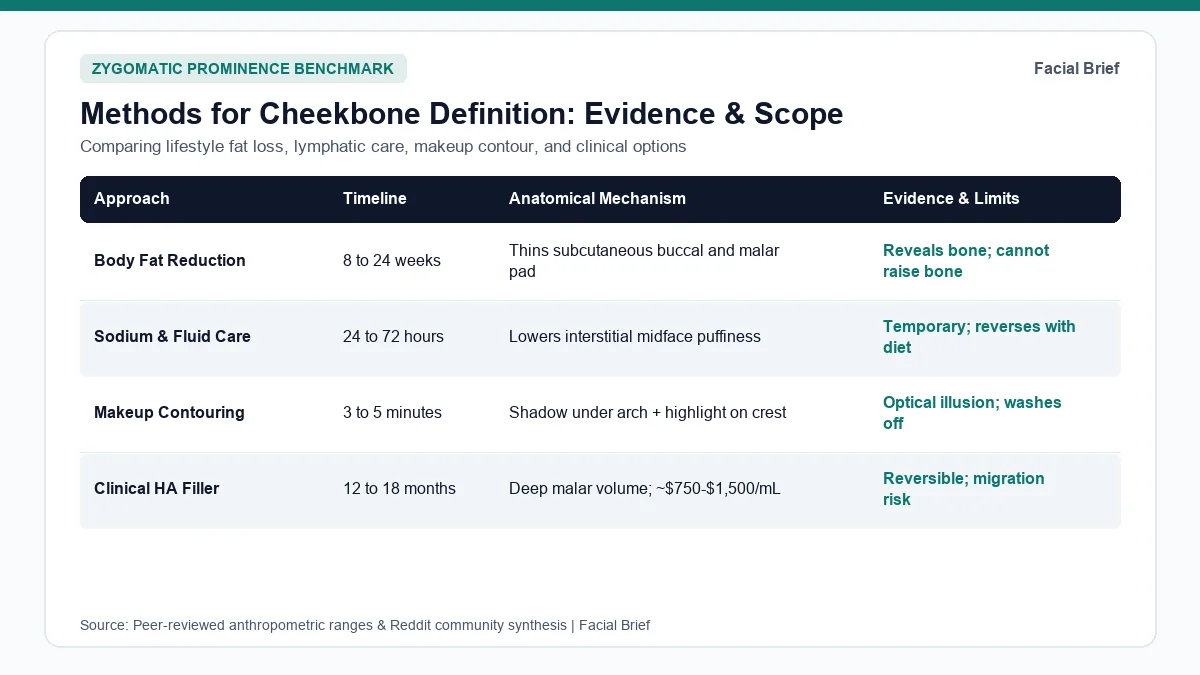
Weighing lifestyle changes, optical styling, and medical procedures clarifies realistic timelines, budgets, and trade-offs.
| Approach | Primary Mechanism | Expected Timeline | Typical Cost | Evidence & Safety Limits |
|---|---|---|---|---|
| Body Fat Loss (Gradual Deficit) | Thins subcutaneous malar and buccal fat | 8 to 24 weeks | $0 to groceries/gym | Reveals existing bone; genetics set max height |
| Sodium, Hydration & Sleep Care | Clears interstitial midface water retention | 24 to 72 hours | $0 | Temporary fluid control; reverses after high salt |
| Gua Sha / Cold Facial Massage | Manual lymphatic fluid drainage toward ears | Immediate; lasts 2-4 hrs | $10 to $35 tool | Zero bone or permanent fat change |
| Contour Makeup & Grooming | Sub-malar shadow + upper crest light reflection | 3 to 5 minutes daily | $15 to $60 basics | Optical illusion only; depends on lighting |
| Clinical HA Malar Filler | Deep hyaluronic gel placed along periosteum | Immediate; lasts 12-18 mo | $750 to $1,500 per mL | Reversible; risks bruising, migration, rare occlusion |
| Zygomatic / Malar Implants | Solid silicone or porous polyethylene anchored to bone | Permanent; 6-8 wk healing | $4,000 to $8,500+ US | Surgical risks: infection, numbness, shifting, bone erosion |
Previewing subtle midface volume against baseline facial proportions before any clinic consultation helps set realistic expectations. You can examine structural changes inside Facial Brief's Procedure Preview or compare full midface metrics in a sample biometric report.
Clinically, high-viscosity hyaluronic acid fillers placed deeply onto the upper zygomatic arch by a board-certified dermatologist or plastic surgeon add discrete projection without weighing down soft cheek fat, and remain reversible via hyaluronidase. Temporary swelling, bruising, and rare vascular occlusion still require medical expertise. Malar implants use intraoral surgery under IV sedation or general anesthesia with 1 to 2 weeks of acute swelling and lifelong risks including nerve numbness, shifting, or localized bone pressure resorption. Dermatologists also advise daily broad-spectrum SPF 30+ sunscreen and gentle topical retinoids across the upper cheeks to protect dermal collagen and skin firmness over time, while cautioning that aggressive buccal fat removal frequently causes premature midface hollowing in one's thirties and forties.
Frequently Asked Questions
Can you naturally learn how to get higher cheekbones after age 20?
You cannot raise fused zygomatic bones upward naturally in adulthood without surgical implants or skeletal repositioning. What changes visibly over time is the soft tissue covering those bones: lowering overall body fat, keeping evening sodium moderate, sleeping 7 to 9 hours consistently, and improving forward head posture all deepen the shadow under the arch so existing cheekbones look noticeably sharper and higher.
Does chewing mastic gum make your zygos bigger or wider?
No. Heavy daily chewing stimulates the masseter muscles located over the back angles of the lower jaw, not the upper zygomatic arches or malar bones. Enlarging the masseters noticeably widens the lower third of the face, which shrinks your cheek-to-jaw taper ratio and makes midface cheekbones appear narrower, flatter, and far less sculpted beside a thick square jawline.
At what body fat percentage do defined cheekbones usually appear?
Fat distribution varies genetically across individuals, yet most men notice clearer sub-malar shadows once they reach roughly 10 to 14 percent body fat, while most women see sharper upper cheek contours around 18 to 22 percent body fat. Natural facial subcutaneous fat thinning between the early twenties and late twenties also sharpens underlying bone visibility at a stable body weight.
What is the safest way to preview defined cheekbones before considering filler?
Begin with fully reversible, non-invasive styling tests before booking any clinical consultation: capture five-foot window-daylight photos at a rested morning hydration baseline, practice cool-toned taupe contour placement directly beneath the upper malar arch, and measure your bigonial-to-bizygomatic ratio digitally. Always consult a board-certified dermatologist or facial plastic surgeon in person before pursuing any injectable hyaluronic acid cheek volume.
Referenced Community Discussions & Sources
- r/beauty: Practical ways to make cheekbones more prominent without surgery: Compares cool-toned contour placement, morning de-bloating, and lighting limits.
- r/AskMen: Body fat thresholds for sharper jawlines and cheek definition: Points to gradual body fat reduction and age-related facial fat thinning over facial gadgets.
- r/orthotropics: Reality check on prominent cheekbones and adult bone limits: Separates genetics and fat loss from unrealistic adult tongue-posture claims.
- r/Mewing: Does hard chewing widen zygomatic bones or only masseters?: Clarifies why chewing builds lower-jaw muscles instead of growing upper cheekbones.
- r/LooksmaxingAdvice: Why "growing zygos" myths and bone smashing fail: Backs safe fat loss and grooming while strongly warning against physical trauma.
- Clinical Reference: Farkas LG, Anthropometry of the Head and Face (bizygomatic width zy-zy and bigonial width go-go adult norms), plus American Society of Plastic Surgeons cheek augmentation safety guidance.
Paired Facial Brief Analyzer
Measure your own proportions on-device
Run private 478-point landmark geometry in your browser with zero server photo upload on free tools.
Continue Reading