Facial Harmony Score: Face Thirds, Ratios & Profile Norms
See what drives a facial harmony score across face thirds, side profile angles, and symmetry tools, with Reddit benchmarks and a 6-metric comparison table.
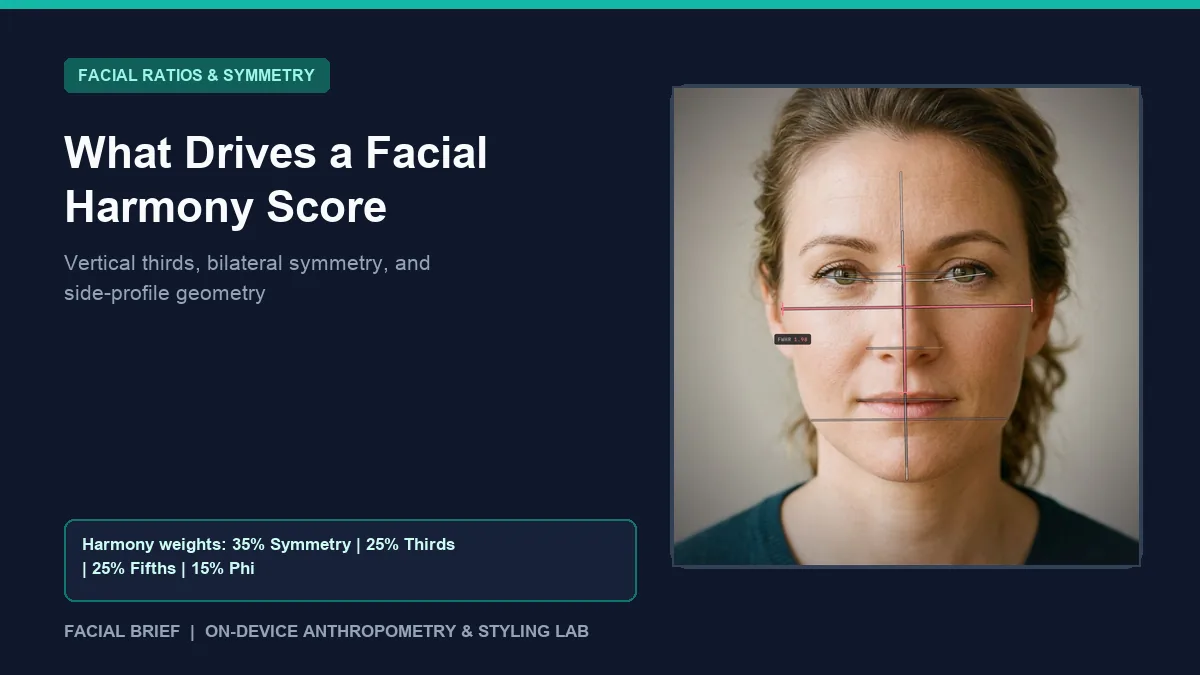
Searching facial harmony score usually happens right after an automated website returns a single percentage without explaining how the score was computed. In craniofacial anthropometry and aesthetics communities, harmony measures how well your eyes, nose, lips, cheekbones, and jaw fit together spatially as one balanced unit across both front and side views.
Black-box apps frequently confuse users by penalizing slight head tilts or applying one rigid golden mask across every face shape, age group, and heritage. To inspect explicit math running locally inside your browser, you can Try Attractiveness Test, which calculates a transparent 0 to 100 harmony score from 35% bilateral symmetry, 25% vertical face thirds, 25% horizontal fifths, and 15% phi alignment.
Key Takeaways
- Everyday healthy adult faces normally score 80 to 90 out of 100 on bilateral symmetry, while composite facial harmony sits around 68 to 82 for balanced portraits.
- Classical face thirds use equal 33.3% vertical segments as an artistic baseline, though Leslie Farkas's anthropometric surveys confirm attractive adults span 30% to 37% per third without looking imbalanced.
- Side-profile harmony centers on documented soft-tissue intervals: 163 to 173 degrees facial convexity, 85 to 105 degrees nasolabial angle, 118 to 132 degrees mandibular angle, and lip clearance near Ricketts' E-line.
- A close-range 24mm smartphone selfie held 12 to 18 inches away expands apparent nose width, stretches the midface, and narrows outer cheekbones, shifting an analysis score by 6 to 12 points.
- Reddit evaluations on
r/Vindictaandr/trueratediscussionsshow that balanced, unremarkable proportions outperform faces pairing one dramatic standout trait with mismatched neighboring ratios.
How a Facial Harmony Score Works Beyond Isolated Features
Within r/Vindicta guides on evaluating facial harmony, contributors repeat one guiding rule: a harmony score grades spacing relationships across the whole face. Someone can have a textbook straight nose and full lips that look disconnected if eye spacing sits unusually wide or the lower jaw recedes beneath them.
Forum comparisons illustrate that trade-off directly. In a r/trueratediscussions thread comparing 72% average-feature harmony against 76% standout traits, voters observe how moderate traits arranged in steady proportions create natural visual ease. Similarly, when raters apply strict proportional models to well-known actors, such as this r/VindictaRateCelebs breakdown scoring Emma Watson at 77.4% facial harmony, results land far below internet fantasies near 95% because natural charm rarely follows robotic symmetry.
What a Symmetrical Face Calculator Measures
Running a portrait through a symmetrical face calculator tests left-to-right parity across the midline drawn down the nasal bridge and philtrum. On Facial Brief's Face Symmetry Test, 12 paired coordinates cover five weighted facial zones: eyes carry 24% of the reading via inner and outer corner elevation, mouth corners carry 20%, jaw corners and cheekbones carry 20%, eyebrows carry 18%, and nasal wing centering carries the remaining 18%.
Perfect 100/100 symmetry practically never occurs in living faces. Research on mirrored composites shows that mathematically mirrored portraits often trigger an uncanny reaction, whereas everyday asymmetry between 80 and 92 out of 100 preserves natural warmth. Even 3 degrees of sideways head roll or yaw drops one jaw corner below the other and suppresses automated scores artificially.
Face Thirds, Horizontal Fifths, and Key Frontal Facial Ratios
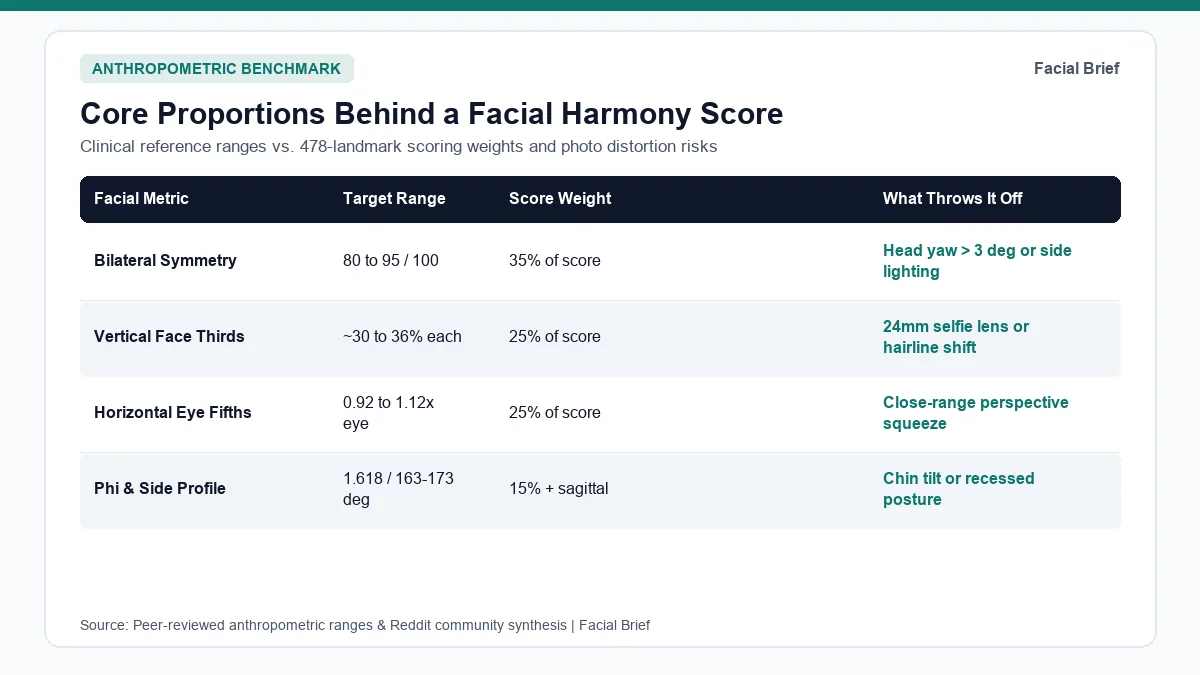
Frontal spacing anchors the remaining 65% of a harmony calculation across vertical thirds, horizontal fifths, and proportion ratios. Checking every metric together inside the Facial Ratios Calculator keeps one mild outlier in perspective.
Vertical Face Thirds in Real Populations
Neoclassical canons divide face height into three matching segments: hairline (trichion) to brow center (glabella), brow center to nose base (subnasale), and nose base to chin tip (menton). While textbook illustrations pin each segment at 33.3%, craniofacial measurements led by Dr. Leslie Farkas confirmed that real attractive faces rarely split cleanly at 33 / 33 / 33.
Hairline height varies naturally with hairstyle density, and sexual dimorphism shifts lower-third proportions. A slightly shorter lower third (31% to 33%) often reads softer on female faces, while a slightly taller chin-to-jaw third (34% to 37%) gives masculine profiles stronger grounding. When a user in r/trueratediscussions asked whether 31%, 33%, and 36% facial thirds look off, commenters confirmed that a few percentage points of variance fits squarely inside balanced human anatomy.
Horizontal Fifths and Essential Frontal Ratios
Across the width of the face, classical canons divide head width into five eye-widths from ear to ear, leaving one eye-width between the inner eye corners. Our facial measurement norms guide outlines adult reference bands across four core frontal ratios.
First, facial width-to-height ratio (fWHR) divides cheekbone width by upper-face height from brow midpoint to upper lip, normally clustering between 1.80 and 2.10. Second, midface compactness divides interpupillary distance by pupil-to-upper-lip height, landing between 0.90 and 1.05 on compact profiles. Third, eye spacing divides inner-corner gap by single eye width (0.92 to 1.12x ideal). Fourth, jaw-to-cheekbone taper compares lower jaw width against cheekbone span, sitting between 0.75 and 0.88 without looking pinched or overly wide.
Golden Ratio Side Profile Geometry and Profile Angles
People searching golden ratio side profile often expect a 1.618 spiral grid to explain 90-degree silhouette attractiveness on its own. Clinical orthodontists and maxillofacial specialists skip spiral overlays and rely on angular planes and lip projection lines that capture sagittal balance accurately.
Four profile angles measured inside Facial Brief's Side Profile Analyzer and Golden Ratio Calculator track side harmony cleanly:
- Facial convexity (glabella to nose base to chin tip) spans an open angle between 163 and 173 degrees (roughly a 12-degree +/- 4-degree soft-tissue deviation from straight). Tighter angles suggest lower-jaw recession, whereas angles near 180 degrees appear flat or concave.
- Nasofrontal angle tracks the bridge transition between forehead, nasal root, and nasal tip, resting normally between 120 and 135 degrees.
- Nasolabial angle measures the turn from nasal base into the upper lip, averaging 85 to 105 degrees (typically 90 to 95 degrees in men and 95 to 105 degrees in women).
- Ricketts' E-line links nasal tip directly to chin tip. Traditional orthodontic standards place the upper lip 1 to 4 mm behind that tangent and the lower lip between 2 mm behind and 1 mm ahead, though modern studies recognize slightly fuller lip posture across diverse populations.
| Measurement Metric | Clinical / Reference Band | What It Evaluates | Common Distortion Triggers | Practical Framing & Habits |
|---|---|---|---|---|
| Bilateral Symmetry | 80 to 95 / 100 | Left-right alignment across eyes, brows, nose, mouth, jaw | 3+ deg head roll/yaw; side window shadow | Level camera height; brow grooming parity |
| Vertical Face Thirds | ~30% to 36% per third | Forehead, midface, and chin vertical share | High/low camera pitch; swept-back hair glare | Fringe, side part, or crown volume tuning |
| Horizontal Eye Fifths | 0.92 to 1.12x eye width | Inter-eye spacing and outer temple width | Close 24mm lens narrowing outer temples | Temple-flared frames or side-swept hair volume |
| Facial Ratio (fWHR & L/W) | fWHR 1.80-2.10; L/W 1.35-1.62 | Cheekbone breadth vs. upper and full height | Cheek puffing, harsh beard line, wide-angle lens | Lean body composition; clean jaw/beard taper |
| Facial Convexity & E-Line | 163 to 173 deg; lip -4 to +1 mm | Sagittal projection of maxilla, lips, and chin | Forward head posture or chin tucking | Upright cervical posture; orthodontic review |
| Nasolabial & Gonial Angles | 85-105 deg / 118-132 deg | Nasal tip-to-lip slope and lower jaw corner | Smiling, mouth breathing, low-angle shot | Nasal tip balance awareness; jawline grooming |
Refining lower-third definition starts with non-invasive habits. Lowering submental puffiness through steady sleep and body composition, correcting forward-neck slump, tapering facial hair cleanly along the jaw border (see our improve jawline guide), and protecting midface elasticity with daily SPF 30+ and dermatologist-standard skincare (see our nasolabial fold reduction guide) improve how lighting hits natural bone structure.
Why Automated Calculators Fluctuate and What Reddit Critiques
Even transparent geometric formulas wobble when fed casual smartphone photos. In a r/QOVESStudio debate arguing facial harmony resists pure math, posters document two recurring blind spots in automated rating software.
First is lens optics and lighting direction. Front-facing phone cameras shoot near 24mm equivalent at arm's length. Because the nasal tip sits inches closer to the glass than ears or jaw corners, perspective enlargement widens the nose, elongates midface ratios, and pulls cheekbones backward. Stepping back six to eight feet with a 2x or 3x rear lens (50mm to 85mm equivalent) in even daylight raises harmony readings without changing bone. Developers note the same distortion in r/SideProject discussions on privacy-first proportion calculators, emphasizing consistent camera geometry.
Second is cultural calibration and dynamic expression. Mid-century cephalometric norms drew from small European cohorts, misreading fuller lip projection, higher cheekbones, and varied nasal bridges across global populations. Static photos also omit voice, smile warmth, skin clarity, and movement. Reviewing geometric ratios alongside hairstyle balance and color season inside Facial Brief's 42-Metric Full Report or checking our sample report page connects raw numbers to everyday grooming choices.
Frequently Asked Questions
What is considered a good facial harmony score?
On a transparent 0 to 100 landmark model such as Facial Brief's Attractiveness Test, everyday healthy adults commonly land between 68 and 82, while readings above 83 indicate unusually tight alignment across symmetry, thirds, fifths, and width-to-height proportions. Because lighting, facial tension, and camera distance move pixel measurements noticeably, tracking consistency under identical photo conditions matters far more than chasing an arbitrary cutoff.
Are my face thirds bad if they are 31%, 33%, and 36%?
No. A 31% / 33% / 36% vertical split sits cleanly inside normal healthy variation documented across peer-reviewed craniofacial studies. Classical 33.3% thirds serve as an artistic drawing guideline, whereas real attractive faces naturally shift by several percentage points depending on hairline placement and chin height. Parted bangs, crown volume, or beard length adjust apparent third balance effortlessly in everyday life.
Does the golden ratio 1.618 apply accurately to a side profile?
The 1.618 golden ratio works only as a rough artistic grid on a side profile and fails as a clinical diagnostic rule. Orthodontists and maxillofacial surgeons evaluate profile balance using angular planes: 163 to 173 degrees facial convexity, 85 to 105 degrees nasolabial inclination, 118 to 132 degrees mandibular jaw angles, and lip clearance relative to Ricketts' E-line across varied populations.
How accurate is a free symmetrical face calculator on selfies?
A landmark-based symmetrical face calculator measures pixel parity accurately on the uploaded frame, yet close-up selfies introduce geometric distortion. Shooting from 12 to 18 inches away exaggerates central features via wide-angle perspective, while tilting your head even 3 degrees skews eye and jaw corner parity. Using a timer five to eight feet away with a 2x rear lens produces steady baseline readings.
Referenced Community Discussions & Sources
- r/Vindicta: What facial harmony is and how to evaluate proportions: Explains why feature integration outweighs isolated trait perfection in perceived attractiveness.
- r/QOVESStudio: Hot take on why facial harmony cannot be reduced to raw formulas: Debates limits of mathematical ratios relative to skin quality, motion, and expression.
- r/trueratediscussions: Evaluating 31% / 33% / 36% facial thirds proportions: Demonstrates how modest percentage deviations sit comfortably inside normal attractive harmony.
- r/trueratediscussions: Moderate harmony with average features vs. higher harmony extremes: Explores how cohesive proportions read better than mismatched standout traits.
- r/VindictaRateCelebs: Quantitative facial harmony breakdown on Emma Watson: Shows why strict mathematical scores (~77%) diverge from broad real-world appeal.
- r/SideProject: Building a privacy-first browser facial-proportion analyzer: Notes on-device processing benefits and sensitivity to lighting and capture angles.
- Craniofacial anthropometric and orthodontic norms: Leslie G. Farkas (Anthropometry of the Head and Face), Legan-Burstone soft-tissue profile analysis, and Ricketts' Esthetic Plane guidelines.
Paired Facial Brief Analyzer
Measure your own proportions on-device
Run private 478-point landmark geometry in your browser with zero server photo upload on free tools.
Continue Reading