Face Width Height Ratio and Average Face Length Norms Explained
Review face width height ratio norms (fWHR 1.73-1.95) and average face length in mm, selfie lens errors, and our adult biometric comparison table.
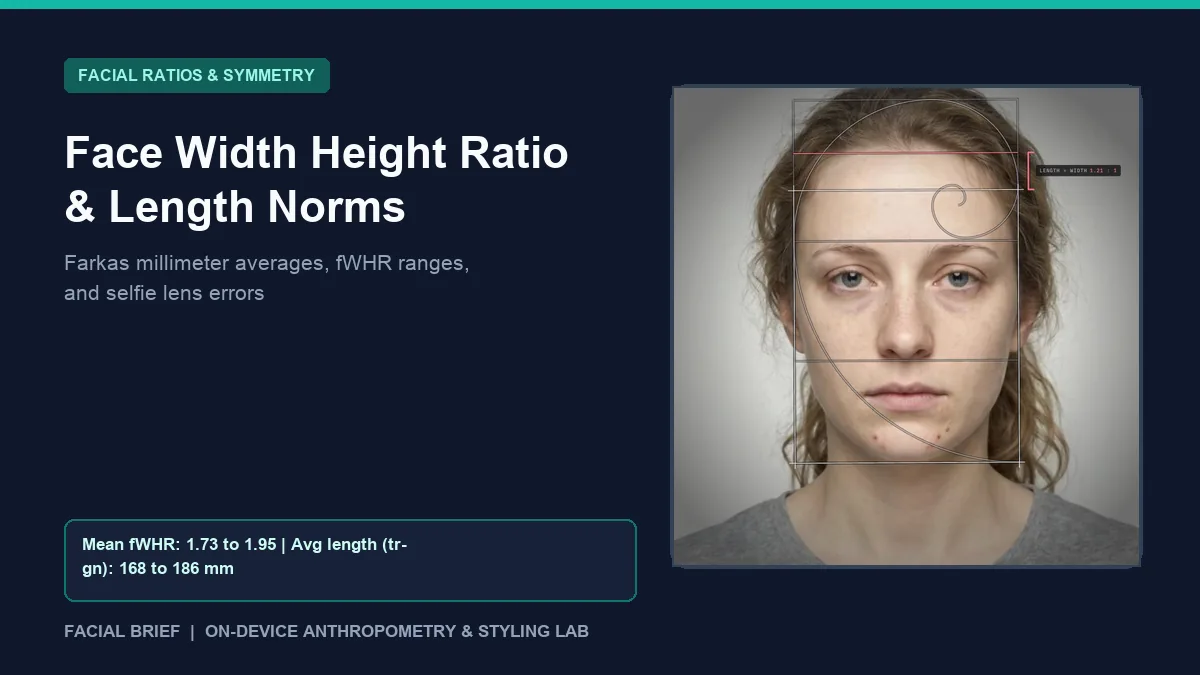
Searching for face width height ratio (fWHR) numbers online quickly turns into confusion. One chart calls 1.95 an ideal masculine benchmark, another warns that anything under 1.75 looks overly narrow, and half of Reddit disagrees on whether you measure up to the eyebrows or the eyelids. Before judging your own proportions against an internet infographic, you need the exact anatomical landmarks used in anthropometry alongside realistic camera calibration.
A front phone selfie held at arm's length narrows your cheekbones visually while enlarging central landmarks, throwing ratios off by double digits before any math begins. You can benchmark your front proportions under consistent landmark coordinates using Calculate Facial Ratios, or inspect vertical spacing with the Golden Ratio Face Analyzer.
Key Takeaways
- Standard anthropometry calculates fWHR as bizygomatic cheekbone width divided by upper-face height (upper lip to brow or nasion), with adult averages clustering near 1.83 to 1.95 in men and 1.73 to 1.82 in women.
- Leslie Farkas's craniofacial norms place average face length from hairline to chin (
tr-gn) at 180 to 186 mm in men and 168 to 174 mm in women, while morphological length from nose root to chin (n-gn) averages 116 to 120 mm and 108 to 112 mm. - Moving your upper height anchor by just 1 to 2 mm between brow edge and upper eyelid alters fWHR considerably, preventing direct comparisons across mismatched photo methods.
- Wide-angle smartphone front lenses (roughly 24 mm equivalent) squeeze cheekbones inward relative to nose height; reliable checks require 1.5 to 2 meters distance using a 2x or 50 mm to 85 mm lens.
- Newer psychology meta-analyses and
r/sciencecritiques challenge early claims linking higher fWHR to testosterone or dominance once body size is controlled.
How Face Width Height Ratio (fWHR) and Face Length Are Measured
Clinical craniofacial datasets rely on fixed anatomical landmarks rather than casual eyeball estimates. Checking which coordinates sit in the numerator and denominator settles most disagreements across online ratio calculators.
Landmarks Behind Bizygomatic Width and Upper-Face Height
Under Carré and McCormick's (2008) protocol, face width height ratio divides bizygomatic breadth (zy-zy, spanning the widest outer cheekbone points) by upper-face height (upper lip labrale superius to lower brow edge or nasion). Adult zy-zy breadth averages 135 to 145 mm in men and 125 to 135 mm in women, while upper-face height typically runs 70 to 82 mm.
A calibration method shared in this r/QOVESStudio fWHR measurement thread keeps home pixel math honest. Readers measure philtrum length physically with a ruler or calipers, match those exact pixels in an editor, and convert pixel ratios back to millimeters. Even carefully calibrated photos stay sensitive: picking the eyelid fold over the brow line shifts the same face from 1.82 to 1.94, and smiling pulls lateral cheek tissue outward by 3% to 6%.
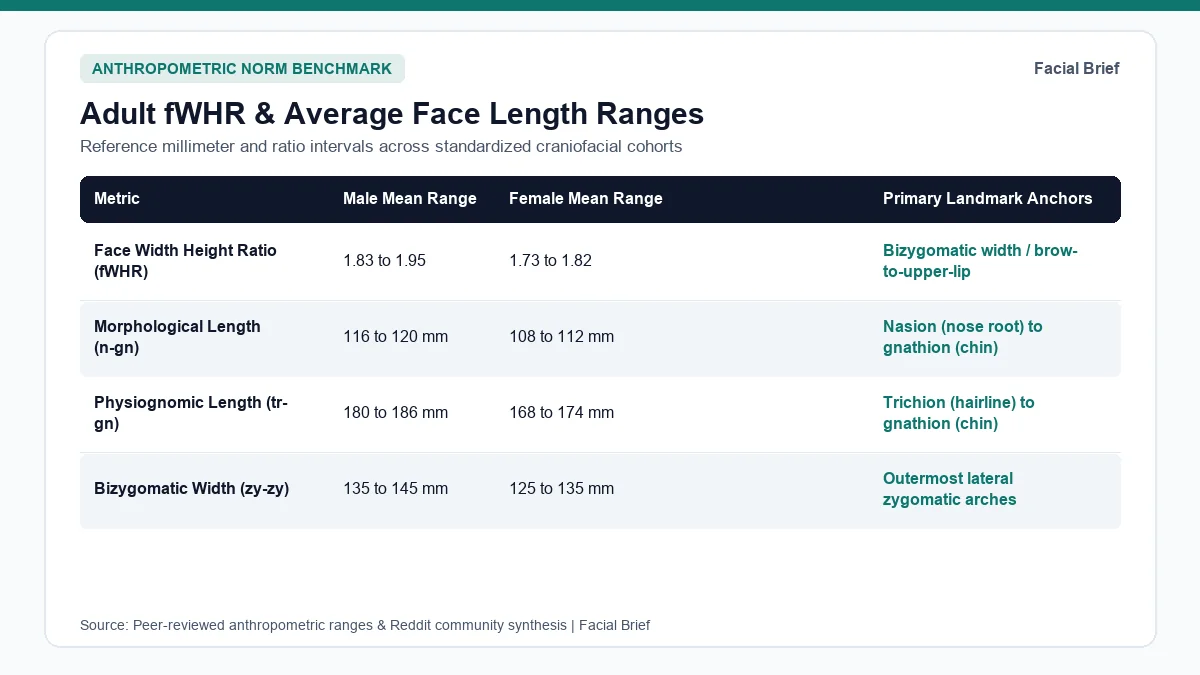
Morphological vs. Physiognomic Average Face Length
People searching average face length frequently confuse two separate Farkas craniofacial standards:
- Physiognomic face height (
tr-gn) runs from the hairline (trichion) down to the chin tip (gnathion), averaging 180 to 186 mm in adult men and 168 to 174 mm in adult women (±7 to 8 mm). - Morphological face height (
n-gn) starts lower at the nasal root (nasion) down to the chin (gnathion), averaging 116 to 120 mm in men and 108 to 112 mm in women (±5 to 6 mm).
In this r/Vindicta discussion on midface length, contributors observe that faces labeled "long" because of low fWHR often simply have tall chins or high hairlines while midface proportions sit near average. Checking lower-third shape in our gonial angle guide separates chin height from true midface length.
What Population Norms Actually Mean vs. Reddit Ratio Myths
Ratios describe skeletal spacing well, yet online forums routinely stretch single decimals into sweeping verdicts about personality or attractiveness.
Why Evolutionary Psychology Dominance Claims Stalled
Earlier 2010s papers suggested men with high fWHR carried higher pubertal testosterone and showed greater aggression or financial drive. Subsequent debates in this r/science review of macho face ratio theory and this r/psychology replication thread document meta-analytic pushback. Once studies apply allometric scaling for overall head size and body weight, sex differences narrow and behavioral links frequently disappear.
Inside r/QOVESStudio's debate asking if fWHR is overhyped, regular analysts point out another flaw: gaining 7 kg of cheek fat raises measured fWHR without improving bone sharpness.
Facial Harmony vs. Single-Ratio Anxiety
Compulsive measuring often fuels confidence drops seen in this r/self thread on fWHR insecurity and r/QOVESStudio's discussion on whether an atypical fWHR ruins a face. Commenters on r/trueratediscussions harmony threads stress that viewers perceive adjoining proportions together rather than isolated ratios. A narrow 1.72 fWHR balances smoothly with strong cheekbones and clear skin, whereas a wide 2.05 ratio looks heavy if cheek fat shadows the midface, an anatomical pattern examined in our nasolabial fold reduction guide.
Selfie Distortion and Practical Ways to Balance Proportions
Clean measurement starts with camera geometry before touching grooming or weight goals.
Stopping Wide-Angle Camera Errors Before Measuring
Front phone cameras held 35 cm away widen central noses and compress outer cheekbones backward, dragging calculated fWHR sharply down. Follow a repeatable three-step setup:
- Place a rear 2x or 50 mm to 85 mm lens 1.5 to 2 meters away at eye height.
- Align ear canals level with the lower eye socket (Frankfort horizontal plane) so chin tilt does not shorten midface pixels.
- Shoot relaxed with closed lips, hair tucked back, and soft indirect window light.
Grooming and Styling Framing Without Bone Surgery
As r/LooksmaxingAdvice notes on changing fWHR, adult cheekbone width and upper-face bone height cannot change without complex maxillofacial surgery carrying nerve and infection risks. Non-surgical levers still shift visual balance cleanly. Trimming excess body fat sharpens lower borders as outlined in our strengthen jawline guide, while fuller temple hair volume widens narrow midfaces and tighter sides with crown height elongate compact faces. Straighter, slightly lower-set brow grooming also narrows perceived upper-face vertical gap subtly.
Adult Craniofacial Norms and Measurement Tools Compared
The reference table below summarizes standard anthropometric benchmarks alongside the exact landmark errors that throw casual home readings off course.
| Facial Metric | Adult Male Mean | Adult Female Mean | Anatomical Landmarks | Primary Reading Error |
|---|---|---|---|---|
| Face Width Height Ratio (fWHR) | 1.83 to 1.95 | 1.73 to 1.82 | zy-zy / brow-to-upper-lip | Brow vs. eyelid top shift; 24 mm selfie squeeze |
Morphological Face Length (n-gn) | 116 to 120 mm | 108 to 112 mm | Nasion (nose root) to chin tip | Chin tilt or parted jaw exaggerates height |
Physiognomic Face Length (tr-gn) | 180 to 186 mm | 168 to 174 mm | Trichion (hairline) to chin tip | Receding hairline inflates upper third |
Bizygomatic Face Width (zy-zy) | 135 to 145 mm | 125 to 135 mm | Outer lateral cheekbone edges | Smiling or cheek fat mimics wider bone |
| Midface Ratio (IPD / Vertical) | 0.95 to 1.05 | 0.96 to 1.08 | Interpupillary width / pupil-to-lip | Downward camera pitch shrinks vertical gap |
| Facial Height-to-Width Index | 84% to 92% | 82% to 90% | (n-gn / zy-zy) x 100 | Wide-angle lens exaggerates central height |
Looking at fWHR next to facial thirds, jaw taper, eye spacing, and skin tone gives far better guidance than fixating on a single number. You can map all 42 front and proportion benchmarks together inside Facial Brief's 42-Metric Full Report, or view a complete example layout on our sample Face Report page.
Frequently Asked Questions
What is an average face width height ratio for men and women?
Across large craniofacial datasets and meta-analyses, general adult fWHR means cluster between 1.73 and 1.95, averaging roughly 1.83 to 1.95 in men and 1.73 to 1.82 in women. Moderate variation above or below those intervals is completely normal across ethnicities, body fat levels, and measurement protocols depending on whether brow ridge or upper eyelid anchors the height line.
What is the average face length in millimeters?
Anthropometric studies by Leslie Farkas report two primary lengths. Morphological face length from the nose root to the chin tip (n-gn) averages 116 to 120 mm in adult men and 108 to 112 mm in adult women. Physiognomic length from the hairline to the chin (tr-gn) averages 180 to 186 mm in men and 168 to 174 mm in women.
Can you widen or increase fWHR naturally as an adult?
No non-surgical exercise, chewing drill, or tongue posture routine alters adult zygomatic bone breadth or upper-face skeletal height once craniofacial sutures fuse in late adolescence. Dropping excess body fat still sharpens existing cheekbone contour visually, while haircuts with gentle temple volume and fuller, straighter eyebrow grooming shift your perceived width-to-height balance cleanly in everyday indoor lighting without clinical risks.
Why does my fWHR look completely different in selfies than in a mirror?
Close-range front phone cameras use wide-angle lenses (around 24 mm equivalent) held 35 to 45 cm from your nose, which stretches midline vertical landmarks upward and drops the outer cheekbones backward behind perspective curvature. Standing 1.5 to 2 meters away from a rear 2x or 50 mm lens placed straight at eye level eliminates distortion and matches mirror geometry accurately.
Referenced Community Discussions & Sources
- r/QOVESStudio: Measuring your facial width-to-height ratio accurately: Details philtrum tape calibration and why rear-camera distance prevents selfie errors.
- r/QOVESStudio: Debate over whether fWHR metrics are overhyped: Examines how cheek fat and tiny landmark shifts distort casual fWHR conclusions.
- r/QOVESStudio: Is an unusual fWHR actually a major flaw?: Weighs single-ratio scores against surrounding eye, jaw, and skin harmony.
- r/science: Critique of evolutionary psychology macho face ratio theory: Covers meta-analytic pushback against linking fWHR tightly to aggression or testosterone.
- r/Vindicta: Distinguishing true midface length from total face length: Explains why long lower-third chins get mislabeled as midface or fWHR problems.
- r/trueratediscussions: Intuition vs. mathematical ratios in facial harmony: Compares hard numerical ranges with holistic proportion balance.
- r/self: Coping with low confidence after calculating fWHR online: Highlights the psychological trap of rating distorted close-up photographs.
- r/LooksmaxingAdvice: Realistic limits to changing fWHR naturally: Separates fixed bone geometry from hair, brow, and weight framing.
- Clinical References: Farkas L.G., Anthropometry of the Head and Face (
n-gnandtr-gnnorms); Carré & McCormick (2008) fWHR protocol; Kramer et al. (2012) and Geniole et al. craniofacial sexual dimorphism meta-analyses.
Paired Facial Brief Analyzer
Measure your own proportions on-device
Run private 478-point landmark geometry in your browser with zero server photo upload on free tools.
Continue Reading