Facial Thirds & Golden Ratio: Real Face Proportions Guide
Compare classical 1:1:1 facial thirds and the 1.618 golden ratio against Farkas adult anthropometric norms, camera skew, and non-surgical framing options.
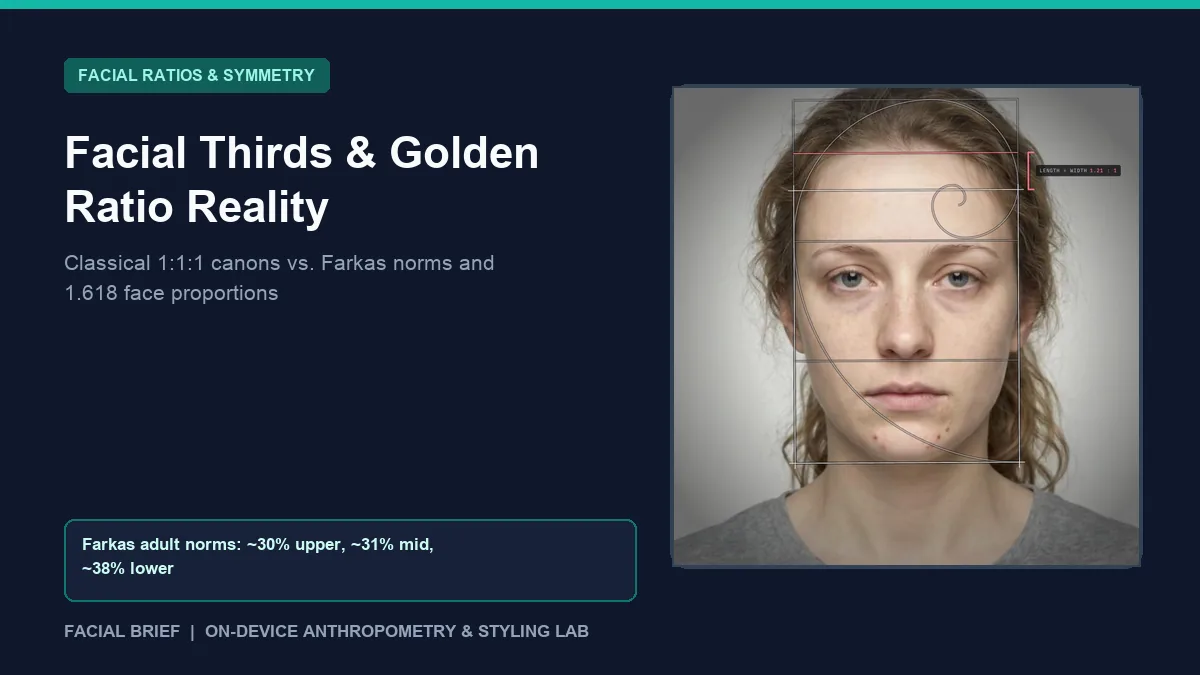
Open any looksmaxxing forum or aesthetic blog, and two mathematical benchmarks appear almost immediately: equal facial thirds (splitting vertical face height into 33.3% bands) and the 1.618 golden ratio. Yet when real people upload selfies into automated calculators, almost nobody hits 33 / 33 / 33% or scores 95% against a golden ratio of beauty overlay. That mismatch leads people to worry about a "long midface" or an uneven chin that looks balanced in person. Understanding how Renaissance artist canons diverge from live clinical measurements clears up most of that confusion before you touch a ruler. You can Measure Golden Ratio on a leveled straight-on photo to inspect your own proportions cleanly.
Key Takeaways
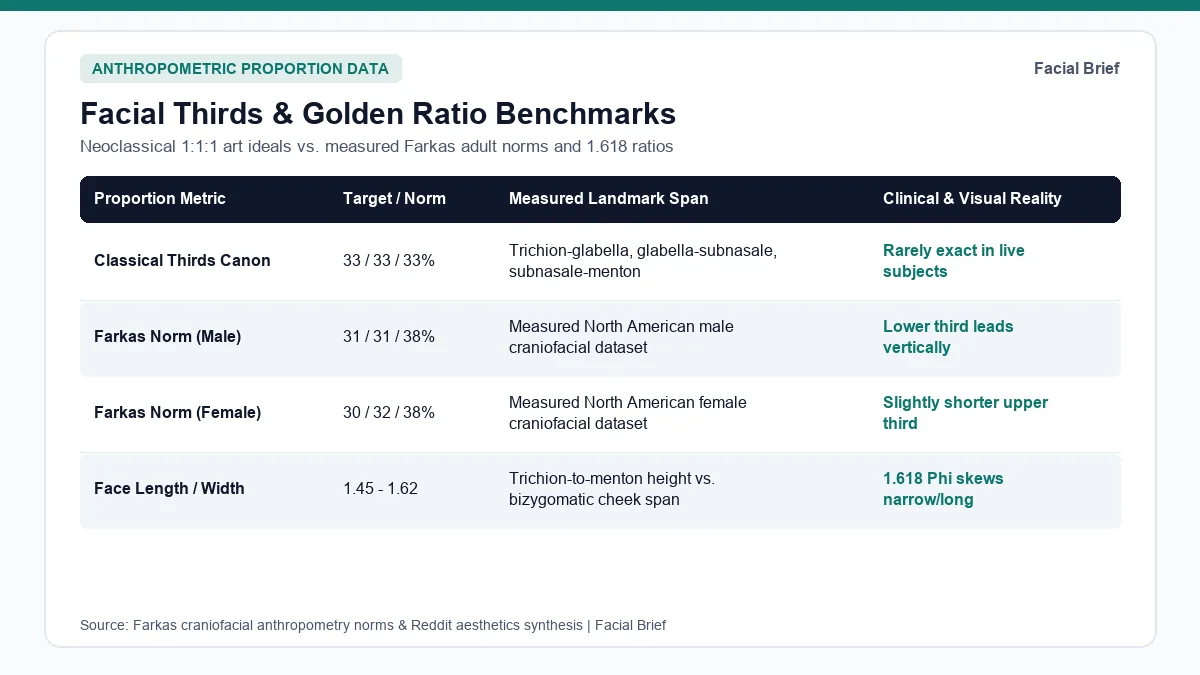
- Classical neoclassical canons divide the face into equal 1:1:1 thirds (33.3% each), while Dr. Leslie Farkas's clinical measurements show healthy North American adults average 30 to 31% upper third, 31 to 32% middle third, and 38% lower third.
- A slightly taller lower third (34 to 38%) is anatomically standard in both sexes and often supports masculine structure on men with solid chin height.
- Applying 1.618 (golden face ratio) overlays such as the Marquardt Phi Mask favors narrow Western bone structures and penalizes wider cheekbones across diverse ethnic backgrounds.
- Wide-angle smartphone lenses held at arm's length stretch the middle third and compress outer jaw margins, distorting face proportions significantly.
- Bangs, eyebrow height, glasses depth, and beard shaping rebalance uneven thirds visually, while adult skeletal shifts require clinical orthognathic evaluation.
How Facial Thirds Are Measured vs. Live Anthropometric Norms
Artists since the Renaissance divide vertical face proportions along four surface landmarks: the central hairline (trichion) to the smooth brow center (glabella) forms the upper third; glabella to the nasal base (subnasale) marks the middle third; and subnasale to the lowest chin border (menton) defines the lower third. Classical art manuals teach an exact 33.3% split per zone alongside five horizontal eye widths across the cheeks.
When craniofacial researcher Dr. Leslie Farkas measured live healthy adults with sliding calipers, that rigid 1:1:1 symmetry vanished. In North American adult cohorts, Farkas recorded averages of 31.0% upper, 30.5% middle, and 38.5% lower in men, and 29.5% upper, 32.4% middle, and 38.2% lower in women. The lower jaw and chin naturally carry the largest share of vertical height.
Reddit evaluation threads reflect those clinical numbers. In r/trueratediscussions posts asking whether 31 / 33 / 36% thirds are bad, commenters point out that a 31 / 33 / 36 distribution matches normal adult anatomy. Similarly, threads dissecting whether men are supposed to have equal facial thirds note that taller lower thirds driven by solid chin projection strengthen masculine balance, whereas severely compressed midfaces disrupt side harmony more noticeably. Pairing our facial measurement norms guide with horizontal metrics in our midface ratio and fWHR guide keeps vertical numbers in context.
The 1.618 Golden Section Face: Science or Overfit Math?
Alongside vertical thirds sits Phi ($\phi \approx 1.618$), often promoted online as the perfect ratio face blueprint. Automated golden section face tools check trichion-to-menton height divided by cheekbone width (~1.618), pupil-to-mouth spacing versus nose-to-chin height, and mouth width compared with nasal alar width. Dr. Stephen Marquardt popularized this approach with his 2D Phi Mask, yet striking actors routinely score lower on face golden ratio software than generic composite faces.
Three structural gaps explain why a strict golden face ratio fails as a universal test:
Multi-ethnic anthropometric reviews demonstrate that 1.618 length-to-width grids fit narrow Northern European bone structures while penalizing East Asian, African, and Hispanic faces that carry wider malar arches or softer jaw planes, a critique central to r/trueratediscussions threads on golden ratio flaws.
Flat 2D overlays also ignore anterior projection. Brow ridge depth, cheekbone contour, and chin projection dictate how shadows fall in real life, meaning identical 2D vertical numbers can look completely different across two people.
Holistic fit outweighs isolated ratios. In r/QOVESStudio discussions on why facial harmony resists simple math, users note that how individual features complement one another carries far greater visual weight than matching 1.618 decimals. Our 42-Metric Full Report maps width, tilt, and projection together so single ratios never mislead you.
Measurement Traps: Hairlines, Head Tilt, and Lens Distortion
Before trusting one uneven scan, inspect your photo setup. As users detail in r/Vindicta guides on measuring facial thirds and ratios, three errors warp home calculations:
Upper-third hairline drift inflates forehead height quickly. Measuring from a receding temple peak or swept-back hair pushes the upper third above 38%. Clinical anthropometrists measure from the top crease of the frontalis muscle when hair recedes so shifting hair edges do not skew skeletal thirds.
Selfie lens proximity stretches midface proportions. A wide-angle front phone lens held 30 cm away enlarges central features like the nose while pushing cheekbones and ears backward. Stepping back 5 to 6 feet with a 2x zoom lens restores accurate facial perspective.
Head pitch shifts vertical shares immediately. Dropping your chin 5 degrees compresses the lower third and inflates forehead height, while tilting up stretches the chin. Leveling the Frankfort horizontal plane (ear canal top to lower orbital rim) prevents tilt distortion, a step also detailed in our side profile geometry guide.
Comparing Facial Thirds Imbalances and Practical Fixes
When leveled photos still confirm one dominant third (such as a 37% forehead or a compact 28% chin), non-surgical styling shifts visual balance cleanly. Threads across r/Splendida on softmaxxing uneven facial thirds share practical framing fixes alongside clear evidence limits.
| Facial Third Pattern | Visual Effect | Non-Surgical Framing & Grooming | Evidence Limits & Posture Reality | Clinical / Specialist Scope |
|---|---|---|---|---|
| Long Upper Third (>35%) | Broad high forehead; prominent brow space | Curtain bangs, textured fringe, slightly fuller brow thickness | Scalp massage and face yoga cannot lower hairline bone | Dermatologist check for hair loss; transplant consults |
| Long Middle Third (>35%) | Extended distance from brows to nose tip | Horizontal brow shape, mid-depth glasses rims, upper cheek blush | Mewing does not shorten adult midface bone vertically | Orthognathic evaluation only for severe functional bite issues |
| Short Lower Third (<31%) | Compact chin height; softer jaw boundary | Structured beard/stubble taper, clean chin highlight, layered collar lines | Jawline chewing gum builds masseter width, not vertical chin height | Orthodontic bite alignment or genioplasty consult with surgeon |
| Long Lower Third (>40%) | Heavy jaw length; prominent chin verticality | Longer wavy hair past jaw, lower-lip balance, clean shaven or trimmed chin | Tongue posture cannot shrink adult mandibular bone length | Clinical maxillofacial assessment only for functional malocclusion |
| Narrow Length/Width (>1.65) | Long slender oval or oblong silhouette | Side volume hairstyles, taller 42+ mm eyeglasses, horizontal blush sweep | Weight shifts affect cheek tissue, not underlying cranial width | Standard grooming & eyewear selection cover 95% of cases |
Evidence Limits of Exercises and Mewing
Can tongue posture, chewing hard gum, or facial exercises lengthen a compact chin or compress a tall midface in adults? Clinical evidence shows they cannot. Once cranial sutures fuse in late adolescence, resting tongue force cannot shift fused maxillary bone vertically, as examined in our mewing results evidence guide. Over-chewing tough gum enlarges side masseter muscles horizontally, widening the back jaw corner without changing vertical height while raising jaw-joint soreness risk.
Practical Everyday Styling Adjustments
Optical framing solves most mild third imbalances right away. Textured curtain bangs shorten a tall upper third by interrupting forehead height cleanly. For a longer middle third, medium-depth eyeglasses rims and horizontal brow lines break up vertical midface length and direct attention across the cheekbones. For a compact lower third, keeping beard length 4 to 8 mm longer at the chin while tapering cheek stubble adds vertical presence cleanly. Viewing these ratios together in a sample biometric report helps pinpoint which single styling adjustment makes the cleanest difference.
Frequently Asked Questions
What is the ideal percentage for facial thirds?
Classical drawing canons teach an equal 33.3% / 33.3% / 33.3% split, yet live clinical measurements by Dr. Leslie Farkas show healthy adults typically average roughly 30 to 31% upper third, 31 to 32% middle third, and 38% lower third. Minor variations between 29% and 38% look natural across balanced faces, especially when horizontal width and feature symmetry align cleanly.
Does the 1.618 golden ratio of beauty apply to every face?
No. Applying a rigid 1.618 golden ratio of beauty template reflects narrow classical Western artistic canons and fails to represent universal human anatomy across diverse global populations. Multi-ethnic craniofacial studies show many highly attractive faces across Asian, African, Hispanic, and European cohorts deviate noticeably from Phi decimals while displaying clear symmetry, natural facial balance, healthy skin clarity, and strong feature harmony.
Why do my facial thirds look uneven in phone selfies?
Front phone cameras held close use wide-angle optics that magnify features near the center of the lens, stretching your middle third and nasal bridge while tapering outer cheekbones and ears backward. Even a slight chin-down or chin-up head pitch shifts forehead and chin proportions substantially. Shooting straight-on at eye level from 5 to 6 feet away with a 2x lens removes most camera distortion.
Can you change uneven facial thirds without surgery?
Adult bone lengths remain fixed after craniofacial growth finishes, so tongue posture, gua sha rollers, and facial yoga cannot lengthen a chin or shorten a midface. Everyday styling still shifts visual weight reliably: curtain bangs lower a tall forehead line, horizontal brows and structured eyeglasses frames break up a long midface, and tailored beard shaping extends compact chins cleanly without procedures.
Referenced Community Discussions & Sources
- r/Vindicta: Step-by-step guide to measuring facial thirds and golden ratio landmarks: Covers trichion, glabella, subnasale, and menton placement plus avoiding hairline measurement drift.
- r/trueratediscussions: Is a 31 / 33 / 36% facial thirds split balanced?: Demonstrates why real-world percentages closely matching clinical norms remain visually harmonious.
- r/trueratediscussions: Are men supposed to have strictly equal facial thirds?: Compares male lower-third jaw dominance against textbook 1:1:1 neoclassical ideals.
- r/Splendida: Practical softmaxxing tactics for balancing uneven facial thirds: Details non-surgical hair framing, brow adjustment, and visual balance strategies.
- r/QOVESStudio: Why holistic facial harmony resists single-ratio formulas: Explains why feature coordination outweighs isolated mathematical decimals.
- r/trueratediscussions: Structural limits and ethnic bias in golden ratio scoring: Critiques over-reliance on narrow Western 1.618 overlay templates.
- Clinical anthropometry reference: Farkas LG et al. neoclassical canons vs. live adult craniofacial proportions (North American male and female vertical facial third normative datasets) and systematic multi-ethnic anthropometric reviews.
Paired Facial Brief Analyzer
Measure your own proportions on-device
Run private 478-point landmark geometry in your browser with zero server photo upload on free tools.
Continue Reading