Best Eyeglasses for Heart Shaped Face: Proportions & Fit
Find the best eyeglasses for heart shaped face ratios near 0.72 using rimless, round, and soft cat-eye frames, bridge sizing, and a full comparison table.
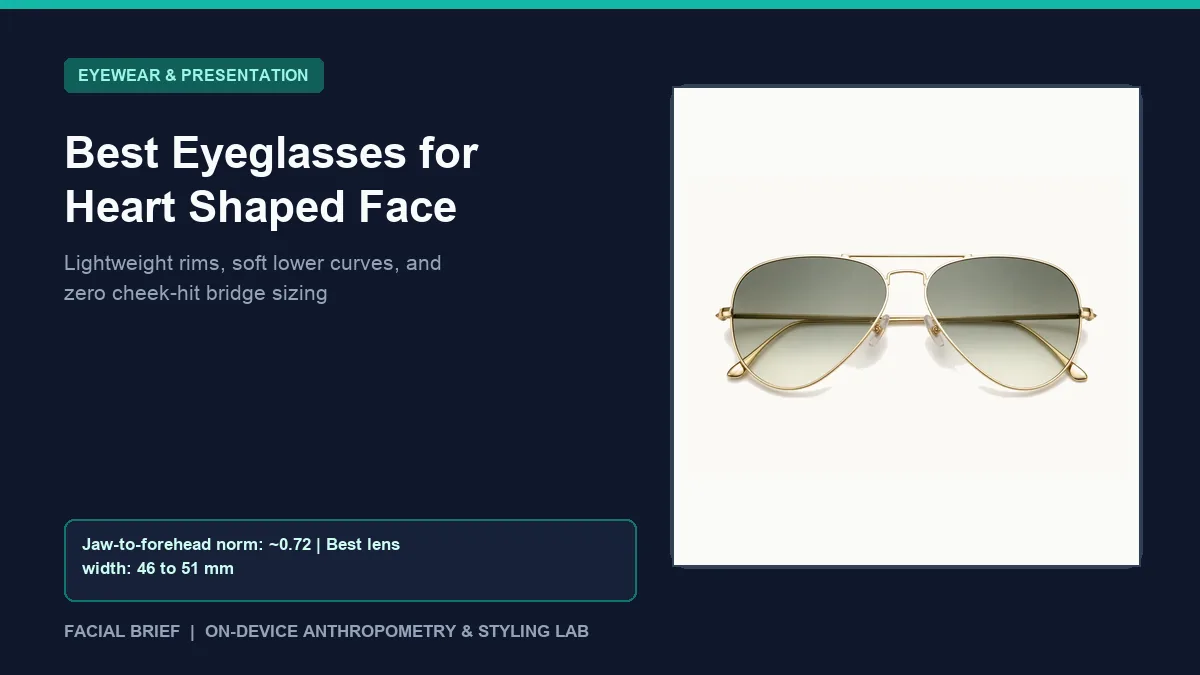
Finding the best eyeglasses for heart shaped face proportions starts with controlling upper-third visual weight rather than hunting for one magic frame name. In soft-tissue anthropometry, heart geometry combines a wide forehead and prominent bizygomatic cheekbones (zy-zy) with a slender mandibular jaw (go-go). Across Facial Brief landmark scans, jaw-to-forehead width centers near 0.72 (0.63 to 0.81 range) and facial height-to-width sits around 1.15 to 1.32.
Because your upper face holds the widest horizontal span, thick black browlines or bulky rectangles stack extra visual mass above the brow while exaggerating chin taper. On r/glasses and r/femalefashionadvice, buyers frequently regret ordering trendy chunky frames that look top-heavy in daylight. First Detect Your Face Shape across 478 landmarks in your browser to separate genuine upper-third width from smartphone selfie distortion.
Key Takeaways
- Lightweight upper rims outperform thick dark brow bars: rimless drill-mounts,
1.2 to 2.2 mmtitanium wires, translucent crystal or champagne acetates, and slender P3 rounds avoid widening the forehead. - Compact single-lens width (
46 to 50 mmfor petite faces,50 to 52 mmfor medium-to-wide spans) keeps outer corners aligned with cheekbones instead of jutting past the temples. - Narrower lower faces frequently accompany slender nasal bridges (
16 to 18 mm); adjustable silicone nose pads center lenses neatly over your pupils without touching high cheekbones during smiles. - Soft cat-eyes and bottom-weighted wire aviators flatter high malar bones when upper rims stay slender, whereas dramatic flared cat-eyes or chunky dark Clubmasters emphasize brow breadth.
- High minus prescriptions (
-3.50Dto-6.00D+) need1.67or1.74high-index polycarbonate or Trivex lenses and compact circular diameters if you want rimless styles without thick exposed outer walls.
How Heart Face Ratios Shape Eyewear Balance
Why certain eyeglasses balance instantly while others overwhelm narrow chins depends on forehead span, bizygomatic cheek flare, and bigonial taper. Oval faces typically hold jaw corners at 78% to 85% of upper facial breadth. Heart proportions drop 20% to 35% from temples to chin, placing prominent malar bone directly beneath lower lens edges.
Visual Weight Across the Upper Third
Optical fitters separate gram weight from visual contrast. A thick 5 mm black plastic top bar sitting across a broad forehead pulls attention straight to the widest border of the face, making the chin look sharper. Shifting to 1.5 mm brushed gold or gunmetal wire, translucent tortoise, light rose crystal, or drill-mount rimless lenses blends edges cleanly into skin tone so eyes and cheekbones lead.
Why Smartphone Selfies Exaggerate Heart Proportions
Before discarding frame shapes based on mirror selfies, adjust for camera perspective. Arm's-length front smartphone cameras shoot near a 24 mm wide-angle equivalent focal length, magnifying upper facial width relative to the recessed jaw. Stepping back for a 50 to 85 mm rear-camera portrait or checking non-reversed proportions through our true mirror guide gives a realistic baseline before buying prescription frames.
Best Eyeglasses for Heart Shaped Face Shapes on Reddit
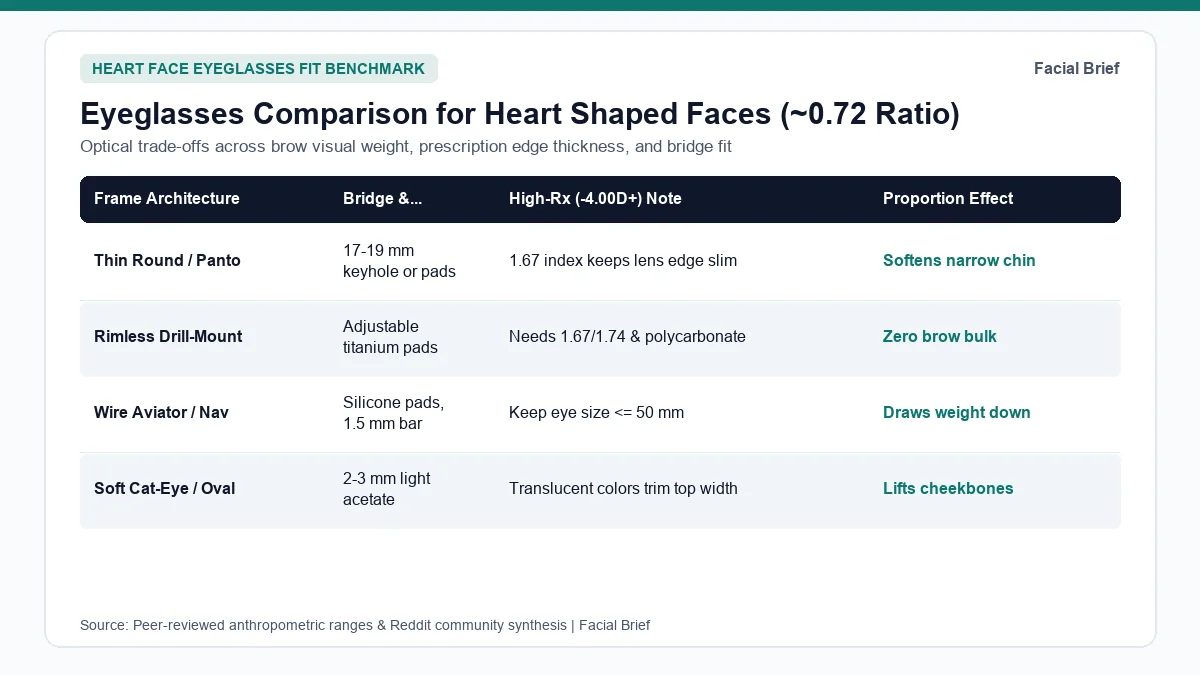
Fit feedback across r/glasses, r/EyewearEnthusiasts, and r/mensfashionadvice converges on four low-bulk frame silhouettes, along with practical prescription constraints conventional buying guides skip.
Rimless and Semi-Rimless Frames
Minimalist drill-mount rimless frames win consistent praise across r/glasses because removing the rim drops upper-third visual bulk to near zero. As wearers demonstrate in this r/glasses round rimless fit thread, slender titanium bridges paired with rounded P3 or oval lens cuts preserve delicate jawline balance effortlessly. Semi-rimless frames (with a fine metal brow bar and nylon suspension thread below) provide comparable lightness with modest upper definition.
Stronger prescriptions introduce one clear limit: edge thickness. Opticians in this r/glasses high-prescription rimless discussion warn that minus powers past -3.50D to -4.00D expose noticeable 4 to 6 mm+ outer lens walls in frameless mounts. Keeping lens widths compact (46 to 48 mm circular shapes), upgrading to 1.67 or 1.74 high-index material, and choosing shatter-resistant Trivex or polycarbonate keeps exposed edges sleek and prevents drill-hole cracking.
Round, P3 Pantos, and Thin Oval Shapes
Traditional style charts sometimes push heart faces strictly toward angular rectangles, yet regulars in this r/EyewearEnthusiasts frame fit thread frequently choose rounded P3 pantos or thin oval silhouettes instead. Smooth bottom curves soften a pointed chin cleanly while narrow metal or translucent rims keep temple alignment crisp.
Scale still governs success. Giant 54+ mm round wire frames slide onto high cheekbones and dwarf narrow lower faces. Staying in the 47 to 50 mm lens bracket with 1.5 to 2.2 mm rims frames each eye comfortably without dropping into smile lines.
Soft Cat-Eye, Trapezoid Wayfarers, and Wire Aviators
Upswept cat-eye frames echo high cheekbone angles naturally, though wing extension changes the outcome. Sharp 1950s-inspired outer corners flaring well past your temples exaggerate upper width. Soft, subtly rounded cat-eyes in translucent champagne, pale tortoise, or thin wire (2 to 3 mm rim weight) lift the eye line cleanly without widening the forehead.
For men or neutral styles, bottom-weighted wire aviators (49 to 52 mm optical sizes rather than oversized 58 mm sunglasses) and slim rounded trapezoids draw visual balance downward toward the lower third, as debated in this r/mensfashionadvice heart-shaped head thread. Test translucent acetates and lighter wire frames alongside hair volume inside Facial Brief's Custom Style Studio, or match eyewear choices with our heart face hairstyles guide.
Bridge Sizing, Cheek Clearance, and Prescription Optical Checks
Favorable frame contours still fail when bridge spacing or vertical lens drop clashes with narrow nasal anatomy. On r/glasses, shoppers with narrow chins repeatedly discover that hardware measurements solve sliding and cheek contact faster than switching silhouettes.
Why Narrow Heart Faces Struggle With Standard Bridge Widths
Heart-shaped proportions frequently pair wide cheekbones with slender nasal bridges. Standard retail display shelves stock adult acetate frames around 19 to 21 mm molded bridges and 52 to 54 mm lenses (136+ mm total width). As buyers explain in this r/glasses petite frame thread, oversized fixed bridges slide steadily forward while deep 42+ mm lower rims graze cheekbones whenever you smile.
Targeting three optical measurements prevents both errors:
- Choose
16 to 18 mmfixed bridges on acetate frames, or pick metal frames with adjustable silicone nose pads to raise lenses3 to 5 mmabove prominent malar bone. - Limit vertical lens height to
35 to 41 mminstead of tall45+ mmsquares so bottom edges hover clear of midface skin. - Match total hinge-to-hinge front width against outer temple hairline (
124 to 132 mmfor petite-to-medium spans,133 to 138 mmfor wider upper cheekbones) rather than guessing by single-lens width alone.
Pupillary Distance, Vertex Distance, and Coating Choices
Verify that pupils sit horizontally near the center of each lens rather than crowding inner nasal rims, especially on wide frames. Measure your pupillary distance (PD, commonly 58 to 68 mm) accurately with our Pupillary Distance Tool before ordering prescription glasses online.
For stronger minus prescriptions (-4.00D+), adjustable nose pads keep vertex distance snug (12 to 14 mm from cornea to lens), reducing eye minification behind high-power glass. Adding a crisp anti-reflective (AR) coating eliminates white surface reflections so eye detail stays sharp, a styling principle covered in our general glasses for face shape guide and daily presentation habits in our glow-up presentation guide.
Heart Shaped Face Eyeglasses Comparison Table
Pairing visual weight limits with bridge hardware and prescription caps narrows online choices in seconds.
| Frame Style | Ideal Specs (Lens-Bridge) | Visual Weight on Forehead | Best Prescription Range | Community Fit Consensus |
|---|---|---|---|---|
| Rimless Drill-Mount | 46-50 lens; 17-19 pads | Minimal (< 1 mm edge) | Mild to -3.50D (or 1.67+ index) | Top lightweight pick for narrow chins |
| Thin P3 / Round Wire | 47-50 lens; 17-20 bridge | Low (1.5-2.0 mm titanium) | All Rx (1.60/1.67 for high minus) | Softens chin taper without top bulk |
| Wire Optical Aviator | 49-52 lens; 15-17 pads | Low-moderate (1.5 mm bar) | Mild to moderate (-4.00D max) | Pulls balance downward for men/unisex |
| Soft Translucent Cat-Eye | 48-51 lens; 16-18 bridge | Moderate (2-3 mm crystal/tortoise) | Mild to high (conceals bevel edges) | Lifts cheekbones if wings stay subtle |
| Semi-Rimless Top Bar | 49-52 lens; 17-19 pads | Moderate (slender metal top) | Mild to -4.00D (nylon groove) | Leaves lower face completely open |
| Chunky Dark Clubmaster | 51+ lens; 20+ brow bar | High (5+ mm dark upper slab) | High Rx hidden by thick rim | Usually skipped; widens upper third |
Review how jaw taper, cheek prominence, and facial thirds align in one complete sample biometric report before ordering prescription pairs.
Frequently Asked Questions
Are round or rectangular eyeglasses better for a heart shaped face?
Round, P3 pantos, and softly curved oval silhouettes typically balance heart proportions more easily than crisp rectangular boxes. Sharp horizontal rectangles mirror pointed chins awkwardly and concentrate visual mass across the upper brow, while rounded lower borders soften mandibular taper and keep cheek clearance steady. If you prefer rectangular glasses, select slim wire or rounded bottom-heavy trapezoids in lighter translucent tones.
Do cat-eye glasses make a wide forehead look bigger?
Dramatic cat-eyes with thick dark frames and pointed outer wings jutting past the temples widen the upper third noticeably. Softened, shallow cat-eye profiles in translucent crystal, warm champagne, or slim metal wire (2 to 3 mm rims) track natural cheekbone curves cleanly without extending past the outer hairline, keeping upper proportions calm while gently lifting midface balance above a narrow chin.
Can you get rimless glasses with a strong nearsighted prescription?
Yes, provided you adapt lens shape and index once powers exceed -3.50D to -4.00D. Minus lenses thicken toward the outer edge, making wide rimless shapes show bulky 4 to 6 mm walls. Pick compact circular or oval diameters (46 to 48 mm), choose 1.67 or 1.74 high-index polycarbonate or Trivex for drill resistance, and specify polished bevel edges.
What bridge width works best for high cheekbones and a narrow chin?
Petite or narrow-bridged heart faces commonly fit cleanly in 16 to 18 mm fixed acetate bridges paired with gentle 7 to 9 degree pantoscopic tilt and vertical lens heights under 41 mm. If molded plastic frames slide steadily down your nose or tap your cheeks during smiles, switch to metal frames with adjustable silicone nose pads or Low Bridge Fit molded bridges.
Referenced Community Discussions & Sources
- Perfect Round Rimless Fit on Narrow Proportions (r/glasses): Wearer fit photos demonstrating how drill-mount circular lenses keep delicate chins open without heavy brow bulk.
- Rimless Glasses With High Prescriptions Trade-Offs (r/glasses): Optician and buyer guidance covering
1.67/1.74high-index thickness, Trivex durability, and small lens diameters for stronger minus powers. - Glasses Shape Ideas for a Heart-Shaped Head (r/mensfashionadvice): Male styling feedback comparing optical wire aviators, slim rounded rectangles, and light brow profiles against wider foreheads.
- Petite Face Frame and Bridge Sizing Recommendations (r/glasses): Community recommendations detailing
46 to 49 mmlens widths, narrow bridge stability, and avoiding cheek hits. - Frame Suggestions Based on Facial Geometry (r/EyewearEnthusiasts): Collector perspectives on why temple alignment and eye centering outweigh rigid retail shape labels.
- Anthropometric & Optical Standards: Leslie G. Farkas soft-tissue craniofacial landmark ratios (
zy-zy,go-go,tr-gn); standard ophthalmic vertex distance (12-14 mm) and ANSI impact standards for drill-mount Trivex/polycarbonate lenses.
Paired Facial Brief Analyzer
Measure your own proportions on-device
Run private 478-point landmark geometry in your browser with zero server photo upload on free tools.
Continue Reading