What Is Hunter Eyes? Eye Anatomy, Canthal Tilt & Reality
Learn what is hunter eyes anatomy vs. round eyes, +2 to +6 deg canthal tilt norms, A10 slang, and styling vs. surgery risks in our comparison table.
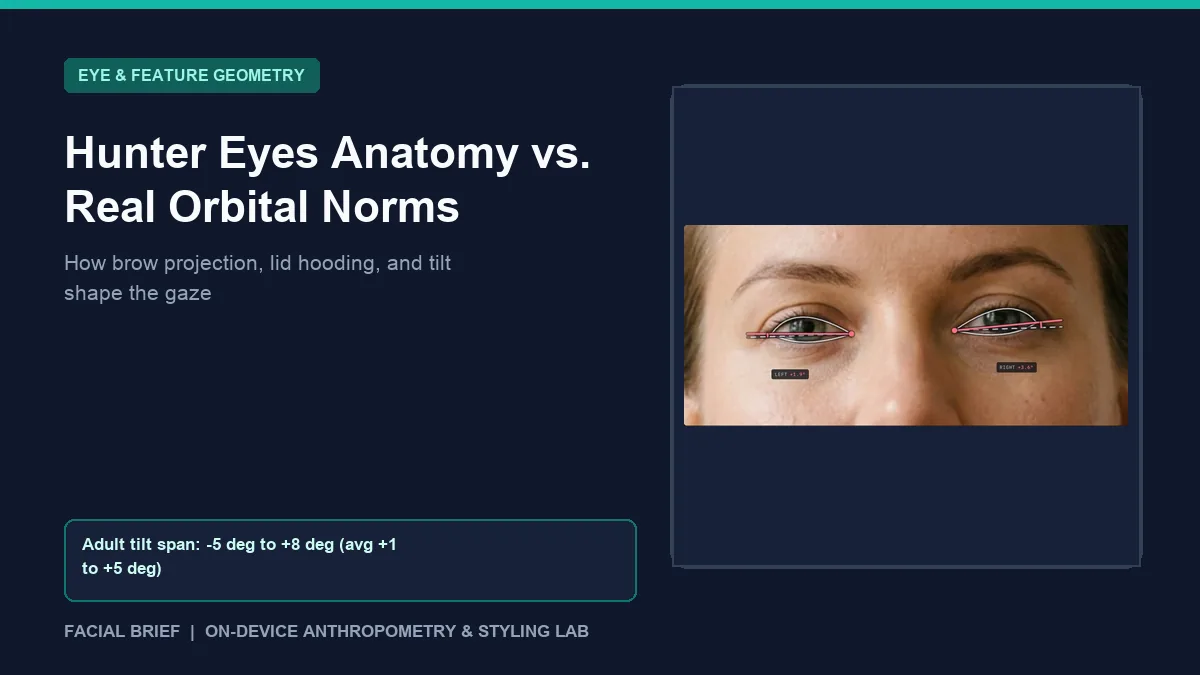
Forum threads on facial aesthetics throw around what is hunter eyes (often mistyped in searches as hunt eyes) as if it were a formal medical diagnosis. Anatomically, the term describes a compact cluster of periorbital features: eyes set deep inside the orbital socket beneath a projecting supraorbital brow ridge, narrow vertical opening height, minimal exposed upper-eyelid skin at rest, firm lower-lid support, and a level or upturned outer corner.
Casual phone selfies mislead people constantly because downward chin pitch, faint squinting, and harsh overhead shadows mimic deeper eye sockets. You can Measure Canthal Tilt inside your browser on an eye-level portrait to check outer corner inclination directly before comparing your resting eyelids against edited internet stereotypes.
Key Takeaways
- Adult palpebral fissures measure roughly 27 to 31 mm horizontally by 8 to 12 mm vertically in craniofacial surveys, with healthy canthal tilt spanning -5 to +8 degrees (+1 to +5 degrees typical).
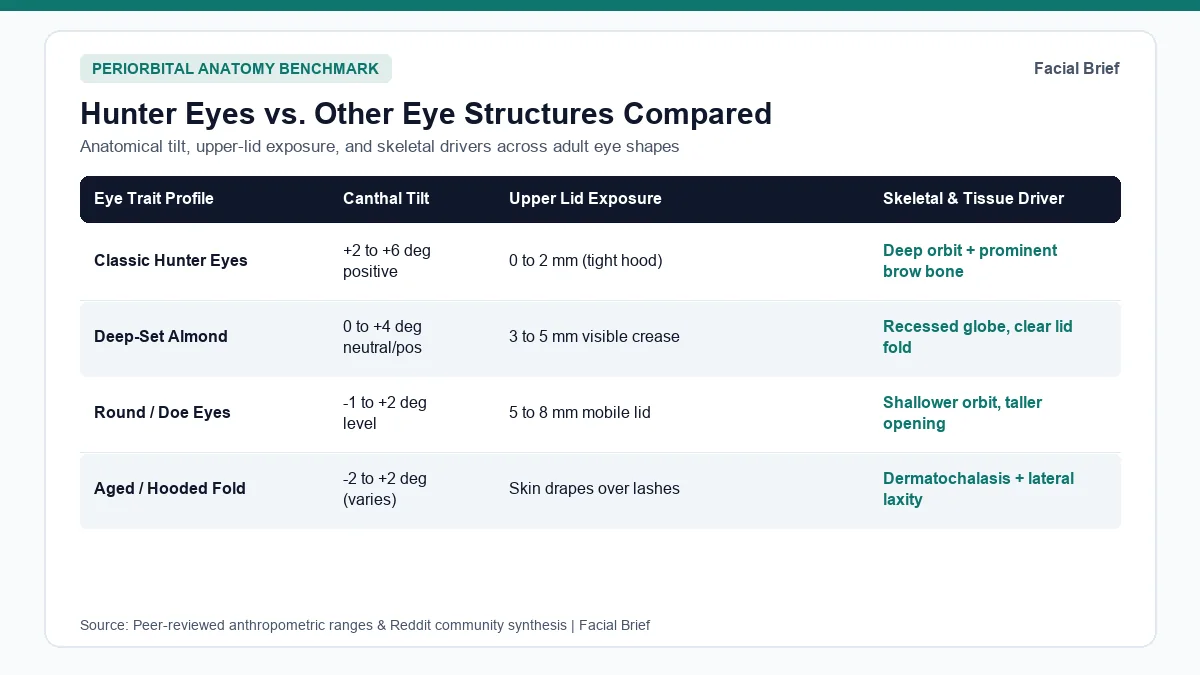
- Hunter eyes combine deep orbital recession, 0 to 2 mm of visible mobile upper lid at rest, a neutral-to-positive outer corner (+1.5 to +6 degrees), and tight lower-lid support with zero white sclera beneath the iris.
- A10 hunter eyes pairs two separate genetic traits from online charts: compact socket geometry alongside pale ice-blue or grey iris grading ("A10" eye color).
- Mewing, tongue posture, and deliberate squinting ("squintmaxxing") cannot remodel adult orbital bones or lift bone-anchored lateral canthal tendons.
- Surgical procedures marketed for eye-corner shape, such as lateral canthoplasty ($3,500 to $6,500+ in the US, or roughly EUR 3,000 to 8,000+ abroad for combined packages), carry concrete risks including dry eye, corner rounding, asymmetry, and lower-lid retraction.
What Do Hunter Eyes Look Like? The Four Anatomical Traits
To answer what do hunter eyes look like without relying on retouched model portraits, split the eye region into four measurable anatomical parts. Orbital bone depth, upper soft tissue, globe placement, and tendon height operate together as one frame.
First is orbital depth and supraorbital projection. In a deep-set socket, the upper brow ridge projects slightly forward relative to the eyeball. That bony overhang creates gentle shading above the lid crease and reduces how much roundness of the eye globe shows from a three-quarter angle.
Second is minimal upper eyelid exposure. Relaxed, open lids typically show 5 to 8 mm of mobile skin between the upper lash margin and the crease. On compact hunter-style lids, low brow fullness or tight folding narrows visible mobile skin to roughly 0 to 2 mm when staring straight forward. Our hooded eyes guide covers how overhanging brow folds differ from recessed sockets.
Third is positive or level canthal tilt. When the outer corner (lateral canthus) sits 1.5 to 6 degrees higher than the inner corner (medial canthus), the eye opening tapers into a horizontal almond. Our negative canthal tilt guide explains how cheekbone projection and lateral orbital bone height set downward outer angles.
Fourth is taut lower-lid support and narrow aperture height. Craniofacial measurements compiled by Dr. Leslie Farkas place normal adult eye width near 27 to 31 mm and vertical opening near 8 to 12 mm. Hunter-style geometry sits toward the narrower end of opening height (eye aspect ratio around 0.24 to 0.28), keeping the lower eyelid margin flush against the bottom edge of the iris.
Decoding A10 Hunter Eyes and Forum Slang
Searches for a10 hunter eyes come from internet color-tier graphics merged with facial rating slang. In those charts, "A10" labels light ice-blue or pale grey irises, while "hunter" describes the compact almond socket frame.
Iris pigment and orbital bone depth follow separate genetic pathways. A thread on r/trueratediscussions comparing hunter eyes and blue eyes notes that pale irises simply boost contrast around the pupil in bright photos, while brown or hazel eyes with identical brow depth and lid tightness share the exact same skeletal geometry.
Do I Have Hunter Eyes? Testing Without Camera Illusion
Posts asking do i have hunter eyes fill r/Howtolooksmax feedback threads, and most confusion stems from how close-up phone cameras warp upper-face posture. Dropping your chin even 5 degrees while looking straight at the lens pulls brows downward over the crease while flattening apparent corner tilt.
Run four plain checks in even window light before labeling your eye area. Start by relaxing your forehead and lower eyelids completely while standing five to six feet from a mirror or rear camera lens. Raising your lower lids slightly ("squintmaxxing") hides white sclera temporarily, yet vanishes the moment you speak or blink naturally.
Next, test your brow-to-globe plane by resting a clean finger vertically across your eyebrow ridge and lower cheekbone rim without pressing your eyelid. On recessed orbits, the closed eyelid sits flush behind that vertical plane; on shallower orbits, the globe sits slightly forward.
Finally, inspect your aperture proportions alongside horizontal spacing using Facial Brief's Eye Shape Analyzer, and compare inter-eye spacing in our eye shape chart guide and pupillary distance guide. Eyes spaced near one eye-width apart (0.92 to 1.12x) look steadier horizontally than unusually narrow or wide spacing, and most adults show mixed traits such as +3 degrees of tilt paired with 4 mm of visible upper eyelid.
What Reddit Debates About Hunter vs. Prey Eyes
Rating boards pit "hunter eyes" against "prey eyes" (rounder eyes with taller upper lids or downward outer tilt), treating one pattern as universally best. Mainstream feedback looks far less uniform. Across r/VindictaRateCelebs threads asking women about hunter eyes and r/trueratediscussions comparisons of small hunter eyes versus larger eyes, voters split sharply. Many like strong brow-to-eye intensity on angular bone structures, while equally many note that narrow, squinted eyes read cold compared with warmer almond eyes. In r/QOVESStudio threads on women with hunter eyes and r/QOVESStudio anatomy breakdowns, commenters add that upturned hooded eyes pair tightly with high cheekbones, while softer faces often balance cleanly with taller lids.
Getting Hunter Eyes: Grooming Framing vs. Surgical Reality
People searching for getting hunter eyes or hunter eye surgery typically encounter unverified exercise drills alongside high-stakes oculoplastic procedures. Comparing non-surgical framing against medical boundaries keeps expectations realistic.
| Approach | Anatomical Target | Effort & Typical Cost | Realistic Visual Outcome | Limits & Risks |
|---|---|---|---|---|
| Brow Tail & Arch Grooming | Hair density, straight brow line, outer tail tidy | 5 min weekly; $0-$30 | Tightens upper framing with clean brow shadow | Over-plucking underside raises lid gap |
| Under-Eye Skincare & Sleep | Periorbital fluid retention, skin tone, UV care | Daily habit; $20-$75 | Lowers morning puffiness and dark hollows | Cannot raise lower tarsus or move bone |
| Eyewear & Lighting Framing | Browline, square acetate, slender top rims | Frame swap; $40-$240 | Adds straight horizontal line above eyes | Round wire frames accentuate eye height |
| Mewing & Squint Drills | Tongue palate pressure or lower-lid flexing | Unproven drills; $0 | Temporary photo squint; zero orbital shift | Repetitive squinting deepens crow's feet |
| Lateral Canthopexy / Canthoplasty | Outer canthal tendon tightening or re-anchoring | Surgery; ~$2,000-$6,500+ US | Moves outer corner toward neutral or mild slant | Dry eye, corner rounding, scars, asymmetry |
| Infraorbital / Brow Surgery | Lower rim volume, brow lift, upper-lid fat graft | Surgery; ~$3,500-$15,000+ | Alters rim projection or upper soft tissue | Hard revision, nerve irritation, tight pull |
Why Non-Surgical "Hunter Eye" Hacks Fail
Posts on r/Mewing asking how to get hunter eyes draw quick corrections from veteran members: adult facial sutures fuse well before full maturity, so tongue posture cannot advance the brow bone over the eye socket.
Deliberate squinting brings its own downside. Flexing the orbicularis oculi pulls delicate lateral skin inward and etches fine creases years early without changing tarsal height. Practical daily habits sharpen eye presentation noticeably: 7 to 8 hours of sleep, moderate late-night sodium to avoid morning fluid puffiness, daily broad-spectrum SPF 30+ around the orbital rim, and clean straight brow grooming. Checking how brow geometry pairs with facial thirds inside Facial Brief's 42-Metric Full Report helps spot whether hairstyle volume moves overall balance more than eye shape alone.
Clinical Reality of Hunter Eye Surgery
When users research hunter eye surgery across r/QOVESStudio surgery discussions and r/SeoulPlasticSurgery threads, surgeons separate tightening an outer tendon from altering the bony socket.
Lateral canthopexy places internal sutures to stabilize an intact tendon during blepharoplasty, whereas lateral canthoplasty cuts, shortens, and re-anchors the tendon higher on the orbital rim. Standalone US canthoplasty fees frequently run $3,500 to $6,500+, while combined brow, lid, and lower-rim packages discussed in South Korea or Turkey often sit around EUR 3,000 to EUR 8,000+.
Anatomical support limits every surgical outcome. Pulling an outer corner upward across a shallow cheekbone or forward-set globe can slide the lower lid under the curve of the eyeball, increasing white sclera show. Post-op reports also cite blunted outer corners, persistent dry eyes, tight blinking sensations, and uneven healing. Any structural eyelid evaluation belongs strictly with a board-certified oculoplastic specialist.
Frequently Asked Questions
What is the difference between hunter eyes and hooded eyes?
Hooded eyes describe excess upper-eyelid skin or soft brow tissue draping downward over the natural crease toward the lash line, which occurs across round, neutral, or upturned eyes alike. Hunter eyes specifically pair minimal mobile upper-lid show with a deeply recessed orbital socket, low straight brow bone projection, taut lower-lid support beneath the iris, and a neutral-to-positive outer corner tilt.
Can mewing or eye exercises give you hunter eyes?
No. Adult orbital bone depth, globe projection, and lateral canthal tendon attachment remain structurally fixed once skeletal growth finishes. Tongue posture and facial workouts cannot push the supraorbital ridge forward or shrink vertical palpebral height permanently. Holding an artificial squint alters casual selfies only while muscles stay flexed, and repeated squinting accelerates fine lateral crow's feet creases around the outer corners.
What does A10 hunter eyes mean online?
"A10 hunter eyes" merges two unrelated internet rating labels: "A10" from online eye-color tier charts denoting bright ice-blue or pale grey irises, and "hunter eyes" describing deep, horizontally narrow almond eye framing with minimal upper-eyelid exposure. Iris melanin genetics set natural iris color contrast independently, whereas orbital bone depth, supraorbital brow projection, and eyelid crease placement determine the surrounding socket geometry.
Is hunter eye surgery like canthoplasty reversible or low risk?
Lateral canthoplasty is permanent structural surgery and carries serious trade-offs when performed purely for aesthetic eye elongation over shallow cheekbones. Documented complications include rounded or blunted outer corners, webbing scars, lower-eyelid retraction exposing extra white sclera beneath the iris, chronic dry eye, tight blinking for months, and left-right asymmetry. Because eyelid margins forgive very little error, revision surgery remains technically demanding.
Referenced Community Discussions & Sources
- r/VindictaRateCelebs: Do women find hunter eyes attractive on men?: Compares varied female attraction preferences between sharp deep-set eyes and softer, open almond gazes.
- r/trueratediscussions: Small hunter eyes versus larger expressive eyes: Examines trade-offs between perceived intensity, approachability, and overall facial balance.
- r/QOVESStudio: Is there any surgery that creates hunter eyes?: Breaks down why orbital bone depth limits what soft-tissue canthoplasty or brow procedures can achieve.
- r/Mewing: Community reality check on getting hunter eyes without surgery: Confirms why posture drills and squinting fail to alter fixed orbital geometry.
- r/Howtolooksmax: Evaluating whether partial hooding qualifies as hunter eyes: Shows how camera pitch, brow relaxation, and mixed traits blur strict internet classifications.
- r/trueratediscussions: Why blue eyes and hunter eyes get grouped together online: Separates iris color contrast from periorbital skeletal structure.
- Craniofacial anthropometric reference norms: Leslie G. Farkas, Anthropometry of the Head and Face (normal palpebral fissure widths 27-31 mm, heights 8-12 mm, and healthy population canthal tilt ranges).
Paired Facial Brief Analyzer
Measure your own proportions on-device
Run private 478-point landmark geometry in your browser with zero server photo upload on free tools.
Continue Reading