Midface Ratio and fWHR Explained: Benchmarks, Limits & Balance
Compare midface ratio (0.90-1.05), fWHR (1.80-2.10), and facial depth norms, selfie lens errors, and optical framing fixes in our full benchmark table.
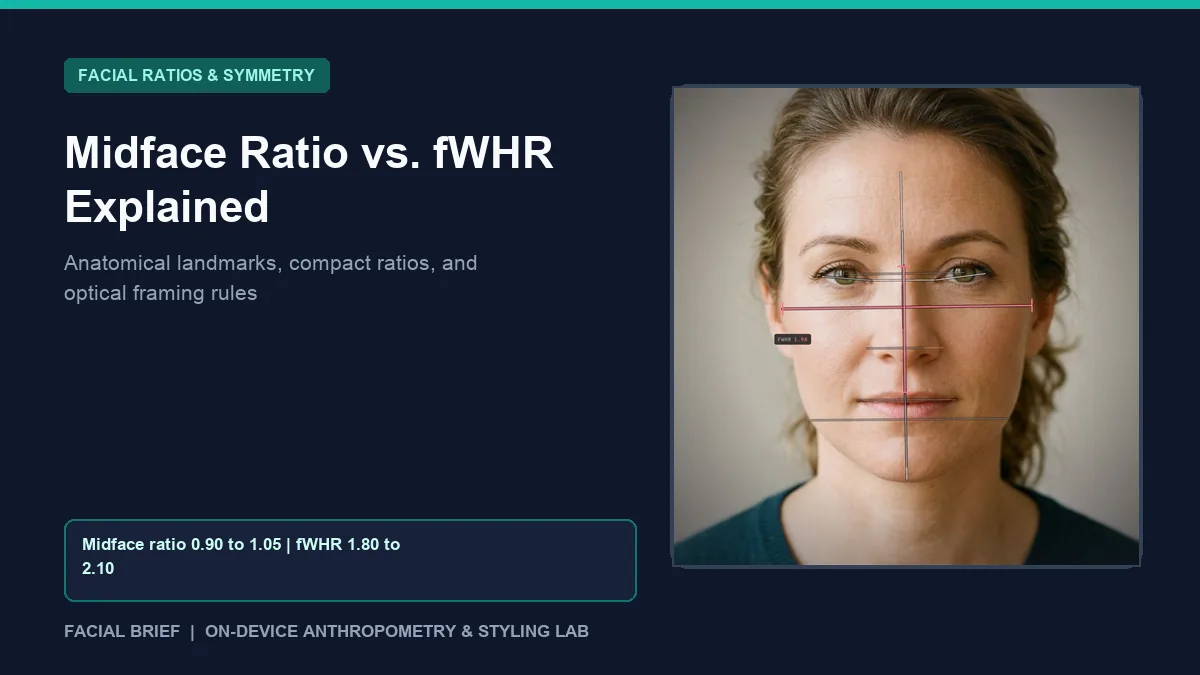
Searching for your midface ratio or fWHR (facial width to height ratio) online quickly produces conflicting charts. One guide insists a 1.00 midface score is mandatory for proportion balance, while another cites fashion models with noticeably longer central thirds. Meanwhile, two calculators can return completely different figures from the same portrait because one anchors upper height at the eyebrows and the other anchors at the upper eyelid crease.
Before judging a long mid face ratio, you need standardized landmarks and a photo captured far enough away to stop wide-angle warping. You can measure your eye spacing, cheekbone width, and upper-face height directly in your browser using Calculate Facial Ratios.
Key Takeaways
- Community calculators compute midface ratio by dividing interpupillary distance (IPD) by the vertical span from the pupil line to the upper lip border, with balanced readings clustering between 0.90 and 1.05.
- Academic anthropometry calculates the facial width to height ratio (fWHR) as bizygomatic cheekbone width divided by upper-face height (upper lip to brow or nasion), averaging 1.83 to 1.95 in men and 1.73 to 1.82 in women, while eyelid-anchored photo tools calibrate between 1.80 and 2.10.
- Close-range smartphone front cameras (near 24 mm equivalent focal length) squeeze cheekbones inward and stretch vertical midface height by 8% to 12%.
- The facial depth to height ratio compares sagittal projection from ear plane to maxilla against vertical height, showing why two faces with identical front scores look different from the side.
- Adult bones do not shorten through exercises or tongue posture, so real improvements come from camera distance, bangs, temple volume, glasses, and strategic blush or beard contrast.
How Midface Ratio, fWHR, and Facial Depth Differ
Although ratio forums lump central measurements together, midface ratio, fWHR, and sagittal depth measure three separate geometric axes. Mixing them up leads people to blame eye spacing for a tall chin or blame cheekbones for a tilted lens.
Interpupillary Midface Ratio Landmarks
Unlike formal metrics in Leslie Farkas's craniofacial datasets, the IPD-based midface ratio originated in online aesthetics forums. You divide horizontal interpupillary distance (center of left pupil to center of right pupil) by the vertical distance from the pupil line down to the upper lip border (labrale superius).
Because adult IPD averages 62 to 64 mm, a ratio near 1.00 means pupil width matches eye-to-lip height. Compact ratios past 1.05 shorten the center face visually, a look prized in East Asian makeup guides, while figures under 0.90 read longer.
Before labeling any sub-0.90 reading a flaw, check surrounding landmarks. In this r/Vindicta breakdown on misreading midface length, contributors observe that tall chins, high hairlines, or long philtrums frequently get blamed on midface height. As this companion r/Vindicta midface guide notes, eye spacing and vertical cheek length interact across the whole face.
Eyelid vs. Brow Anchors in fWHR Calculations
Psychology studies largely follow Carré and McCormick's 2008 protocol for facial width to height ratio (zy-zy divided by upper-face height from upper lip border to mid-brow). Using that brow anchor, adult averages sit around 1.73 to 1.82 in women and 1.83 to 1.95 in men.
Automated 478-point face meshes commonly place the top anchor at the upper eyelid crease instead of the eyebrow because brow grooming varies wildly. Shifting that point down 3 to 5 mm shrinks the denominator and pushes normal fWHR readings into a 1.80 to 2.10 window. That anchor mismatch explains why analysts in this r/QOVESStudio fWHR measurement thread calibrate photos against physical philtrum length using a ruler before comparing ratios across apps.
What Facial Depth to Height Ratio Adds in 3D
Flat front photos hide anteroposterior projection completely. In cephalometry, facial depth to height ratio compares sagittal depth (from the external ear plane or cranial base forward to the nasal root and upper jaw) against anterior face height. When depth runs roughly 62% to 72% of morphological height, under-eye bone and malar arches support cheek tissue cleanly.
When maxillary projection sits further back, the center face loses forward structure and looks longer from the front even when 2D ratios read average. Checking front metrics alongside lateral angles in our perfect side profile guide clarifies whether vertical height or forward projection shapes your center face.
What Reddit Discussions Reveal About Proportions and Myths
Proportion boards often turn descriptive geometry into rigid pass-fail checklists. Weighing community debates alongside replication research keeps those decimals grounded.
Can a Compact Midface Compensate for Low fWHR?
Forum threads frequently ask whether one strong ratio offsets another. In this r/QOVESStudio discussion on midface ratio vs. low fWHR, commenters note that a narrower skull looks well balanced when IPD matches central vertical height near 1.00 and eye spacing obeys the one-eye-width rule.
Meanwhile, r/QOVESStudio's debate on longer midfaces points to runway models and actors measuring near 0.88 to 0.93 whose broad cheekbones, clear brow framing, and strong lower-third support carry horizontal balance smoothly. Single numbers break down quickly when isolated from jaw taper, lip width, and cheekbone projection.
Why Dominance Claims Around fWHR Collapsed
Earlier papers argued higher fWHR signaled elevated testosterone, aggression, or dominance. Replication studies overturned those links. Discussions like this r/science thread on macho face ratio theory summarize pre-registered meta-analyses showing behavioral correlations shrink near zero once body weight and skull size are controlled. Cheek fat alone inflates 2D bizygomatic width without altering bone.
Camera Errors vs. Optical Ways to Balance a Long Midface
Before looking for mid face ratio how to fix tips, rule out smartphone lens warp.
Fixing Wide-Angle Lens Stretch and Head Pitch
A front camera shoots near a 24 mm equivalent focal length. Held 35 cm away, perspective distortion widens nasal bridges, tucks cheekbones back, and stretches central height; a 2018 JAMA Facial Plastic Surgery study measured close selfies inflating nasal width roughly 30% over 1.5-meter portraits. Follow three capture rules:
- Use your rear 2x lens (50 mm equivalent) on a timer from 1.5 to 2 meters away.
- Level ear canals with lower eye sockets (Frankfort horizontal plane) so chin tilt does not shrink or drop midface ratio.
- Keep lips relaxed, since smiling pulls cheek tissue outward 3% to 6% and shortens the upper lip.
With a clean portrait ready, pair your ratios with symmetry and jaw slope inside Facial Brief's 42-Metric Full Report, or view an annotated example on our sample Face Report.
Non-Surgical Framing, Hair, and Makeup Adjustments
Adult skull sutures and maxillary height do not compress through workouts or tongue posture. As our mewing results review notes, palatal suction lifts under-chin tissue while held, leaving midface bone unchanged.
Effective changes shift optical weight. In this r/Splendida thread on balancing a long midface, users break vertical lines with curtain bangs, temple-width waves instead of flat center parts, and medium-tall frames. Meanwhile, this r/AsianBeauty short-midface guide places blush horizontally directly under the eyes, emphasizes lower lashes, skips nose-bridge highlighter, and keeps fuller brows closer to the lash line. Men can maintain tidy chin beard fullness and avoid tall fades. If mild left-right unevenness exaggerates cheek height, check our asymmetrical face correction guide.
Midface Ratio, fWHR, and Framing Methods Compared
The table below compares standardized proportion ranges alongside common lens errors and realistic adult framing options.
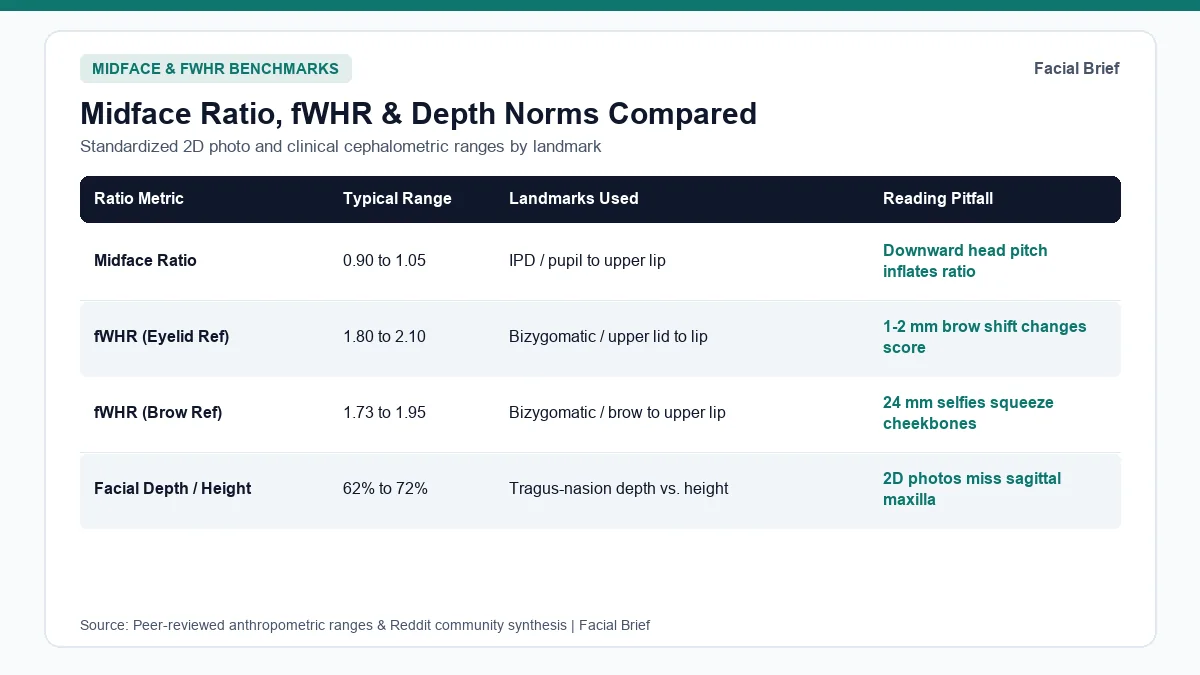
| Metric or Adjustment | Typical Reference Band | Anatomical Landmarks | Common Error or Optical Shift | Realistic Adult Actionability |
|---|---|---|---|---|
| Midface Ratio (IPD Method) | 0.90 to 1.05 | Interpupillary width / pupil-to-upper-lip | Tilted chin or close selfie drops score | Bone height fixed; optically shortened with bangs and horizontal blush |
| fWHR (Eyelid Landmark) | 1.80 to 2.10 | Cheekbone width (zy-zy) / upper lid-to-lip | Wide-angle 24 mm lens narrows zy-zy | Lean cheek fat sharpens edge; temple hair adds lateral width |
| fWHR (Brow Landmark) | 1.73 to 1.95 (F/M norm) | Cheekbone width / lower brow-to-lip | Raised or sparse brows alter denominator | Straighter, fuller lower brow edge subtly increases score |
| Facial Depth to Height | 62% to 72% (3D norm) | Ear-to-maxilla depth / n-gn height | 2D front photos miss sagittal recession | Only orthodontic or surgical skeletal care alters adult depth |
| Cheekbone-to-Jaw Ratio | 0.74 to 0.88 | Bigonial jaw width / bizygomatic width | Smiling flares cheek width laterally | Overall body fat reduction clarifies cheekbone-to-jaw taper |
| Lateral Hair & Eyewear | Side volume at malar zone | Temple hair bulk and mid-frame height | Flat center-parted hair stretches verticals | Curtain fringe, temple width, and taller rims balance vertical thirds |
Comparing these benchmarks together shows why no single decimal defines facial balance. Once lens distance is standardized and hair or eyewear distributes horizontal width evenly, small ratio differences fade in everyday conversation.
Frequently Asked Questions
What is considered a balanced midface ratio?
Most facial ratio calculators treat a midface ratio between 0.95 and 1.05 as balanced, meaning interpupillary distance roughly equals the vertical span from your pupil line to the top of your upper lip. Values from 0.90 to 1.05 sit within common adult norms, while numbers under 0.88 appear longer vertically and numbers past 1.08 look notably compact.
Why do different calculators give me different fWHR numbers?
Two calculators often differ by 0.10 to 0.18 on the exact same portrait because software tools select different upper height landmarks. Academic studies measure from the upper lip up to the lower brow edge or nasion (averaging 1.73 to 1.95), whereas automated mesh calculators frequently anchor at the upper eyelid crease (averaging 1.80 to 2.10).
Can exercises or mewing shorten a long midface ratio?
No. Once adolescent craniofacial sutures fuse in late teens, tongue posture, facial workouts, and hard gum chewing cannot shorten maxillary bone height or pull eye sockets closer to the mouth. Those habits shift under-chin muscle tone or thicken masseter muscles temporarily while leaving midface bone height fixed. Practical adjustments rely on camera distance, hairstyles, brow shaping, and makeup or beard contrast.
How is facial depth to height ratio measured accurately?
Accurate facial depth to height ratio measurement requires a lateral cephalometric X-ray or 3D facial scan instead of a flat front selfie. Specialists compare front-to-back landmarks from the external ear plane or cranial base forward to the maxilla and nose against vertical height from nasion to chin. Pairing a straight front scan with a leveled 90-degree lateral image reveals projection clearly.
Referenced Community Discussions & Sources
- r/Vindicta: Distinguishing true midface length from chin or forehead height: Explains why long chins and tall hairlines get mislabeled as long midface ratios.
- r/Vindicta: Understanding midface ratio formulas and eye-spacing context: Breaks down interpupillary-to-upper-lip scaling and why neighboring proportions matter together.
- r/QOVESStudio: Can an ideal midface ratio compensate for low fWHR?: Compares narrower skulls against balanced central proportions and highlights close-up lens distortion.
- r/QOVESStudio: Measuring fWHR with ruler-calibrated philtrum references: Shows how brow vs. eyelid landmarks and perspective skew DIY ratio calculations.
- r/QOVESStudio: Weighing longer midfaces against cheekbone and jaw harmony: Examines how strong malar width and jaw support balance sub-0.95 midface ratios.
- r/Splendida: Non-surgical styling strategies for a longer midface: Reviews fringe placement, lateral wave volume, and eyewear sizing that soften vertical height.
- r/AsianBeauty: Makeup placement techniques for compacting the central face: Details upper-cheek horizontal blush, lower-lash emphasis, and brow adjustments to balance midface space.
- r/science: Meta-analytic pushback on fWHR dominance claims: Summarizes replication studies showing weak links between fWHR and aggression once body size is controlled.
- Clinical References: Farkas, L. G. (1994), Anthropometry of the Head and Face; Carré, J. M. & McCormick, C. M. (2008), fWHR landmark definition; Ward, B. et al. (2018), JAMA Facial Plastic Surgery perspective distortion study.
Paired Facial Brief Analyzer
Measure your own proportions on-device
Run private 478-point landmark geometry in your browser with zero server photo upload on free tools.
Continue Reading