What Makes a Perfect Side Profile? Angles, E-Line & Smile Shifts
Learn how a perfect side profile compares with normal side profiles across convexity, nasolabial angle, Ricketts E-line, smile shifts, and styling.
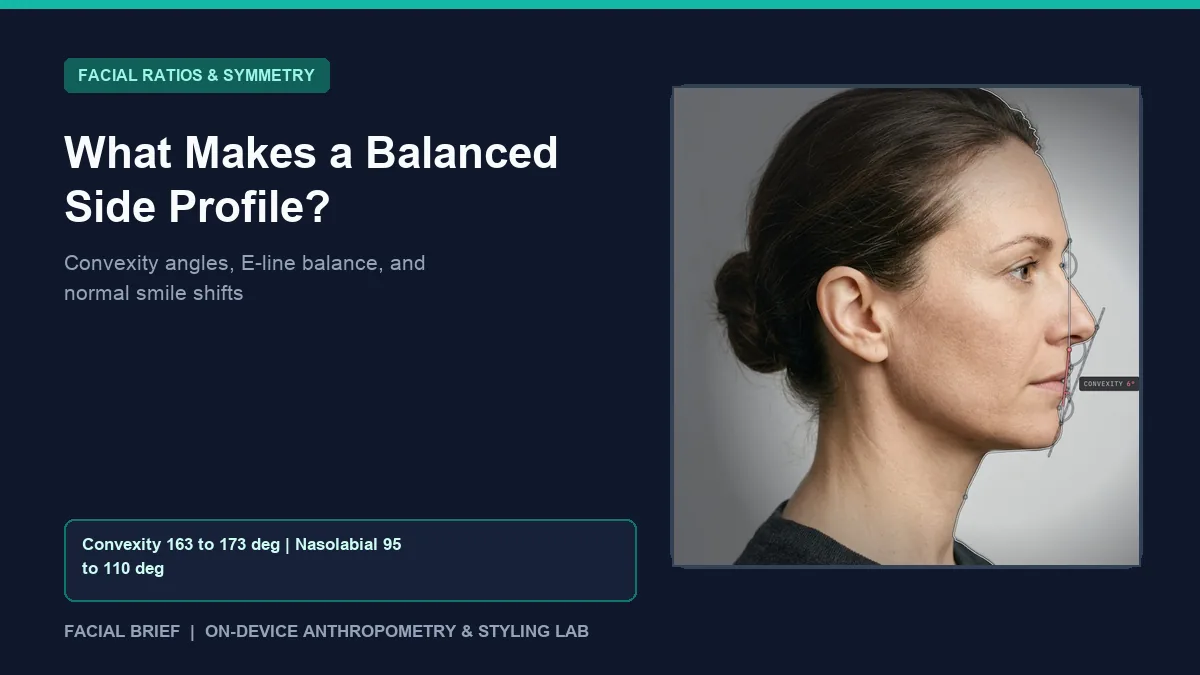
Almost everyone feels caught off guard the first time they see an unposed photograph of their own side profile. Mirrors display your front profile every morning, so catching a flat 90-degree silhouette from a candid angle feels unfamiliar even when your measurements sit squarely inside normal clinical bounds. Social media feeds narrow expectations further by treating one sculpted celebrity template as the perfect side profile, overlooking how ethnic variation, dental alignment, and facial movement change side profiles of faces in everyday life.
Separating camera distortion from bone balance starts by checking fixed anatomical lines on a leveled 90-degree image. You can measure facial convexity, nasolabial angle, nasal slope, and Ricketts' E-line in your browser using Analyze Side Profile.
Key Takeaways
- Clinical norms place balanced facial convexity (
glabella-subnasale-pogonion) between 163 and 173 degrees, meaning gentle forward projection across the nose and upper jaw is healthy instead of a flat 180-degree line. - Along Ricketts' E-line (nasal tip to chin tip), balanced lips typically sit near
-4 to -1 mm(upper) and-2 to +1 mm(lower), with wider variation across diverse ethnic profiles. - Standard nasolabial angles measure 90 to 98 degrees in men and 95 to 110 degrees in women, while nasofrontal angles at the brow-to-nose junction cluster between 120 and 135 degrees.
- A side profile smile lowers the nasal tip slightly, flares nostrils, lifts cheek fullness, and moves lips forward by several millimeters, which is normal muscular mechanics.
- Upright neck posture, lower body fat, layered haircuts, and sharp beard necklines alter profile balance immediately without surgical risk.
Side Profile of a Face: The Five Core Clinical Measurements
Clinicians evaluate the side profile of a face through relationships among neighboring structures instead of judging any single feature alone. A slightly recessed chin makes an average nose appear larger; strong upper-jaw support keeps the same nose looking balanced.
Facial Convexity and the Nasofrontal Transition
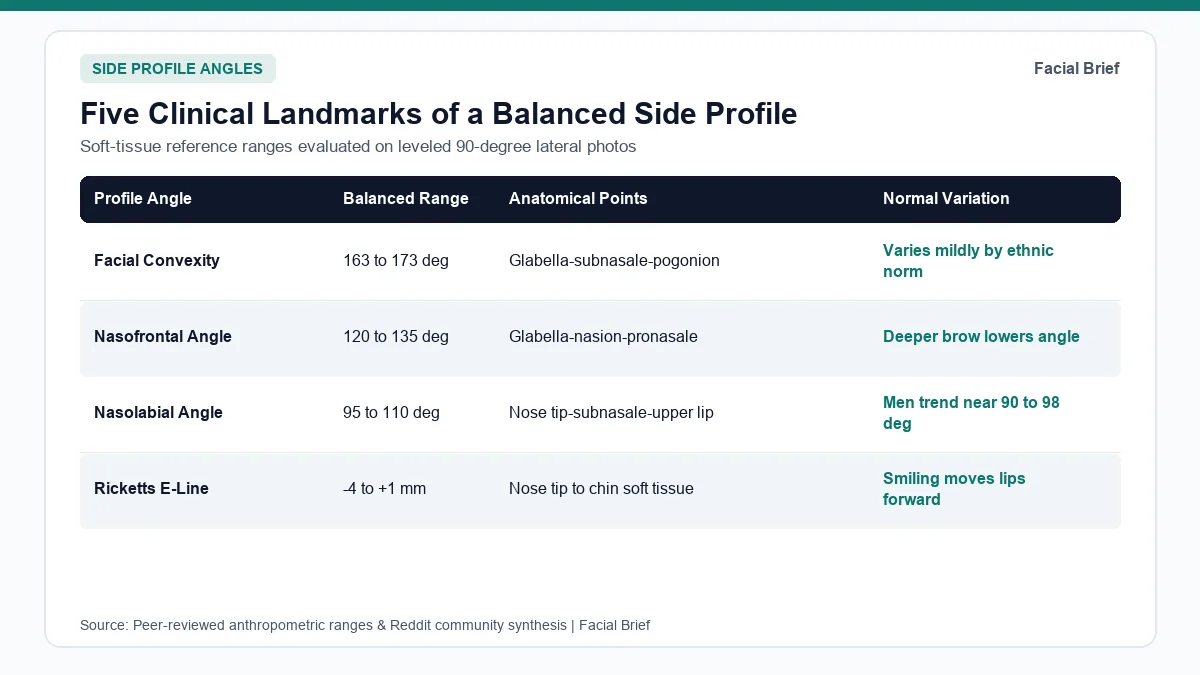
Facial convexity traces three soft-tissue landmarks: the glabella (between the brows), subnasale (base of the nose), and pogonion (chin tip). In a level head position, balanced readings sit between 163 and 173 degrees. Angles below 160 degrees look distinctly convex due to upper-jaw prominence or chin retrusion, while angles near 178 to 180 degrees appear very straight or faintly concave.
Directly below the glabella lies the nasofrontal angle, where the forehead drops into the nasal root (nasion) and slopes along the nasal bridge (pronasale). Typical readings cluster between 120 and 135 degrees. Strong brow projection deepens the crease toward 120 degrees, while a smoother forehead opens closer to 135 degrees. Angles past 140 degrees create a high nasal root transition between the eyes.
Nasolabial Angle and Ricketts' E-Line
The nasolabial angle measures the turn from the underside of the nose (columella) down to the upper lip. Orthodontists target 90 to 98 degrees in men for a horizontal nasal base and 95 to 110 degrees in women for subtle upward tip rotation without showing excess nostril from the front.
Ricketts' Esthetic Line (E-line) connects the nasal tip straight to the soft-tissue chin. European orthodontic standards place the upper lip 2 to 4 mm behind this plane and the lower lip 0 to 2 mm behind it. Yet contributors in this r/QOVESStudio side profile type comparison and this r/Splendida facial profile breakdown emphasize that fuller lips touching or crossing the E-line slightly are completely harmonious across East Asian, African, and mixed-ancestry profiles.
Normal Side Profile vs. Social Media Standards
Searching "side profiles" online displays an ultra-specific look: sharp 120-degree jaw angles, low body fat, and sculpted chin support. Comparing natural human motion against rigid photo grids explains why normal profiles feel unexpectedly harsh on camera.
Front Profile Familiarity vs. Static 90-Degree Shock
In this r/beauty thread asking how much side profiles matter, commenters repeatedly admit disliking their own normal side profile while rarely noticing anyone else's from 90 degrees. Familiarity bias drives much of that discomfort. You see your front profile in mirrors every morning, while lateral views appear mainly in unguarded snapshots.
In real life, people observe you in continuous three-quarter motion driven by expression and posture. Low-angle phone photos held below chin level also exaggerate throat folds and soften jaw definition unfairly.
What Happens During a Side Profile Smile
Posters in this r/PlasticSurgery thread on looking completely different while smiling often worry when comparing a resting profile against a side profile smile. Normal facial muscles alter three landmarks at once:
- Lip-elevating and depressor septi muscles pull the upper lip higher while tugging the nasal tip downward, trimming the nasolabial angle by 5 to 10 degrees.
- Smiling stretches soft lip tissue forward across upper front teeth, moving lips closer to or past Ricketts' E-line.
- Cheek pads lift toward the lower eyelid, compressing skin slightly near the ear.
Because expression reshapes soft tissue naturally, side profile readings are always measured at rest with relaxed lips and level gaze.
Non-Surgical Side Profile Framing vs. Clinical Interventions
When lateral proportions sit modestly outside textbook windows, knowing what daily habits improve versus what belongs strictly to orthodontics or surgery prevents wasted spending.
Posture, Body Fat, and Grooming Adjustments
Forward head posture pushes the skull ahead of the neck, folding tissue under the mandible and hiding the jawline even on lean adults. Stacking ears directly over your shoulders opens the neck-to-chin break immediately.
In this r/HowToBeHot thread on practical side profile improvements and this r/malegrooming breakdown on jaw and beard framing, top non-surgical gains come from reducing facial bloating and adjusting hair silhouettes. Trimming excess body fat and limiting evening sodium reduce submental puffiness. Men can keep slightly fuller beard length at the chin while tapering cleanly one finger-width above the Adam's apple to extend apparent chin support. Collarbone layers or tucked side-swept bangs soften steep foreheads or stronger nasal bridges cleanly.
As covered in our mewing results evidence review, resting tongue suction lifts under-chin muscle tone right away while held, yet adult jawbones do not migrate forward without mechanical orthognathic care. For readers noticing mild left-to-right differences or jaw tightness, our facial exercises symmetry guide and asymmetrical face guide separate habit tension from fixed bone shape.
Orthodontic Alignment, Fillers, and Structural Procedures
When severe overjet, crossbite, or chin recession pulls the lower third far back, grooming reaches clear limits. Threads like this r/PlasticSurgery discussion on non-surgical side profile options weigh conservative camouflage against structural treatments:
- Orthodontics shifts dental flare and lip support cleanly along the E-line over 12 to 24 months without altering basal jawbone.
- Temporary hyaluronic acid or calcium hydroxylapatite chin filler ($650 to $1,400 per visit, lasting 9 to 18 months) adds modest projection forward, though repeated refills can widen or soften the mentolabial fold.
- Rhinoplasty, sliding genioplasty (advancing chin bone), or orthognathic jaw surgery reposition bone permanently, carrying surgical recovery, sensory nerve risks, and $5,000 to $40,000+ costs.
To preview how subtle chin or nasal balance adjustments affect your own lateral proportions before any consultation, test soft-tissue changes inside Procedure Preview or compare front and profile scoring on our sample Face Report.
Comparing Side Profile Traits and Realistic Interventions
The table below maps five core lateral profile traits, their clinical norms, common camera or smile shifts, and realistic framing or medical boundaries.
| Profile Trait | Balanced Clinical Window | Primary Anatomical Landmarks | Common Photo or Smile Bias | Non-Surgical Framing vs. Clinical Scope |
|---|---|---|---|---|
| Facial Convexity | 163 to 173 degrees | Glabella, subnasale, pogonion | Chin tilt up or down shifts angle 5+ deg | Neck posture helps; skeletal gaps require orthognathic care |
| Nasofrontal Angle | 120 to 135 degrees | Glabella, nasion, nasal tip | Raised brows or fringe alter brow point | Side-swept bangs soften deep roots; rhinoplasty modifies radix |
| Nasolabial Angle | 90-98 deg (M) / 95-110 deg (F) | Columella base to upper lip | Smiling pulls nasal tip down 5 to 10 deg | Neutral lip pose for readings; orthodontics adjusts lip support |
| Ricketts' E-Line | Upper -4 to -1 mm / Lower -2 to +1 mm | Nose tip to soft chin pogonion | Smiling shifts lips ahead of plane | Beard chin shaping balances; genioplasty moves bone forward |
| Mandibular Corner | 118 to 132 degrees | Tragus, gonion, pogonion | Forward head pitch hides jaw border | Fat loss, beard fade, posture; fillers or implants alter outline |
| Submental Contour | Crisp chin-to-neck angle | Hyoid plane to throat border | Low camera angle doubles neck skin | Tongue suction, sodium control, posture; liposuction removes fat |
Reviewing all six rows together clarifies why fixing posture, camera elevation, and chin-to-neck contrast solves most everyday profile frustration.
Frequently Asked Questions
What defines a perfect side profile mathematically?
Orthodontists and facial plastic surgeons look for harmony across interconnected measurements instead of a single magic score. Typical benchmarks sit near 163 to 173 degrees for facial convexity, 120 to 135 degrees for the nasofrontal angle, 90 to 110 degrees for the nasolabial angle, and a mandibular angle between 118 and 132 degrees, with lips resting near Ricketts' E-line. Ethnic background and individual proportions shift those ranges naturally.
Why does my normal side profile look worse in photos than my front profile?
Because you check your front profile in mirrors every morning, unfamiliar 90-degree lateral photographs trigger sharp self-criticism from simple lack of visual familiarity. Close smartphone wide-angle lenses held at arm's length also magnify the nose relative to your ears and chin, while shooting below eye height highlights under-chin softness. Capturing a leveled portrait from 1.5 meters away with a 2x lens gives an accurate baseline.
Is it normal for my nose and lips to look different in a side profile smile?
Yes. During a broad natural smile, facial muscles lift the upper lip and pull the nasal tip slightly downward while elevating cheek soft tissue toward the lower eyelid. That healthy muscular motion narrows the nasolabial angle by several degrees and projects the lips forward over the front teeth relative to Ricketts' E-line. Clinical lateral evaluations always photograph the face cleanly at rest.
Can you improve a weak side profile naturally without surgery?
You can noticeably sharpen soft-tissue definition without surgery by aligning your ears directly over your shoulders to eliminate forward head posture, lowering excess body fat and late-night sodium bloating around the throat, and tailoring hair or beard framing. Keeping slightly fuller beard length on the chin with a crisp neck fade strengthens lower-third balance, while layered hair softens prominent noses or steep foreheads.
Referenced Community Discussions & Sources
- r/beauty: How much people notice or judge side profiles in real life: Highlights mirror familiarity bias and why 3D movement matters far more than rigid 90-degree snapshots.
- r/QOVESStudio: Comparing straight, mildly convex, and concave side profile types: Explains how ethnic traits, lip fullness, and sex differences shift attractive convexity and E-line norms.
- r/Splendida: Step-by-step facial profile analysis using angles and Ricketts' E-line: Details how nasal tip rotation, brow depth, and chin projection interact across the profile plane.
- r/PlasticSurgery: Why smiling makes a side profile look completely different: Breaks down normal dynamic nasal-tip drop and lip projection when smiling versus resting.
- r/HowToBeHot: Real-world non-surgical habits that improved members' side profiles: Documents visible neck-to-jaw sharpening from posture alignment, fat loss, and hair framing.
- r/PlasticSurgery: Non-surgical alternatives vs. chin and jaw surgery limits: Contrasts dermal filler limits against orthodontic alignment and skeletal sliding genioplasty.
- r/malegrooming: Beard neckline and posture fixes for a balanced side profile: Covers practical beard density tapering and chin-lengthening trims for softer lower profiles.
- Clinical References: Ricketts, R. M. (1968), Esthetic Plane (E-line) cephalometric standards; Farkas, L. G. (1994), Anthropometry of the Head and Face soft-tissue profile norms.
Paired Facial Brief Analyzer
Measure your own proportions on-device
Run private 478-point landmark geometry in your browser with zero server photo upload on free tools.
Continue Reading