Oval Face Shape: Ratios, Egg vs. Oblong Limits, and Styling
Measure an oval face with 1.30 to 1.50 facial index ratios, egg vs. oblong borders, selfie distortion fixes, and a 6-shape framing comparison.
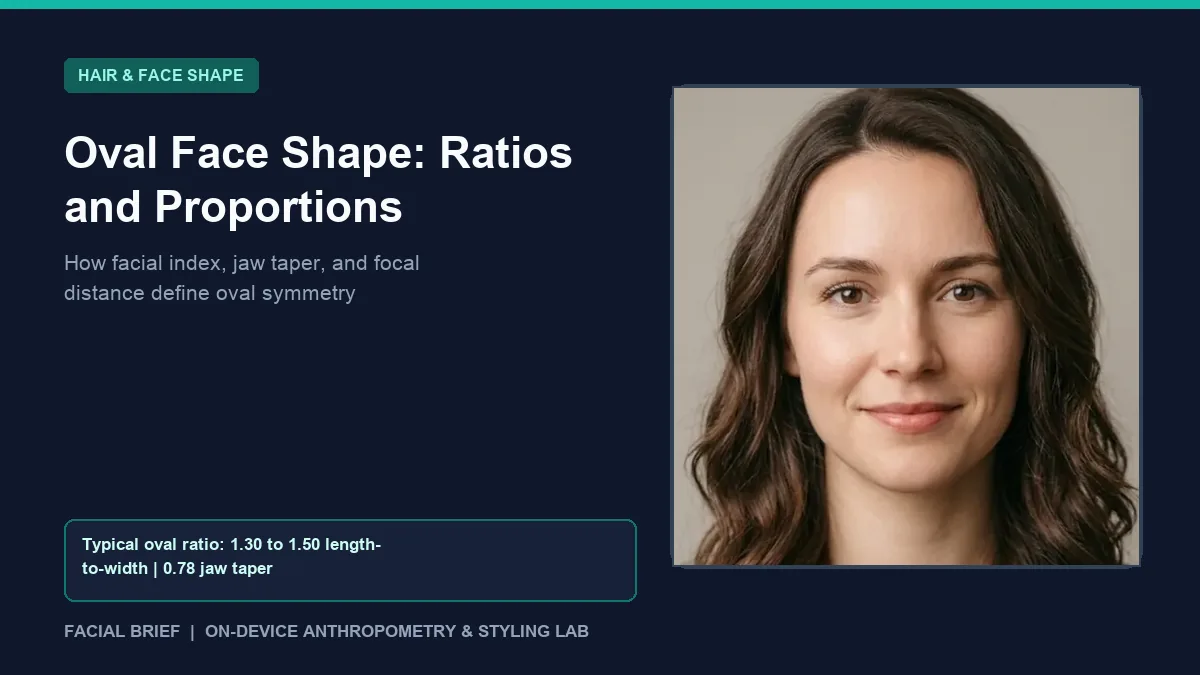
People searching for oval face measurements usually hit two conflicting claims online. Textbook salon charts describe an egg shaped face that flatters every haircut and frame, while users posting selfies on r/Makeup101 and r/QOVESStudio complain that their head looks stretched, narrow, or hard to classify. Anthropometrically, a classic oval shape face has a vertical height roughly 1.30 to 1.50 times its cheekbone width, paired with a forehead slightly broader than the jaw and a smoothly curved gonial taper around 0.78. Whether you sit inside that balanced zone or cross into oblong territory depends on landmark spacing and camera distance. Before changing your hair or glasses, use Detect Your Face Shape to run a 478-landmark measurement directly in your browser.
Key Takeaways
- An oval shaped face sits between a 1.30 and 1.50 hairline-to-chin length-to-width ratio (centering near 1.24 when measured strictly from upper brow landmarks to menton), with cheekbones acting as the widest horizontal anchor.
- Crossing above a 1.52 facial index with parallel cheek-to-jaw walls shifts an oval silhouette into an oval oblong face shape, where tall crown volume stretches the head vertically.
- Wide-angle 24mm front smartphone cameras held at 1 to 2 feet exaggerate nose projection and narrow cheek width, regularly tricking users with an oval head into misreading themselves as oblong.
- On
r/glasses, experienced frame fitters push back against rigid "wear any frame" advice, prioritizing temple-to-temple width matching bizygomatic breadth and nose bridge alignment over arbitrary square vs. round rules. - For oval face women and men, balanced thirds mean minimal heavy contour is needed; keeping cheek width visible and avoiding stacked top volume protects natural symmetry.
Anthropometric landmarks behind an oval face
Clinical craniofacial studies led by Leslie G. Farkas classify facial silhouettes through bone and soft-tissue ratios instead of mirror guesswork. Three measurements separate an oval face from round, square, heart, and oblong contours: facial height divided by bizygomatic cheekbone width, bigonial jaw width divided by cheekbone width, and vertical thirds balance.
Measuring from trichion (center hairline) to menton (bottom chin edge) yields a classic oval index between 1.30 and 1.50, with harmonious orthodontic averages clustering near 1.30 for women and 1.35 for men. Automated landmark detectors anchored tighter around the brow center the oval curve near 1.24 alongside a 0.78 jaw-to-cheekbone taper. In both models, cheekbones stay widest, the forehead narrows modestly relative to the cheeks, the jaw corners curve smoothly instead of jutting at 90 degrees, and vertical thirds stay close to 33 percent each.
That spacing explains why contributors on this r/QOVESStudio discussion on oval attractiveness call oval proportions balanced without oversized competing zones. On a companion r/QOVESStudio thread evaluating male face shapes, however, commenters note a clear gender divide: women with soft tapers often read as classic, while men lacking gonial definition sometimes look softer unless clean facial hair anchors the lower third.
The oval oblong face shape boundary
The hardest classification border on r/Vindicta and r/Makeup101 separates a classic egg shaped face from an oval oblong face shape. Both share curved contours without square corners, splitting vertically once length outpaces width.
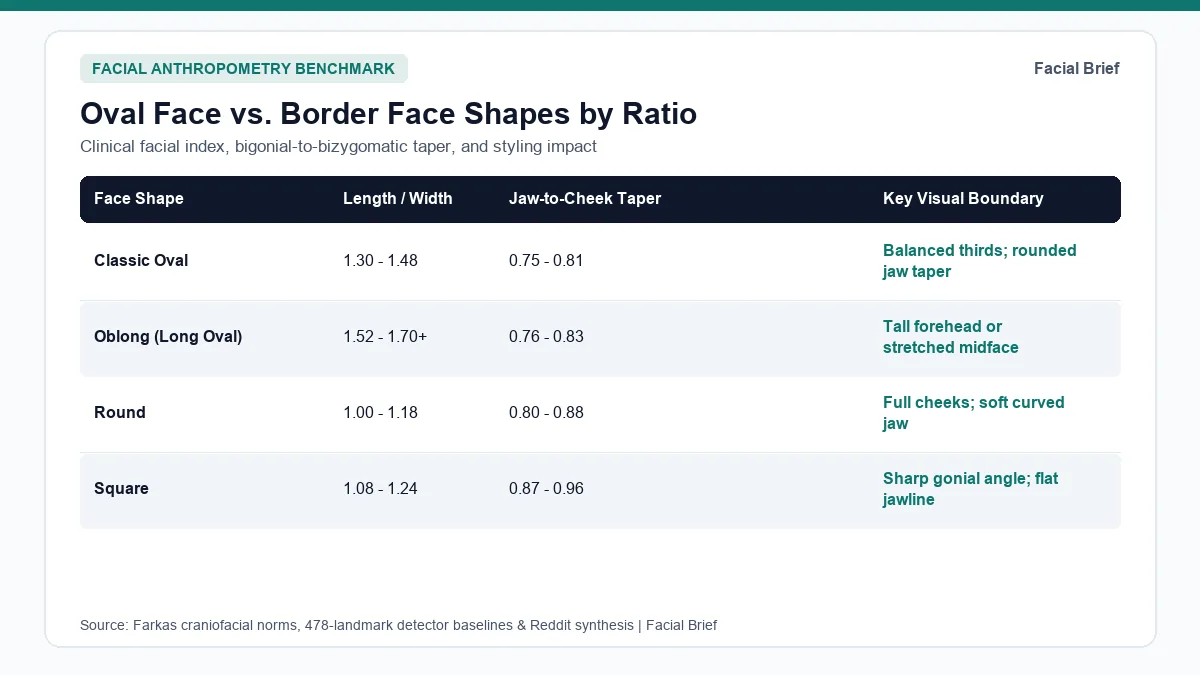
Once hairline-to-chin length reaches 1.52 to 1.70 times bizygomatic width, the middle or upper third stretches out and the cheek-to-jaw walls run parallel. On this r/VindictaRateCelebs thread on oblong proportions, users point out that tall cheekbones with a longer midface can still look poised, even when generic charts treat oblong as a flaw.
Hairline position shifts this boundary. A high forehead or temple recession pushes the upper third past 36 percent of visible face height, pulling an oval shape face toward oblong. Checking hairline stability against Norwood scale progression benchmarks separates bone height from forehead exposure, while our bangs for face shape guide explains how curtain or brow-skimming fringe restores balanced upper-third proportions.
Why selfie focal length turns an oval shape face oblong
Before accepting an oblong label, check how the photo was captured. Front phone cameras use wide-angle lenses near a 24mm equivalent. Held 12 to 24 inches away, perspective projection enlarges features closest to the lens, like the nasal bridge, while pulling outer cheekbones backward.
Photographers in this r/AskPhotography thread on front-camera distortion emphasize that camera distance drives the warp. At 18 inches, a balanced oval shaped face stretches vertically by 10 to 15 percent and shrinks jaw width. Stepping 5 to 6 feet back with a rear 2x lens compresses depth back toward normal vision, which is why commenters on this r/femalehairadvice oval-shape thread and this r/malehairadvice shape diagnosis post ask for distant rear-camera photos before suggesting cuts.
Six-shape geometry comparison
Comparing border metrics side by side keeps self-typing grounded. An oval head sits at the center of six facial categories, shifting round when height drops, square when jaw width expands, and oblong when vertical thirds stretch.
| Face Shape | Length-to-Width Ratio | Jaw-to-Cheek Taper | Widest Anchor | Common Mistake | Framing Goal |
|---|---|---|---|---|---|
| Classic Oval | 1.30 to 1.48 | 0.75 to 0.81 | Cheekbones | Mistyped oblong in 24mm selfies | Preserve balance; avoid vertical spikes |
| Oblong | 1.52 to 1.70+ | 0.76 to 0.83 | Straight cheek walls | Called oval due to rounded chin | Add side texture; keep crown flat |
| Round | 1.00 to 1.18 | 0.80 to 0.88 | Mid-cheek width | Confused with fuller oval | Add vertical lines past chin |
| Square | 1.08 to 1.24 | 0.87 to 0.96 | Jaw equals brow | Confused with sharp oval jaw | Soften corners or frame structure |
| Heart | 1.18 to 1.38 | 0.65 to 0.74 | Forehead and temples | Missed when bangs hide brow | Add mid-length chin balance |
| Diamond | 1.25 to 1.42 | 0.68 to 0.75 | High cheekbones | Called oval if brow is narrow | Frame temples; keep chin open |
Square faces diverge primarily through wider bigonial breadth (0.87 to 0.96 of cheekbone width) and sharper jaw corners near 115 degrees, covered in our square face hairstyle guide. To see how 478 landmarks score symmetry and shape confidence together, view a sample facial report.
Eyewear, grooming, and styling geometry for oval faces
Because an oval face avoids heavy jaw bulk or extreme width deficits, styling acts as fine-tuning where small proportion mistakes become obvious quickly.
Glasses frames, bridge fit, and brow-line rules
Optician charts often claim people with an oval shaped face fit every frame silhouette. Contributors in this r/glassesadvice fitting thread reject that shortcut, noting that wrong sizing breaks oval balance quickly. Aim for total frame width equal to or 2 mm wider than cheekbone breadth so temples neither pinch nor overhang. Center pupils horizontally within each lens with a snug nasal bridge, and keep top rims tracing your brow arch instead of dropping thick lower frames down onto the midface. Rectangular, D-frame, and light round metals work cleanly as long as lens depth respects midface height.
Hair proportions, bangs, and contour for oval face women and men
For oval face women, contributors on r/MakeupAddiction advise skipping heavy dark cheek hollowing meant to narrow round faces, which can make a balanced egg shaped face look gaunt. Sweeping soft blush slightly outward toward the upper ear maintains natural width. In hair geometry, collarbone lobs and cheekbone layers protect balance without dragging cheeks down, whereas thick flat one-length hair or a tall men's pompadour over bald sides stretches the ratio past 1.55. Men sharpening an oval jaw generally benefit from 3 to 5 mm boxed stubble with neat sideburns. Test bangs, lobs, and crops on your own photo using AI Hairstyle Try-On.
Frequently Asked Questions
How do I know if I have an oval face or an oblong face?
Take a straight-on photo from 5 to 6 feet away with a rear camera, hair pulled flat away from your hairline and ears. Divide hairline-to-chin distance by cheekbone width: 1.30 to 1.48 sits squarely in classic oval proportions, whereas 1.52 and above with straight cheek-to-jaw walls leans oblong. Check whether your upper or middle third accounts for the extra height before picking fringe or side volume.
Is an egg shaped face the same thing as an oval face?
Yes, cosmetology textbooks and Reddit shape guides use egg-shaped as the everyday description for a classic oval contour because the upper forehead rounds slightly wider than the softly tapered chin, with cheekbones remaining the widest horizontal anchor. Confusion happens when people with narrow, stretched facial thirds call themselves egg-shaped even though their actual ratio sits in oblong territory above 1.50.
Why does my oval face look long in selfies but balanced in the mirror?
Front smartphone cameras rely on wide-angle lenses near 24mm held close to the face, which exaggerates central depth and narrows outer facial boundaries. When you stand 5 feet back in front of a mirror, perspective distortion drops dramatically and cheek width reads accurately. Shooting with a rear camera on a timer or stepping back with a 2x zoom removes most of that artificial elongation.
Do oval face women need heavy jawline or cheekbone contouring?
Most makeup contributors on Reddit advise skipping heavy sculpting on a true oval silhouette because dark shadow bands placed directly beneath the cheekbones can hollow out the midface and make natural proportions look pinched. Light bronzer dusted subtly along the outer hairline combined with soft cheek blush swept horizontally toward the upper ear preserves natural bone balance cleanly without distorting your overall length-to-width ratio.
Referenced Community Discussions & Sources
- r/QOVESStudio: Why the oval face shape is viewed as balanced across facial aesthetics: Analyzes even vertical thirds, soft jawline taper, and why balanced cheek-to-jaw width minimizes competing focal points.
- r/QOVESStudio: Evaluating oval and diamond proportions on male faces: Discusses how gonial angle definition and lower-third structure affect how soft oval ratios read on men versus women.
- r/VindictaRateCelebs: Distinguishing oval from elongated oblong proportions: Examines real-world examples where higher length-to-width ratios sit beyond standard oval bounds yet retain facial harmony.
- r/glassesadvice: Real-world frame sizing vs. generic oval face charts: Highlights why bridge height, pupil alignment, and temple width matter more than strict rectangular or round frame rules.
- r/AskPhotography: Preventing front-camera wide-angle facial distortion: Explains how 24mm close-range selfies stretch oval faces vertically compared to 50mm-distance rear-camera portraits.
- r/femalehairadvice: Haircut proportion feedback for oval face women: Collects real reader experiences avoiding overly heavy flat lengths and excessive vertical crown height.
- Anthropometric Reference: Farkas, L. G. (1994), Anthropometry of the Head and Face (prosopic facial index, bizygomatic breadth, bigonial-to-bizygomatic taper, and vertical facial thirds norms).
Paired Facial Brief Analyzer
Measure your own proportions on-device
Run private 478-point landmark geometry in your browser with zero server photo upload on free tools.
Continue Reading