Best Sunglasses for Square Face Geometry: Fit & Frame Guide
Compare the best sunglasses for square face shapes using 110-122 deg jaw geometry, 48-55 mm frame sizing, bridge fit rules, and a style comparison table.
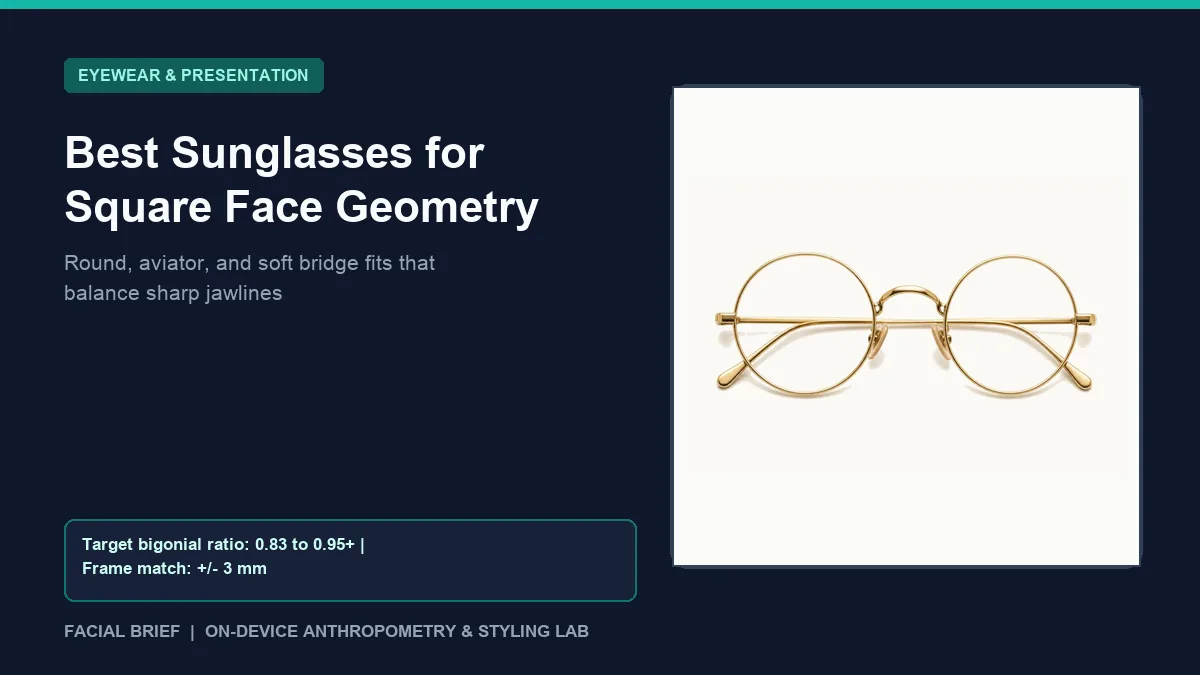
Choosing the best sunglasses for square face geometry starts with countering parallel horizontal and vertical edges without pinching your temples. A square bone structure pairs a broad forehead with wide bizygomatic cheekbones (zy-zy) and mandibular jaw corners (go-go) reaching 83% to 95% or more of cheek breadth, alongside a compact height-to-width ratio near 1.05 to 1.20 and a 110 to 122 degree lateral gonial angle.
On r/sunglasses and r/malefashionadvice, buyers with square jaws often order thick rectangular frames only to see them double jaw width and splay outward at the ears. Before picking silhouettes, Detect Your Face Shape in your browser across 478 landmarks to separate genuine jaw breadth from selfie lens distortion.
Key Takeaways
- Curved lower rims and softened corners provide clean visual contrast against
110 to 122 degreemandibular angles, putting round wire, P3 pantos, teardrop aviators, ovals, and gentle cat-eyes ahead of sharp rectangles. - Total hinge-to-hinge front width governs fit more reliably than style labels; match your cheekbone span within
3 mm, which places many adult square faces around132 to 144 mm(50 to 55 mmsingle-lens width). - Rim weight shifts upper-third balance: thin metal (
1.2 to 2.5 mm) and medium beveled acetate (2.5 to 3.8 mm) lighten strong brow ridges, while heavy5+ mmboxy slab rims echo flat jawlines. - Selecting
18 to 22 mmbridges or adjustable silicone nose pads lifts frames3 to 5 mmclear of prominent cheekbones when smiling. - Softened trapezoids such as the New Wayfarer work as sunglasses square face wearers can wear daily when corners are rounded and vertical lens height stays near
38 to 43 mm.
Why Square Face Proportions Clash With Boxy Sunglasses
Human vision groups repeating geometric borders together. When a face displays a straight hairline, level brow ridge, and crisp lower mandible, placing a rigid rectangular frame across the eyes stacks parallel horizontal lines one over the other. The eye reads the lower jaw as wider and flatter, which is why thick right-angle acetate corners often make sunglasses on square face wearers look cramped.
Separating True Jaw Width From Camera Lens Distortion
Many shoppers misclassify their bone structure after judging close-range phone photos. A standard front selfie lens behaves like a 24 mm wide-angle optic. Held 30 to 40 cm from your nose, perspective projection enlarges the nasal bridge while pulling outer mandibular corners inward, making a square perimeter resemble an oval or heart silhouette. Stepping 5 to 6 feet (1.5 to 1.8 m) away for a rear-camera 50 to 85 mm portrait, or inspecting non-reversed proportions through a DIY true mirror setup, clarifies whether your jaw aligns vertically with your temples.
Visual Weight Across the Brow Ridge
Square anatomy often includes prominent orbital rims and level eyebrows. Thick opaque black plastic sitting above the natural brow arch creates a second heavy horizontal bar across the upper third. Fitters typically align the upper frame border along or just below the eyebrow curve so hair and rim work as one line. Slim titanium wire, brushed alloy, or translucent tortoise and crystal acetates keep upper facial weight light while curved lower rims soften the jaw.
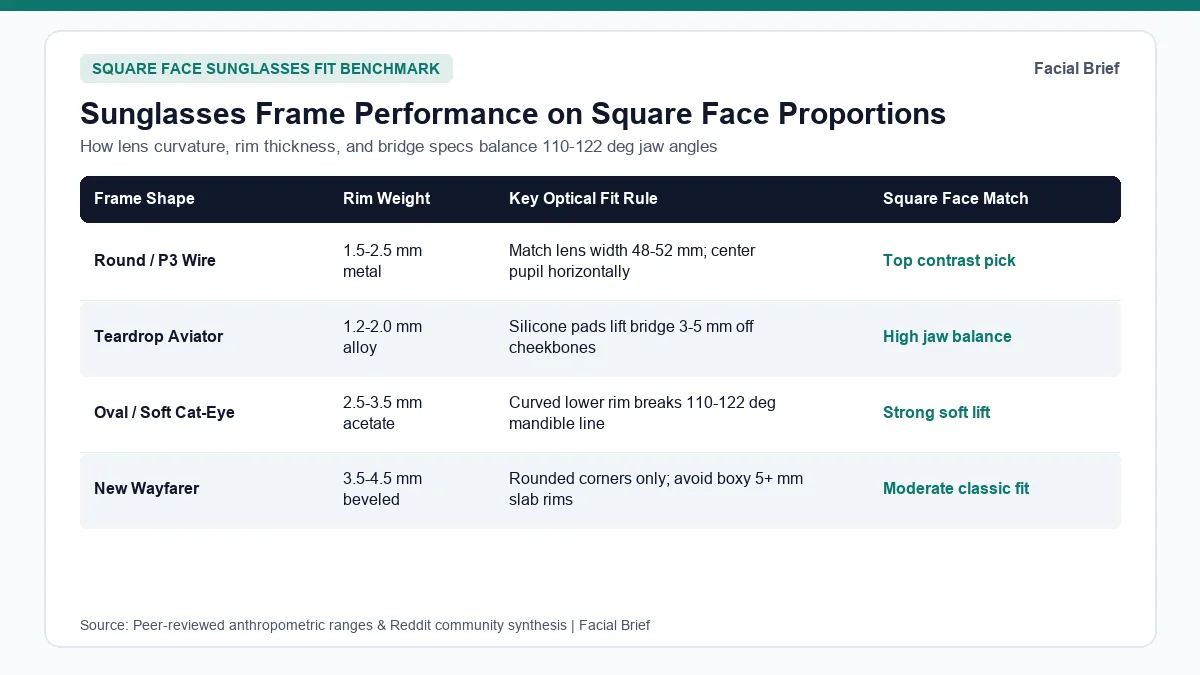
Top Sunglasses Shapes for Square Jawlines From Reddit Fit Threads
Discussions across r/sunglasses, r/malefashionadvice, and r/glassesadvice converge on adding smooth lower curves where bone structure runs straight, then scaling lens width directly to skull span.
Round and P3 Pantos Frames
Circular wire frames and softly tapered P3 pantos profiles provide the most direct contrast against angular mandibles. A P3 lens keeps a gently flattened upper line near the brow before curving into a deep rounded U-shaped base, while 1.5 to 2.5 mm rims keep temple bulk minimal.
Buyers in this r/malefashionadvice visual sunglasses guide add one sizing caveat: tiny 42 to 44 mm micro-rounds sit awkwardly inside wide cheekbones, emphasizing jaw width instead of balancing it. Medium-to-large rounds in the 48 to 52 mm lens bracket keep pupils centered horizontally without losing curved relief.
Teardrop Aviators vs. Square Navigators
Classic teardrop aviators flatter angular faces because the sloping outer-lower curve angles inward toward the nose rather than running parallel to the jaw corner. Adjustable silicone pads lift weight off high cheekbones, and the 1.2 to 2.0 mm brow bar keeps upper weight light. If vintage 58 mm lenses sit too low over smile creases, dropping to a 52 to 55 mm teardrop preserves clearance.
Squared pilot navigators trigger more debate. In this r/sunglasses aviator vs. square comparison, owners note that flat-top navigators work on square jaws mainly when outer corners are gently chamfered and worn for a crisp utilitarian aesthetic. When bigonial jaw width exceeds 90% of cheek breadth, rounded teardrops generally soften proportions faster than strict rectangular pilots.
Softened Wayfarers, Ovals, and Cat-Eyes
Original Wayfarers combine 4.5 to 5.5 mm brow thickness, blocky corner lugs, and steep 10 to 15 degree forward tilt that exaggerate wide jaws. By contrast, rounded New Wayfarer styles trim vertical lens height (38 to 41 mm), curve all four corners, and slim rim mass. Soft keyhole acetates offer similar versatility, a point stressed across r/malefashionadvice face-shape matching threads.
Oval silhouettes and soft cat-eyes deliver comparable balance without circular retro vibes. Oval rims shorten apparent straight vertical lines along the sides, while gently upswept cat-eyes pull attention diagonally toward the temples. Test how rounded frames pair with hair density and facial hair inside Facial Brief's Custom Style Studio, or pair eyewear contrast with our square face haircuts guide.
Sizing Specs That Prevent Temple Pinch and Cheek Contact
Even flattering curvature feels unwearable when bridge width or hinge span clashes with skull dimensions. As retail opticians detail in this r/sunglasses fitter guide, shoppers who ignore stamped millimeter hardware end up returning frames that squeeze behind the ears or slide down their nose.
Decoding the Three-Number Temple Stamp
Check the inner left temple arm on any comfortable pair for three specs formatted like 52-18-145. The first (48 to 58 mm) gives single-lens width; the second (16 to 24 mm) measures nasal bridge distance between inner lens edges; the third (135 to 150 mm) states temple arm length from hinge screw to ear tip.
Two frames both marked 52 mm can differ by 8 to 10 mm overall once thick acetate end pieces are added. Measure horizontally across your outer cheekbones under the eyes with a millimeter ruler held level in a mirror, then match total hinge-to-hinge width within +/- 3 mm:
- Narrow builds need roughly
120 to 128 mmhinge to hinge (46 to 49 mmlenses). - Medium builds fit
129 to 133 mm(50 to 52 mmlenses). - Wide square skulls generally require
134 to 144 mm(53 to 56 mmlenses).
Frames narrower than your cheekbones pull arms outward under tension, causing mastoid soreness behind the ears within an hour. Frames jutting well past your temples admit side glare and shrink eye presence.
Bridge Clearance, Temple Tension, and UV400 Optics
Fixed molded acetate bridges sit lower on flat or narrow nasal bridges, causing rims to touch prominent cheeks when smiling. Metal or mixed-material frames fitted with adjustable silicone nose pads lift lenses 3 to 5 mm clear of skin, while Low Bridge Fit acetates reduce downward lens tilt. Choose spring hinges or adjustable 140 to 145 mm wire arms to prevent temple pinching.
Confirm genuine UV400 certification (99% to 100% blockage to 400 nm) on every pair regardless of price, since dark unrated tint dilates pupils and lets extra ultraviolet radiation reach the retina. Neutral gray and G-15 green-gray tints maintain accurate outdoor color, while polarized amber filters sharpen wet-road contrast (though polarization can dim certain polarized car dashboards). Compare cross-shape sizing in our complete face-shape sunglasses guide and heart-face eyeglasses guide.
Sunglasses on Square Face Comparison Table
Matching frame curves directly to millimeter hardware prevents expensive online sizing mistakes.
| Frame Style | Best Millimeter Range | Bridge & Rim Build | Jawline Contrast Effect | Watch-Out |
|---|---|---|---|---|
| Round / P3 Metal | 48-52 lens, 19-21 bridge | 1.5-2.5 mm wire; silicone pads | Strongest relief on 110-122 deg jaws | Micro-rounds < 45 mm look too narrow |
| Teardrop Aviator | 52-55 lens, 14-16 bridge | 1.2-2.0 mm double bar; pads | Curved lower edge softens jaw width | 58+ mm drops onto high cheeks |
| Oval Acetate | 50-53 lens, 18-21 bridge | 2.5-3.5 mm light or tortoise rim | Breaks flat brow-to-jaw lines gently | Thick dark tops swallow low brows |
| Soft Cat-Eye | 49-53 lens, 17-20 bridge | Slender outer lift; light acetate | Guides focus toward upper cheekbones | Sharp wing points feel overly severe |
| Rounded New Wayfarer | 52-55 lens, 18 bridge | 3.5-4.0 mm curved trapezoid | Everyday structure without boxy edges | Skip 5+ mm hard Original slab fronts |
| Chamfered Navigator | 52-56 lens, 16-18 bridge | Titanium wire; silicone nose pads | Clean balance with softened corners | Strict 90-deg rectangles double boxiness |
Compare your jaw-to-cheek ratios and interpupillary alignment inside a full sample biometric report, or measure horizontal eye spacing accurately using our Pupillary Distance Tool.
Frequently Asked Questions
Can you wear square sunglasses on a square face?
Yes, if outer corners are noticeably rounded and rim thickness stays moderate. Crisp 90-degree blocky frames echo strong jawlines directly, whereas softened trapezoids like the New Wayfarer or lightly chamfered wire navigators preserve a structured profile without feeling boxy. Match hinge-to-hinge front width closely to your outer cheekbone span so temple arms remain parallel rather than bowing outward under pressure or admitting side glare.
Are aviators or round frames better sunglasses for a square face?
Both serve as reliable sunglasses square face buyers wear comfortably, depending on styling goals and bridge shape. Round and P3 metal silhouettes deliver the strongest geometric contrast against flat brow ridges and wide mandibular corners. Teardrop aviators provide wider lateral glare coverage and feature adjustable silicone nose pads, making them easier to lift clear of prominent cheekbones during bright outdoor driving.
What lens width fits a wide square face without pinching temples?
Check total hinge-to-hinge front width first (134 to 144 mm for wider square skulls), which typically corresponds to 53 to 56 mm lens widths depending on rim thickness. Medium faces usually settle comfortably around 50 to 52 mm lenses (129 to 133 mm total width). Look for 145 mm temple arms and flexible spring hinges to eliminate pressure behind the ears.
How do I stop sunglasses from resting on my cheeks when I smile?
Cheek contact occurs when vertical lens height (46+ mm) extends past the malar crest or when a wide fixed acetate bridge slips downward on a lower nose. Choose wire frames with adjustable silicone nose pads to raise the frame 3 to 5 mm, pick Low Bridge Fit molded bridges with gentler vertical tilt, and keep lens height near 38 to 43 mm.
Referenced Community Discussions & Sources
- Sunglass Hut Retail Fitter Sizing & Frame Tips (r/sunglasses): Optical staff breakdown explaining why total hinge-to-hinge width, bridge contact, and arm tension beat generic shape charts.
- Visual Guide to Choosing the Right Sunglasses Frames (r/malefashionadvice): Community reference covering curved contrast rules for square jawlines and why oversized or micro-round frames fail differently.
- Aviators vs. Square Sunglasses Fit Debate (r/sunglasses): User comparisons weighing curved teardrop aviators against squared navigators across structured jaw anatomy.
- Matching Sunglass Frames to Face Shape Discussion (r/malefashionadvice): Buyer advice contrasting New Wayfarer corner softening against heavier blocky classic acetate styles.
- Anthropometric & Optical Standards: Leslie G. Farkas craniofacial soft-tissue landmark norms (
zy-zybizygomatic breadth,go-gobigonial breadth, andtr-gnfacial height); ANSI Z80.3 / ISO 12312-1 UV400 eyewear filtration standards.
Paired Facial Brief Analyzer
Measure your own proportions on-device
Run private 478-point landmark geometry in your browser with zero server photo upload on free tools.
Continue Reading