What Kind of Nose Do I Have? Nose Shape Chart & Angles
Answer what kind of nose do I have with Farkas nasal index ranges, nasolabial angles, nostril types, camera lens checks, and a 6-shape comparison chart.
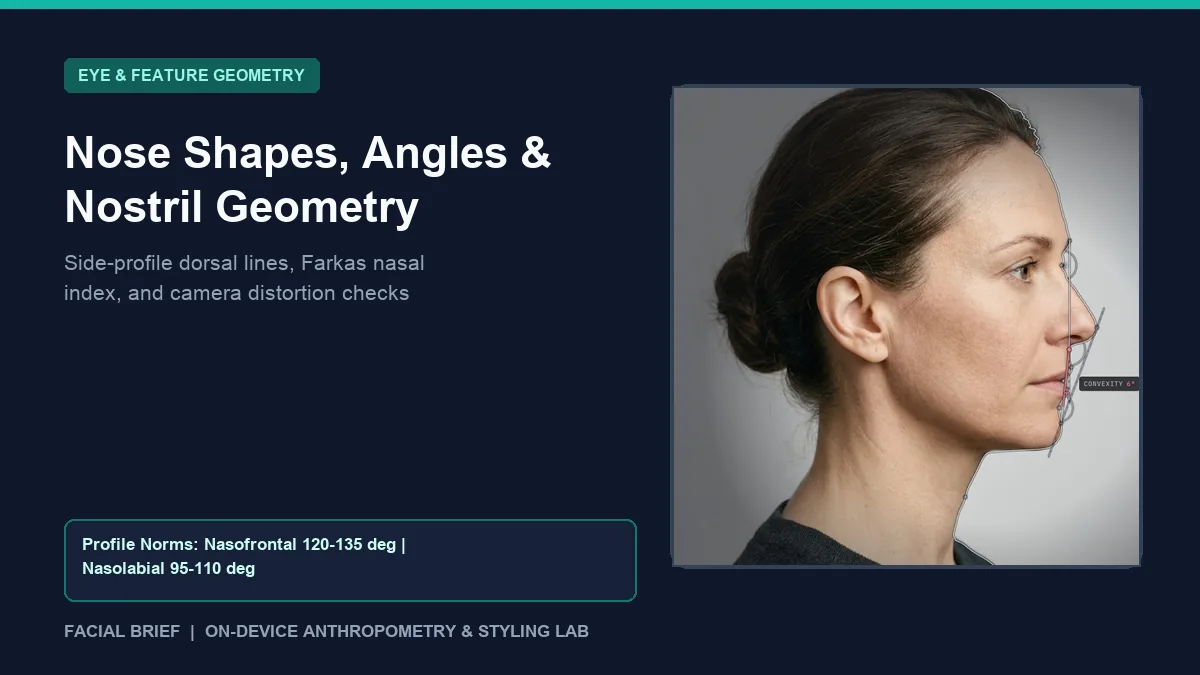
People searching what kind of nose do I have usually run into conflicting folk labels like Roman, Greek, button, Nubian, or hawk, without any rule for where one category ends and another begins. Popular #noseshape charts frequently mix side-profile bridge curves with front-view nostril width, leaving someone with a straight bridge and rounded tip unsure which label fits. In craniofacial anthropometry, researchers separate nasal shape into measurable traits: the bridge curve from a 90-degree side profile, tip rotation in degrees, skin thickness over lower cartilage, and base width relative to eye spacing. Before matching your profile to rough diagrams or judging size from one close selfie, trace your nasofrontal angle, nasolabial rotation, and bridge silhouette on a true side photo when you Analyze Side Profile in your browser.
Key Takeaways
- Standard shapes of noses combine two independent axes: side-profile bridge contour (straight, convex, or concave) and front-view base width (classified clinically by Farkas' nasal index).
- Reference nasofrontal angles sit around
120° to 135°, while balanced nasolabial angles fall near90° to 95°in men and95° to 110°in women; under90°signals a downward tip and above110°signals an upturned tip. - A hawk nose type shares a convex dorsal curve with Roman and aquiline profiles, separated mainly by a narrower bridge and sharper downward tip rotation (
85° to 92°). - Nostril shape and alar flare vary independently from dorsal humps, spanning narrow teardrop, oval, and broader rounded bases set by lower cartilage and skin thickness.
- Close-range front phone cameras (
30 cmaway on24 mmequivalent wide optics) enlarge the nose toward the center of the lens, making a6-footrear-camera shot essential before evaluating size.
Anthropometric Measurements Behind Any Nose Type Chart
Folk terms help people describe profiles quickly, yet clinical anthropometry relies on repeatable landmarks defined by Leslie G. Farkas. When someone asks what type of nose does he have or posts side and front photos on r/Noses, four measurements explain almost every category on a nose type chart.
Farkas Nasal Index and Front Proportions
On a straight-on photo, anthropologists calculate the nasal index by dividing width across the nostrils (alar base) by vertical nasal height from the nasion (the bridge dip between the brows) to the subnasale (where the base meets the upper lip), then multiplying by 100:
- Leptorrhine (
< 70.0): Long, narrow nasal structures with slim bridges and tall apertures, usually sitting inside the inner corners of the eyes. - Mesorrhine (
70.0 to 84.9): Intermediate height-to-width proportions common across mixed, East Asian, and Mediterranean populations. - Platyrrhine (
>= 85.0): Shorter, broader nasal shapes with wider alar bases and fuller nostril flares adapted to warm, humid ancestral climates.
Facial Brief also compares front nasal width against mouth width (noseVsMouthWidth, centered near 0.76) and facial fifths, where intercanthal distance between the inner eye corners approximates outer nostril width. Checking intercanthal width in our pupillary distance guide clarifies whether a nose sits wide on its own or merely reads wider beside closely set eyes.
Side-Profile Angles: Nasofrontal, Nasolabial, and E-Line
Three profile angles map dorsal contour and tip projection:
- Nasofrontal angle (
120° to 135°reference;115° to 130°clinical norm): Measures the transition between forehead (glabella), bridge root (nasion), and nasal tip (pronasale). A deep break under118°accentuates dorsal projection, while a shallow angle above138°creates a smooth Greek glide from brow to tip. - Nasolabial angle (
95° to 110°reference;90° to 95°male norm,95° to 110°female norm): Formed between the underside of the nose (columella) and the upper lip. Readings below90°tilt the tip downward like an aquiline or hawk profile, while angles above110°rotate the tip upward as seen in button and snub noses. - Rickett's E-Line (
-4 to -1 mmupper lip,-2 to +1 mmlower lip): Connects nasal tip (pronasale) to chin (pogonion), indicating how tip projection balances chin strength.
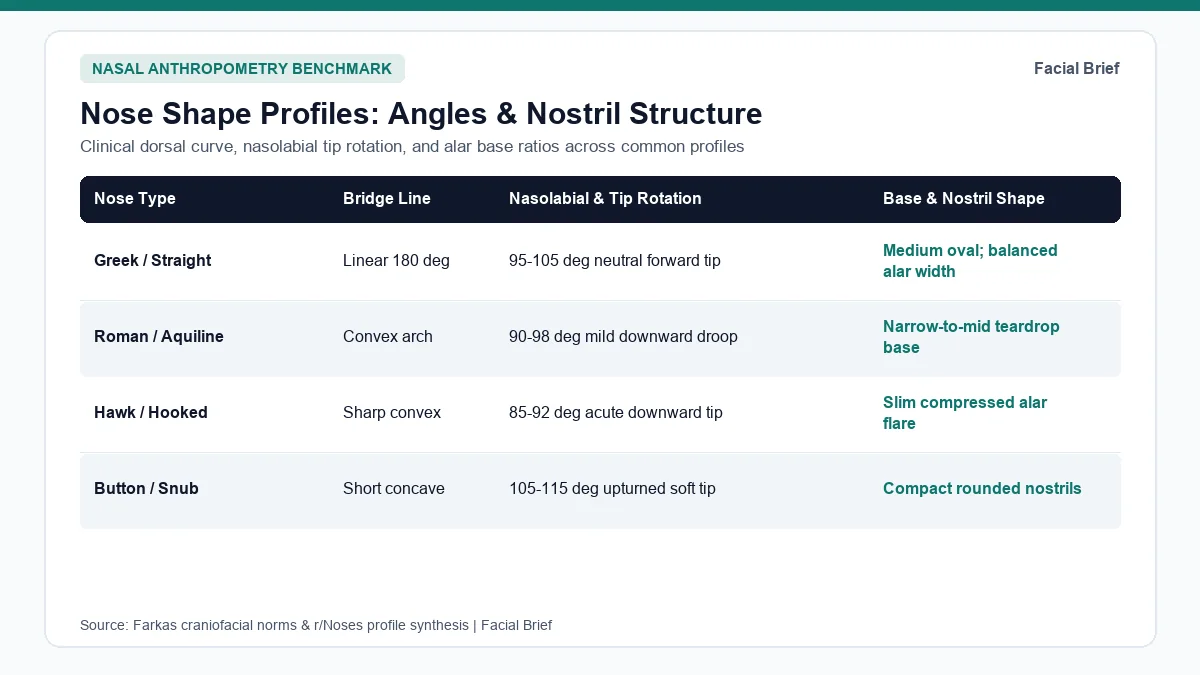
Nose Type Chart: 6 Common Shapes Compared
The table below organizes the main visual chart labels alongside their clinical profile angles, base traits, and framing notes.
| Nose Type | Bridge Curve & Nasofrontal Feel | Nasolabial Tip Angle | Front Width & Nostril Shape | Visual Harmony & Framing Notes |
|---|---|---|---|---|
| Greek / Straight | Linear dorsum; shallow 130°+ brow transition | Balanced 95° to 105° forward tip | Narrow-to-medium; clean oval nostrils | Reads calm and symmetrical; pairs with balanced brow arches |
| Roman / Aquiline | Outward convex arch or gentle dorsal hump | Slightly downward 90° to 98° rotation | Narrow-to-mid bridge; teardrop base | Adds structural authority to defined cheekbones and jaws |
| Hawk / Hooked | Pronounced narrow convex curve; sharp beak contour | Acute downward 85° to 92° tip tilt | Slim compressed alar flare; narrow nostrils | Strong silhouette; can shorten upper lip visually when smiling |
| Button / Celestial | Short, smooth concave slope dipping inward | Upturned 105° to 115° soft tip | Compact rounded base; visible front nostrils | Softens angular jawlines; common in compact facial thirds |
| Snub / Fleshy | Shorter bridge with minimal dorsal height | Neutral-to-upturned 100° to 112° rounded tip | Thicker nasal skin; soft bulbous tip pad | Hides crisp cartilage edges under fuller soft tissue |
| Broad / Nubian | Lower dorsal height with wide nasal bones | Neutral 92° to 104° forward-down tip | Platyrrhine (>= 85); wider horizontal flare | Anchors prominent cheekbones and fuller lips cleanly |
Distinguishing Roman, Aquiline, and Hawk Nose Types
One common mix-up in r/Noses identification threads and aquiline profile discussions sits between Roman, aquiline, and hawk shapes. All three carry a convex bridge, separated by front width and tip tilt. A Roman nose shows a smooth outward arc with a balanced tip (90° to 98°), whereas an aquiline profile curves steadily from mid-bridge downward. A hawk nose type is a narrower, sharper variant with thin nasal bones and a hooked tip (85° to 92°). Community threads like r/coolguides' nose taxonomy guide reject narrow button-nose standards, noting how strong bridges anchor eye framing discussed in our hunter eyes guide and eye shape chart.
Nostril Shape, Alar Flare, and Bulbous Tips
Side-profile charts miss base traits because nostril shape and tip fullness live underneath. Two traits control the lower third: alar flare (nostrils extending past the inner eye corners look wider and rounder) and tip cartilage versus skin thickness. As shown in r/PlasticSurgery bulbous tip comparisons, bulbous tips come from wide rounded lower cartilages or thick skin draping smoothly over the tip, while boxy tips show squared corners.
Why Selfies Distort Your Nose Shape
Before classifying your nose from phone photos, fix camera distance. Across r/photography explanations of selfie distortion and r/Vindicta front-camera warnings, photographers note that subject-to-camera distance warps proportions far more than lens branding. Holding a phone at arm's length (30 to 40 cm) puts a 24 mm wide-angle lens right beside your face, inflating the projecting nasal tip while pulling ears back out of frame. Stepping back 6 to 8 feet with the rear 2x (50 mm) lens or shooting a mirror reflection restores real ratios. Test a rear 2x profile inside Procedure Preview or compare brow framing in our eyebrow shape for round faces guide and sample facial report.
Evidence Limits, Non-Surgical Framing, and Clinical Reality
Why Nose Clips, Exercises, and Mewing Cannot Shrink Cartilage
Social clips market pinching clips, tapping drills, or tongue posture routines to slim nostrils or flatten humps. Adult nasal structure sits on calcified bone above and hyaline cartilage below, neither of which shrinks under external pressure. Day-to-day size swings stem from morning fluid retention, salty meals, or sinus inflammation.
Makeup Contouring and Eyewear Balance
Users in r/MakeupAddiction bulbous nose threads note that harsh parallel contour stripes emphasize round tips. Diffused cool-taupe shading kept softly along outer bridge walls with a pin-point matte highlight slightly higher on the tip softens width visually. Eyewear helps too: heavy dark bridges mid-nose shorten long straight noses, while adjustable nose-pad ("low-bridge") frames keep glasses from sliding down flatter roots.
Non-Surgical Filler vs. Surgical Rhinoplasty Boundaries
Temporary hyaluronic acid filler ("liquid rhinoplasty") can smooth a small dip above a dorsal hump, yet adding gel cannot shrink a large nose and carries rare vascular occlusion risks. Lowering humps, narrowing nostrils (alar base reduction), or refining thick-skinned tips requires surgical rhinoplasty ($6,000 to $14,000+ typical US range), with 1 to 2 weeks of splint downtime and 12+ months for tip swelling to settle. Preview conservative shifts via Procedure Preview or check 42 ratios in our 42-Metric Full Report before consulting a board-certified surgeon.
Frequently Asked Questions
How can I accurately tell what kind of nose I have at home?
Capture two daylight photos using your phone's rear camera from 6 feet away on 2x zoom: one straight-on at eye level and one true 90-degree side profile. Check whether the side bridge line runs straight, curves outward (convex), or scoops inward (concave), observe whether the tip tilts upward or downward above the upper lip, and compare outer nostril width against your inner eye corners.
What is the difference between a Roman nose and a hawk nose?
Both share an outward-curving convex bridge in side profile, yet a Roman nose typically keeps fuller bridge width and a milder tip rotation near 90° to 98°. A hawk nose type is usually narrower across the nasal bones from the front and tapers into a sharper downward-hooked tip around 85° to 92°, producing a steeper beak-like silhouette above the upper lip.
Why does my nose look huge in selfies compared to the mirror?
Front-facing phone cameras held at arm's length (30 to 40 cm) use wide-angle lenses near 24 mm equivalent, creating perspective distortion that magnifies whichever feature sits closest to the glass. Because your nose projects ahead of your eyes and cheeks, it expands sharply on screen. Backing up 6+ feet with a rear 2x lens or photographing a mirror restores natural facial proportions.
Can nose exercises, clips, or contouring permanently shrink a wide or bulbous tip?
No physical clip, tapping drill, massage, or facial exercise permanently narrows adult nasal bone or lower lateral cartilage; day-to-day size swings only reflect temporary morning fluid retention or sinus inflammation. Diffused cool-taupe makeup shading, soft frontal lighting, and well-spaced eyebrows reduce visual tip prominence immediately, while lasting structural reduction belongs strictly to surgical evaluation with a board-certified facial plastic surgeon.
Referenced Community Discussions & Sources
- r/Noses: Community nose shape identification and side-versus-front differences: Illustrates why front tip thickness and side bridge curves frequently fall into separate descriptive categories.
- r/Noses: Distinguishing Roman, aquiline, and hooked dorsal profiles: Clarifies terminology differences between curved aquiline profiles, gentle Roman arches, and sharper downward tips.
- r/coolguides: Visual nose shape taxonomy and profile appreciation: Surveys common nose chart types while challenging narrow single-shape beauty norms.
- r/PlasticSurgery: Anatomical drivers behind bulbous and boxy nasal tips: Details lower lateral cartilage width, thick nasal skin limits, and realistic tip-refinement trade-offs.
- r/MakeupAddiction: Contouring strategies tailored for bulbous and wide nose tips: Explains why harsh parallel contour stripes emphasize roundness compared to soft diffused shading.
- r/photography: Why close-range smartphone selfies distort nasal size: Demonstrates how subject-to-camera distance under 1 meter drives perspective distortion rather than lens labeling alone.
- r/Vindicta: Front-camera wide-angle distortion vs. mirror proportions: Confirms practical
6-footrear-camera and mirror-reflection framing checks for honest nasal evaluation. - Leslie G. Farkas, Anthropometry of the Head and Face (2nd ed., Raven Press): Foundational clinical norms for nasal index classifications, nasofrontal angles, and nasolabial tip rotation.
Paired Facial Brief Analyzer
Measure your own proportions on-device
Run private 478-point landmark geometry in your browser with zero server photo upload on free tools.
Continue Reading